Universe Today
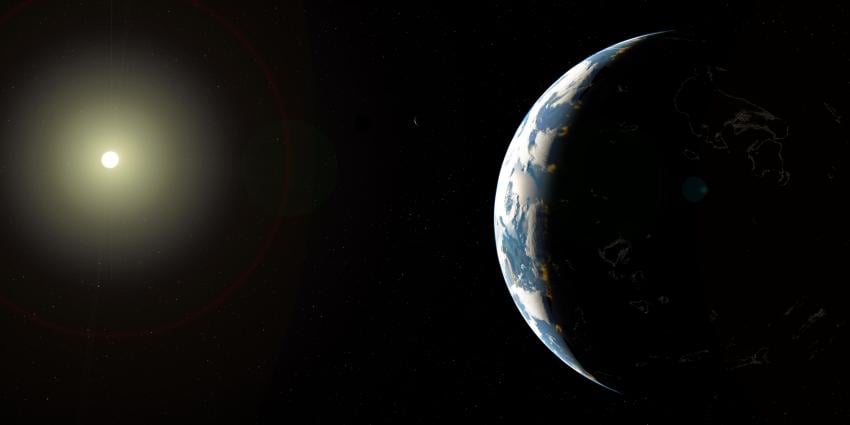
A new study compiles a short list of known terrestrial worlds.
Warning: mild spoilers ahead.
It’s out. The top sci-fi draw of the year Project Hail Mary is now showing in a theater near you. The movie tells the tale of middle school teacher Ryland Grace, who is sent on a one way, last ditch mission to save humanity. Based on the book by Andy Weir, the story is The Martian in reverse, with the character using science to save humanity, rather than humans coming together to get one stranded astronaut home. The movie doesn’t skim on the science, though I’d say this is a rare one that’s worth a read, even if you’ve already seen the film.
Project Hail Mary also visits real nearby star systems and hypothetical worlds, including 40 Eridani and Tau Ceti. I liked how variable star observing tied in to the plot line, as astronomers note that exotic astrophage is dimming every star (including our Sun) in the local neighborhood, with the exception of Tau Ceti.
 Ryan Gosling as Ryland Grace in Project Hail Mary. Credit: Amazon/MGM Studios.
The story is a refreshing take on first contact and just how different life out there could be… but are there real ‘Adrians’ or ‘Erids’ out there? A new paper published in the Monthly Notices of the Royal Astronomical Society identifies 45 rocky worlds with the potential for life, out of the currently 6,281 exoplanets known.
"This target list allows observers all over the world to focus in on these planets and search for them for signs of an atmosphere and life," Lisa Kaltenegger, director of the Carl Sagan Institute at Cornell University told Universe Today. "We have already started to do that for the Trappist-1 system in the list, where we look with JWST (the James Webb Space Telescope) for signs of an atmosphere and then signs of life. But this is really hard to do because planets are so small compared to their hot and huge stars, thus, it takes time, but we are working on it. We are modeling what these planets signal would look like if they had life and then how long we need to observe with different telescopes to find out."
"Signs of life are written in a planet’s light—if you know how to read it."
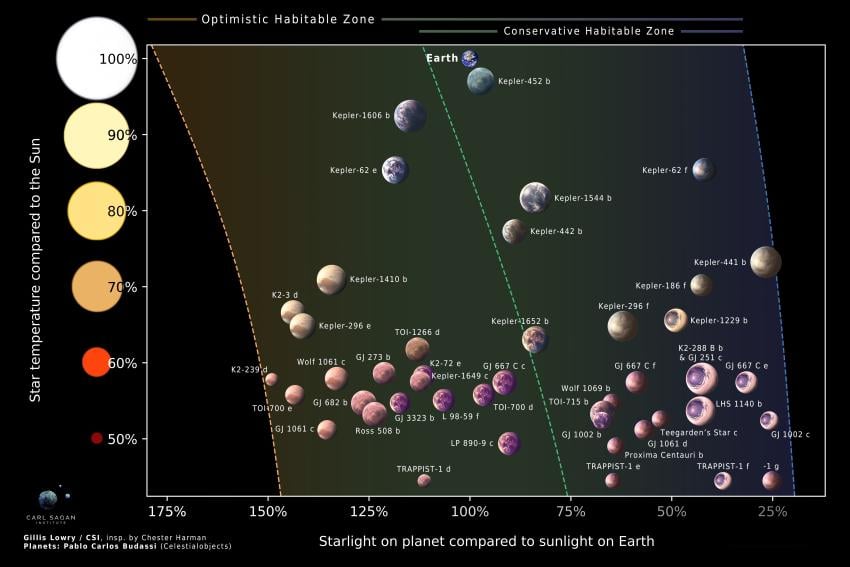 A diagram mapping known terrestrial exoplanets by insolation vs primary star temperature vs our Sun. Credit RAS/Gillis Lowry/Pablo Carlos Budassi/CC by 4.0 license.
The study, titled Probing the Limits of Habitability: A Catalogue of Rocky Exoplanets in the Habitable Zone looks mainly at transiting worlds found by ESA’s Gaia mission, Kepler and the exoplanet catalog in general. Keep in mind, the transit method looks for exoplanets that pass in front of their respective host star as seen from the Earth. Most orbits are likely tipped out of our line of sight, meaning that we’re still missing a majority of the worlds out there.
**Into the Habitable Zone **
Specifically, the study looks at terrestrial (rocky) worlds in the habitable zone, a distance were the planets’ receive a similar ratio of sunlight as the Earth, and water can exist in liquid form on the surface of the planet. The study also notes that a narrower 3D habitable zone narrows the count down to about two dozen worlds, and highly elliptical orbits might even dwindle this count down even further.
I always like to point out that from a distance, a world like Venus on the inner fringe of our solar system’s habitable zone might appear to be habitable, but I wouldn’t bet my precious astrophage fuel on it. (Venus plays into the plot of Project Hail Mary as well).
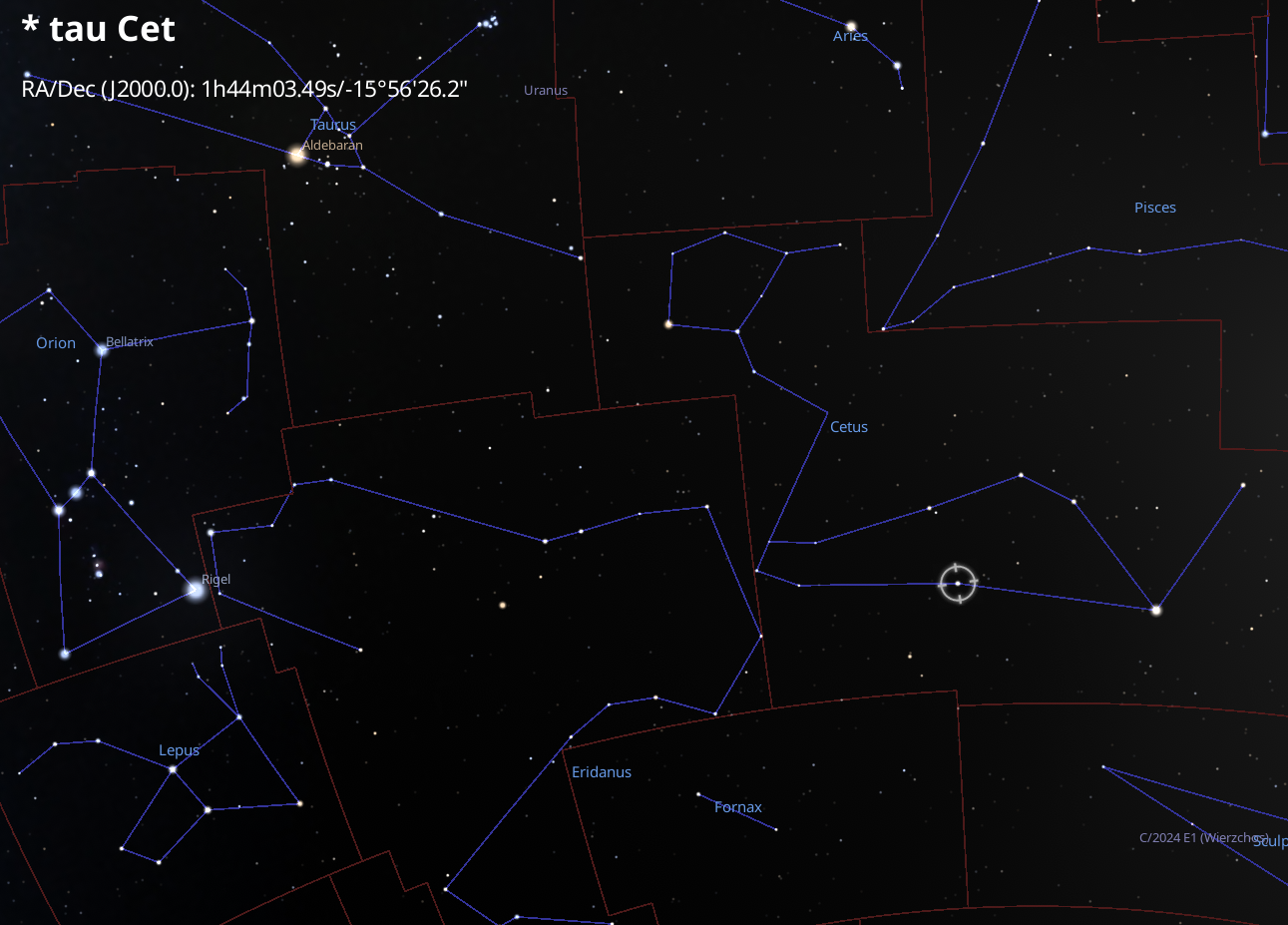 The location of Tau Ceti in the sky. Credit: Stellarium.
‘The 45’ exoplanets featured in the study include some well-known favorites including Kepler-186f, nearby Proxima Centauri b, and sci-fi faves Kepler-186f and Kepler-452b. Spoiler alert: Tau Ceti and 40 Eridani featured in the film aren’t among them, though both were the scene of spurious exoplanet claims that aren’t inside their respective habitable zones.
"Does Tau Ceti have planets? In ‘Project Hail Mary,’ Ryan Gosling’s character heads there, 12 light years away, to save Earth," says Kaltenegger. "But so far there is no unambiguous evidence of any planets in this star system, though we astronomers are still looking. This might, of course, be good news for humankind, because then the fictional Astrophage that threatens humanity in the story won’t have evolved."
"In the movie, another ship arrives in the system from 40 Eridani A, an orange star in a triple-star system about 16 light-years away from us. So far, no unambiguous sign of planets there either, but the search continues."
I've always been a fan of 40 (Omicron^2) Eridani, as it's a triple star system, and also features a fine example of a white and red dwarf pair in easy range of a backyard telescope.
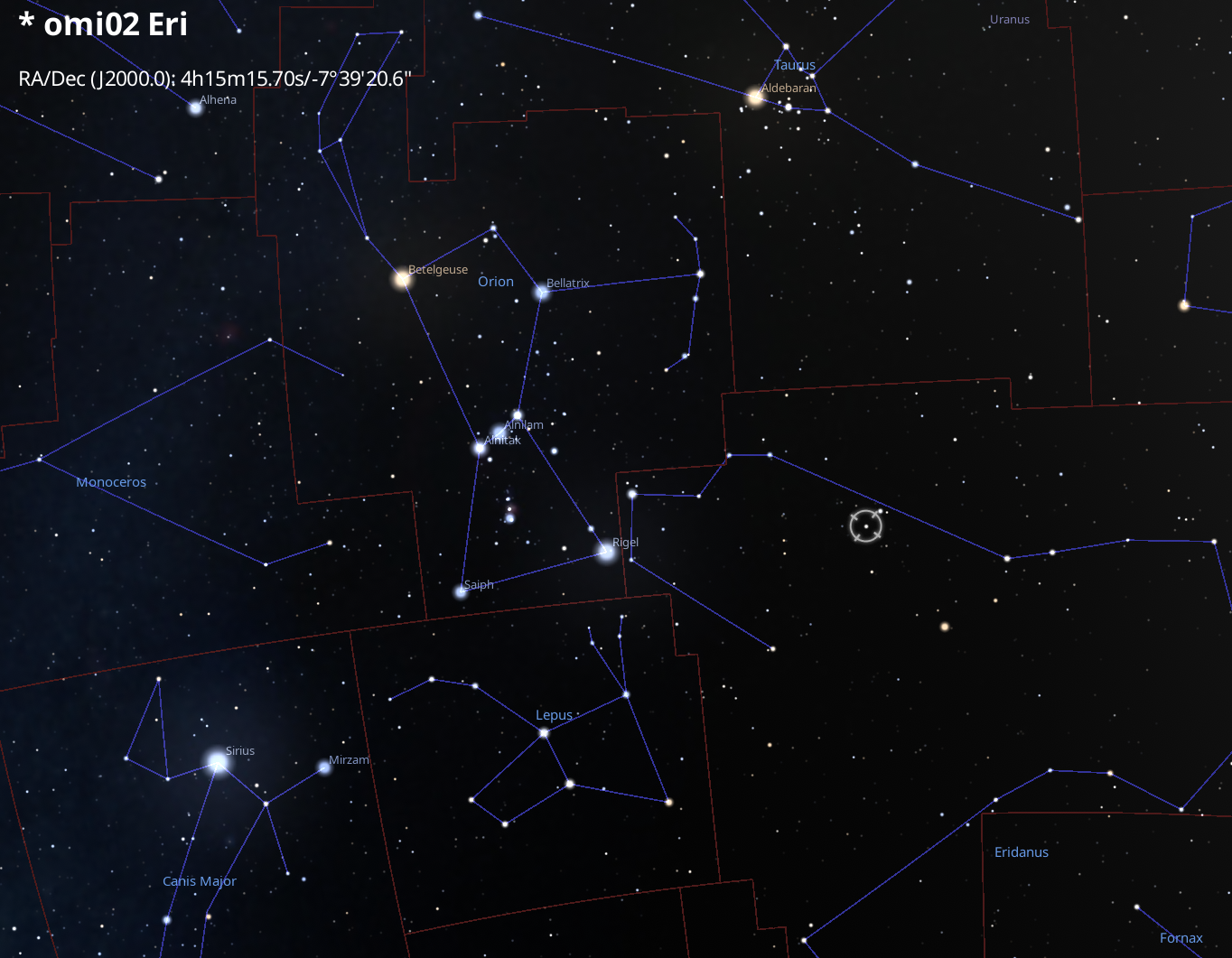 The location of 40 Eridani in the sky. Credit: Stellarium.
Best bets mentioned in the study are the TRAPPIST-1 system with four planets potentially in the red dwarf primary’s habitable zone 40 light-years distant, and LHS-1140 b, located 48 light-years away.
Fun fact: Earth actually transits from the point of view of any star located along the ecliptic plane. Currently, one of the best known exoplanet candidates in this ETZ (Earth Transit Zone) region is Ross 128 in the constellation Virgo, 11 light-years distant. If there’s anyone there using the transit technique to find exoplanets, they could well know that we’re here.
Worlds identified in this study will help inform and provide targets for the Nancy Grace Grace Roman space telescope, the proposed Habitable Worlds Observatory, and the ExoLife Finder telescope. Nancy Grace Roman may launch as early as later this year. The proposed ExoLife Finder array is particularly exciting, as it would use an innovative stellar noise canceling technique to blot out the host star and provide direct, continent-scale resolution of terrestrial exoplanets.
 An artist's conception, of the proposed ExoLife Finder telescope. Credit: Instituto de Astrofísica de Canarias.
It’s amazing to think: as a child of the 70s and 80s, I remember hearing the best astronomical minds of the time stating that we may never find planets beyond our solar system, as they’re simply to faint and distant. Fast forward to 2026, and we now can point to naked-eye stars in the sky and say with certainty that rocky worlds beyond our own solar system exist.
Be sure to check out Project Hail Mary, and ponder the potential for exotic life on worlds beyond our own.