 Universe Today
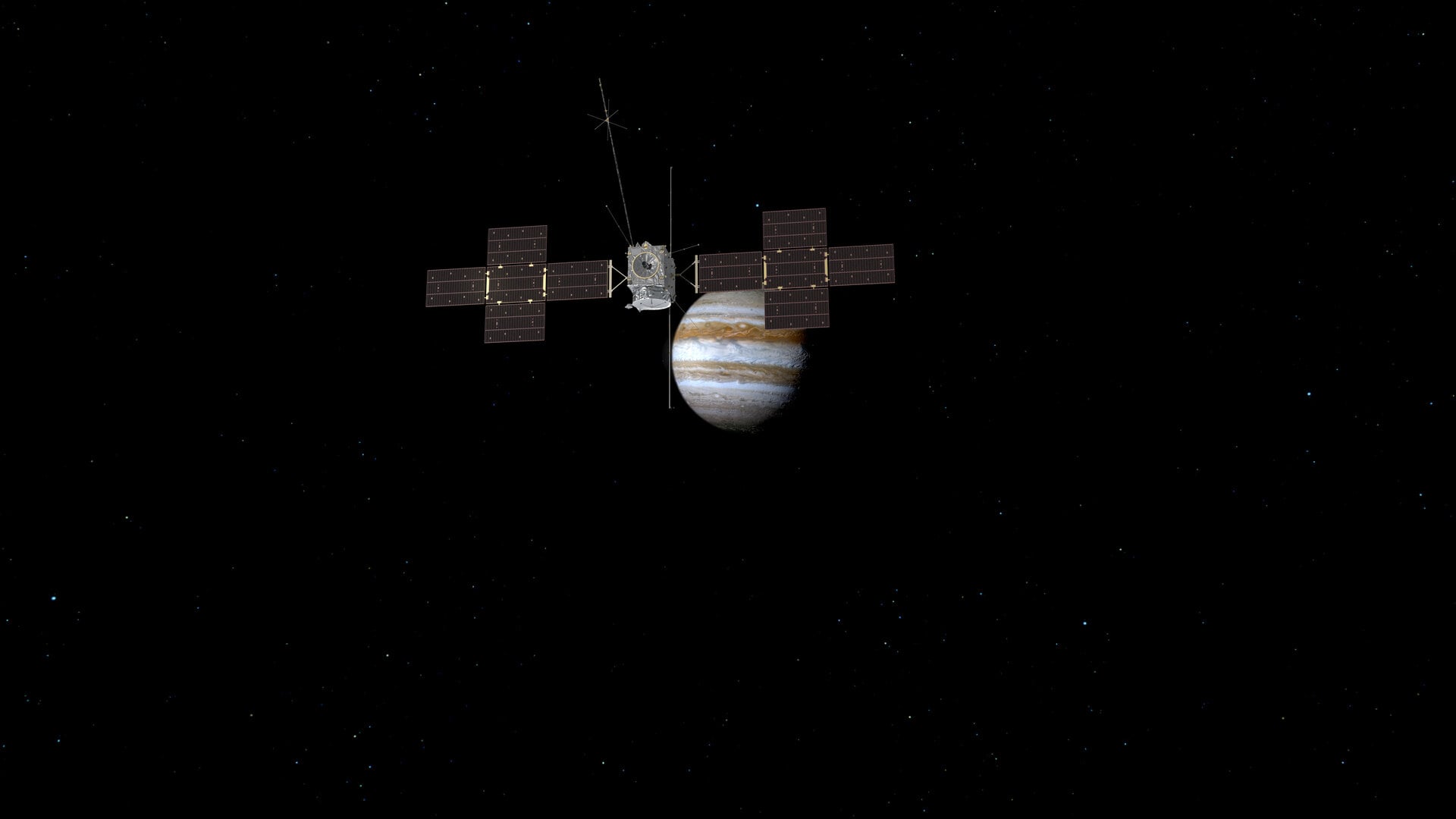
The European Space Agency’s (ESA’s) Jupiter Icy Moons Explorer (JUICE) probe is on its (very long) way to Jupiter, and will finally arrive at the King of Planets in 2031. Its primary mission is to focus on the “big three” icy moons - Ganymede, Europa, and Callisto. But while JUICE is busy mapping Ganymede’s magnetic field, it will also be keeping a sharp eye on the other 94 moons in the Jupiter system. A recent paper published in Space Science Reviews by Tilmann Denk of DLR, Germany’s space research association, and his co-authors showcases just how much “bonus science” JUICE is expected to squeeze out of these other targets.
Io is perhaps the most interesting of the bunch. It is the most geologically active object in our solar system, hosting an astonishing 425 active volcanoes that constantly resurface the entire moon. While the flight plan for JUICE only takes it within a few hundred thousand kilometers of Io, it will still use all of its instrumentation to track as much as it can about it. Specifically, its JANUS camera will track surface changes at a scale of around 6-12 kilometers per pixel, while watching for hot spots and plumes that might be missed by other missions like Juno.
It seems to be a great time to be watching Io, as Juno recently watched the largest eruption ever recorded on its surface, emitting 80 trillion watts of energy. The James Webb Space Telescope also recently detected sulfur in Io’s atmosphere for the first time - offering a way to track how volcanic gas escapes into Jupiter’s massive plasma system. JUICE’s UVS instrument will watch for further sulfur dioxide emissions and auroras, while its PEP instrument will monitor the moon’s plasma torus, a donut-shaped ring of ionized gas supplied by the outgassing of the volcanoes.
ESA video describing JUICE’s orbital path. Credit - ESA YouTube ChannelThere are four smaller moons inside Io’s orbit that reside deep within Jupiter’s radiation belt, and contribute to its faint ring system. Metis, Adrastea, Amalthea, and Thebe don’t have the same sort of violent processes as Io, but hold some interesting scientific mysteries nonetheless. In particular is one known as Amalthea’s Paradox. Despite being close to Jupiter, it has surprisingly low density, suggesting that it is either extremely porous or contains a significant amount of water ice. JUICE should be able to observe Amalthea and its sister moons in enough detail to give us our first detailed spectrographic images of these tiny moons, and potentially answer questions about their compositions. It might even be able to make out tiny “moonlets” near Amalthea itself.
Speaking of moonlets, Jupiter has plenty of its own. As of early 2026, there are 97 confirmed moons in the Jupiter system, many of them farther out past JUICE’s original scientific targets. Some of the largest, such as Himalia, will garner particular attention as JUICE will attempt to study their surface composition to try to figure out if they’re like so many of the other asteroids bound to Jupiter. Another moon, known as Kallichore, is a potential flyby target that mission planners are currently considering for when JUICE first arrives at the system in 2031. If that flyby is approved, it would be our first close-up look at one of these irregular moons.
But JUICE won’t be alone in its studies. Europa Clipper, a mission from NASA launched a year after JUICE, will arrive at Jupiter slightly before ESA’s mission. Currently the mission teams from both agencies have formed a joint committee to coordinate observations of the plasma torus on Io, and potentially other interesting features of the greater Jupiterian system.
Fraser discusses Europa Clipper and JUICEIt will still be awhile before those observations start, though. JUICE has successfully completed several orbital maneuvers to speed its way to the gas giant, including a first ever Lunar-Earth gravity assist, but it still has more than 5 years of travel to go. When it finally arrives at the system in 2031, it will find itself in a target rich environment of dozens of worlds to explore, whether it was originally intended to or not.
Learn More:
T. Denk et al. - Io and the Minor Jovian Moons – Prospects for JUICE
UT - The ESA Restores Communications with JUICE at Venus
UT - ESA's JUICE Mission Reveals More Activity from 3I/ATLAS
UT - The JWST Reveals Some Puzzling Surprises in Jupiter's Northern Aurora

