Universe Today
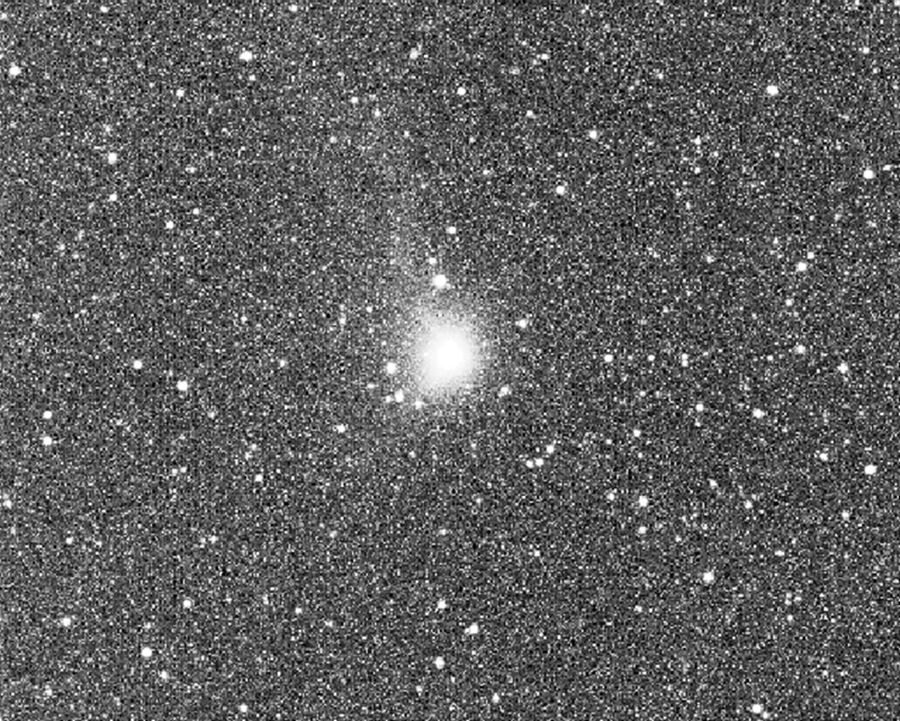
In November 2025, the interstellar comet 3I/ATLAS emerged from behind the Sun and began making its way towards the outer Solar System. This was a momentous occasion, as the comet was experiencing increased activity following its closest approach to the Sun and was once again visible to our telescopes and robotic space missions. One such mission is the European Space Agency's (ESA) JUpiter Icy Moon Explorer (JUICE), which captured the above image of 3I/ATLAS using its Navigation Camera (NavCam).
The image was taken on Nov. 2nd, 2025, two days before JUICE made its closest approach to the comet, at which point, it was about 66 million km (41 million mi) from the comet. While this was farther than the ESA's Mars Express and ExoMars Trace Gas Orbiter (TGO), which took pictures of the comet back in October, the JUICE image captures 3I/ATLAS in a more active state. While the full data from the probe's observations will not reach Earth until February 2026, the team managed to download one quarter of the NavCam image, providing a lovely teaser.
Although the NavCam was not designed to take high-resolution images, the resulting image surprised the science team. In addition to showing the comet's bright coma, the comet also appears to have two tails, consisting of the "plasma tail" and the "dust tail." The former, which extends upwards from the coma, is composed of electrically charged gas, while the latter, extending below, is composed of solid particles released by outgassing. JUICE also observed 3I/ATLAS using five of its science instruments and collected data on the comet's composition and behavior, which are all consistent with it being a comet.
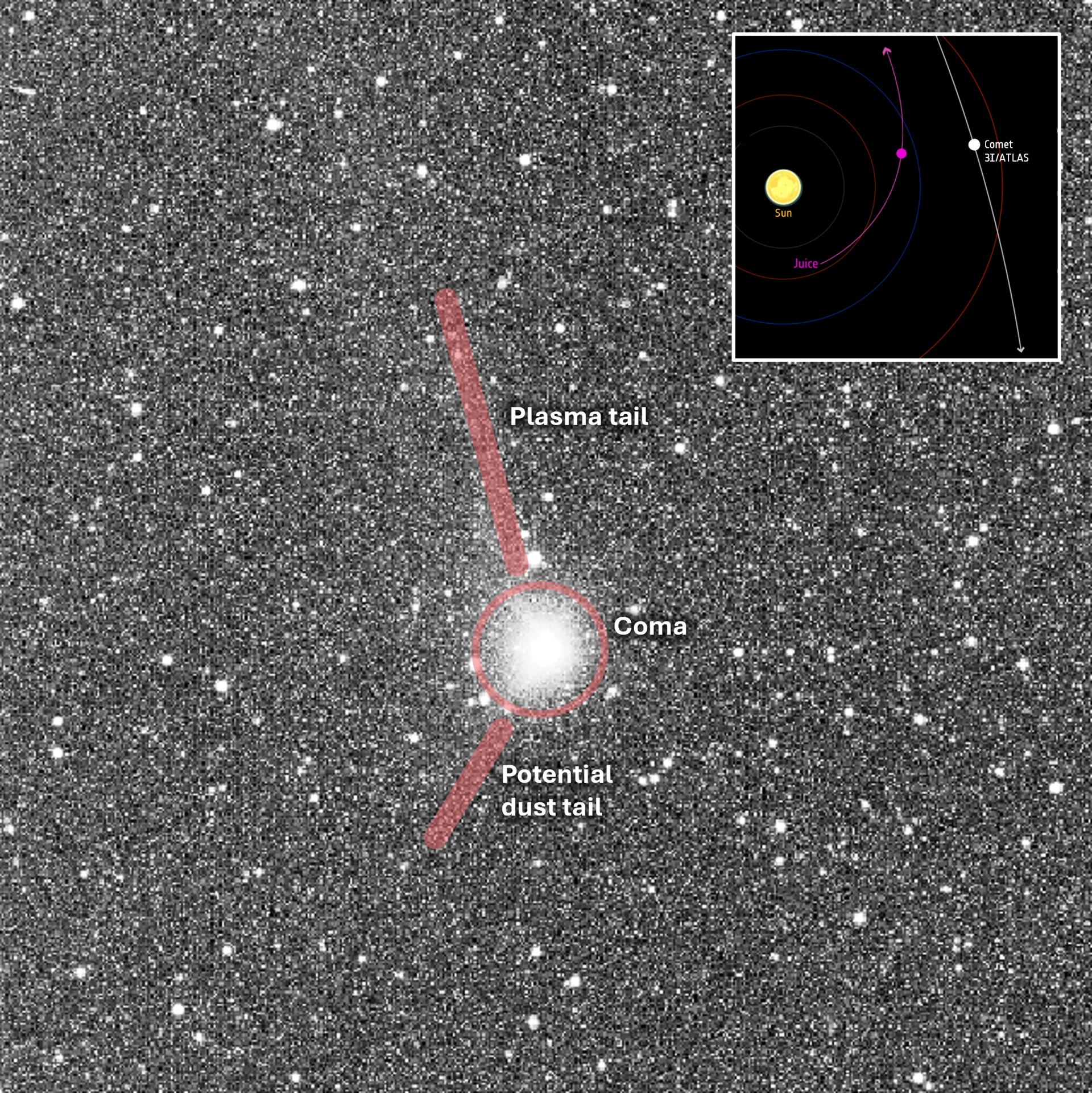 Annotated image of 3I/ATLAS and a map (inset) of its location when observed by JUICE. Credit: ESA/Juice/NavCam
The ESA expects to receive the full data from its instruments between Feb. 18th and 20th. The delay is due to JUICE using its main high-gain antenna as a heat shield. As a result, the probe must rely on its smaller, medium-gain antenna to send data back to Earth, and at a much slower rate. The data from these instruments is also expected to provide a clearer picture of the comet's activity. This includes images from JANUS, the probe's high-resolution optical camera, spectrometry from its Moons and Jupiter Imaging Spectrometer (MAJIS), and UV imaging spectrograph (UVS).
There will also be data on its composition obtained by the Sub-millimeter Wave Instrument (SWI) and particle data from the Particle Environment Package (PEP). This will allow scientists to learn more about where the comet originated and what conditions are like in other parts of the galaxy. Given that 3I/ATLAS could be up to 7 billion years old, this data will provide a window into the history of our galaxy long before Earth and the Solar System existed.
Further Reading: ESA