Universe Today
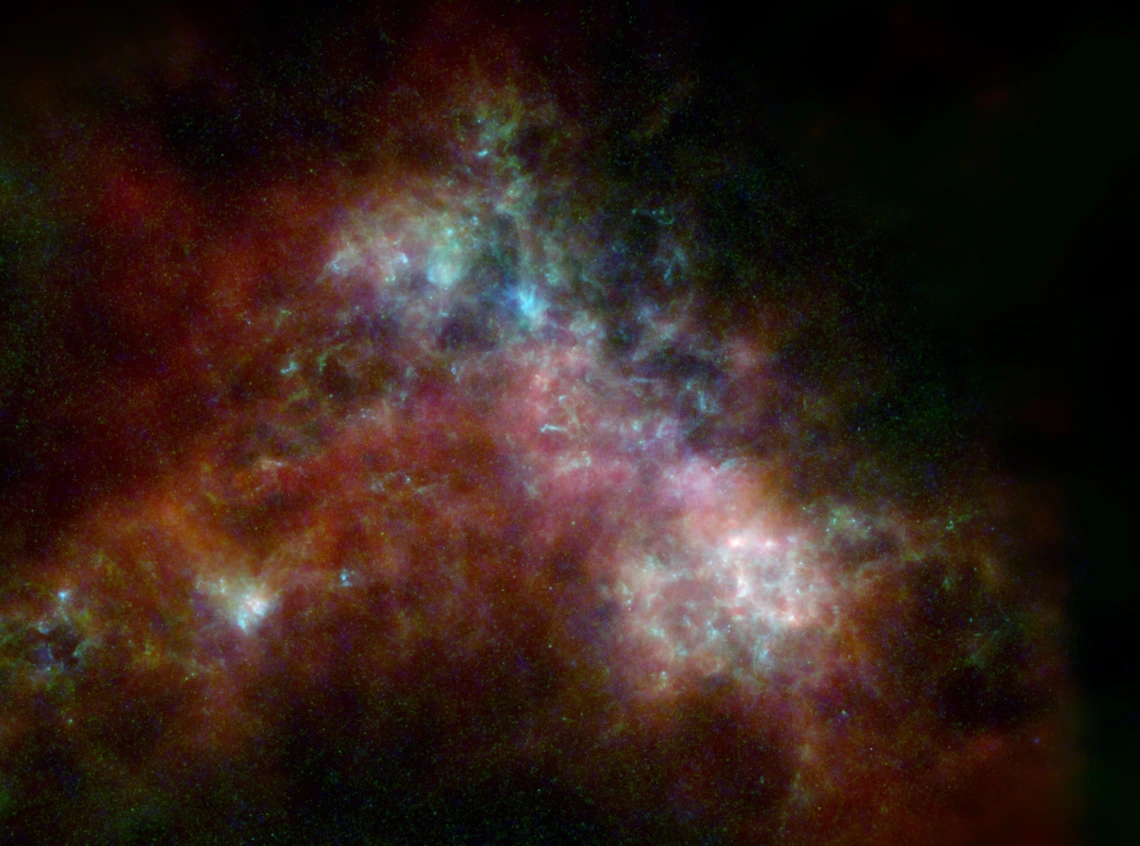
A strange lack of stellar orbits around the core of the Small Magellanic Cloud (SMC) mystified astronomers for decades. Not only that, but the SMC has a strange, irregular shape, and sports a tidal. Now, a team of observers led by graduate student Himansch Rathore at the University of Arizona, has tracked down the reason why the stars don't orbit. It's because the SMC crashed directly through its neighbor, the Large Magellanic Cloud (LMC), in the distant past. That huge collision disrupted stellar motions and sent them on wildly different trajectories. It also disturbed the clouds of gas within the SMC and created a tail of gas stretching out across space.
The team's work provides unique insights into how galaxies change over time. "We are seeing a galaxy transforming in live action," said Rathore. "The SMC gives us a unique, front-row view of something very transformative of a process that is critical to how galaxies evolve."
A Closer Look at the SMC
The Small Magellanic Cloud is one member of a trio of interacting galaxies that includes our own Milky Way, in addition to the Large Magellanic Cloud. The SMC lies about 200,000 light-years away, while the LMC is about 158,000 light-years distant. Both have sites of active star formation. The SMC is categorized as a dwarf irregular galaxy and has a mass equivalent to about 7 billion solar masses. Not all that mass is in stars, however. Most of the SMC's mass is in giant gas clouds that eventually become sites of starbirth. That happens as the clouds cool and contract. If conditions are right, the process creates hot, young stars that astronomers can study as they seek to understand the process of star formation.
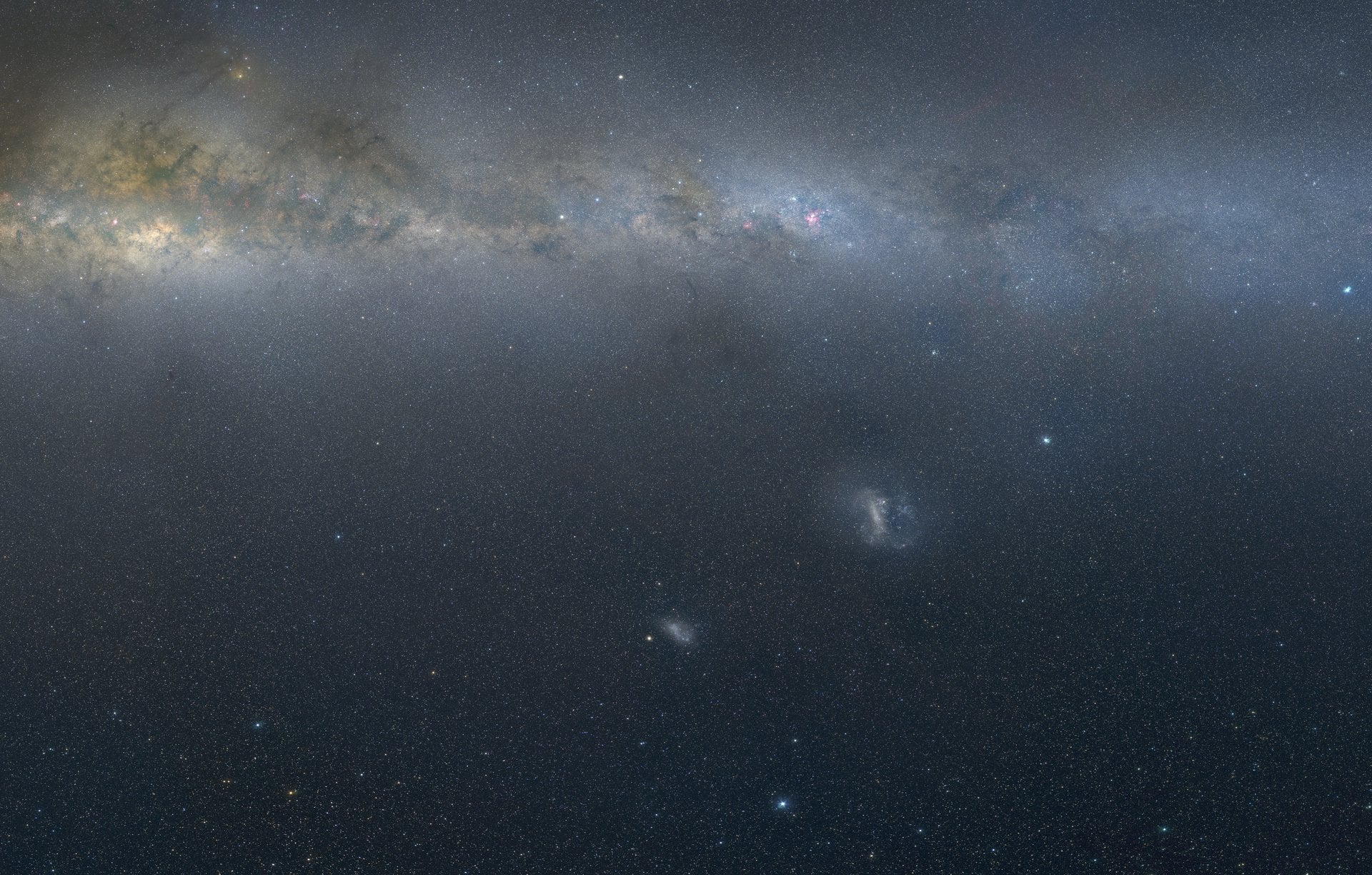 This visible light mosaic shows the LMC and SMC in context with the plane of our own galaxy, the Milky Way. Dusty filaments create dark traces across the bright central plane of the Milky Way, visible across the top of the image. Below it, separated by about 21 degrees, lie the LMC and SMC, the closest major galaxies to our own. The LMC and SMC orbit each other as well as our own Milky Way galaxy. Credit: Axel Mellinger, Central Michigan University (via NASA Goddard Scientific Vizualization Studio).
Astronomers have measured the motion of the stars that exist in the SMC, using the data from the Hubble Space Telescope and the Gaia mission. That's when they found that the SMC's stars don't orbit around that galaxy's center the way stars in most other galaxies do. That lack of orbital activity was puzzling, until Rathore's team considered the effects of a collision on the SMC and LMC. A few hundred million years ago, the SMC crashed directly through the LMC's disk. The LMC's gravity disrupted the SMC's internal structure and sent its stars into random, disordered motion. In addition, the gas in the LMC applied a tremendous amount of pressure to the SMC's gas and destroyed its gas rotation.
Since the LMC, SMC, and Milky Way Galaxy are interacting with each other, astronomers want to understand how that interaction affects all three galaxies. Astronomers found a bridge of gas between the LMC and SMC, likely pulled from one of the galaxies by during tidal interactions between the two galaxies. That bridge is busily forming stars in the shocked gas.
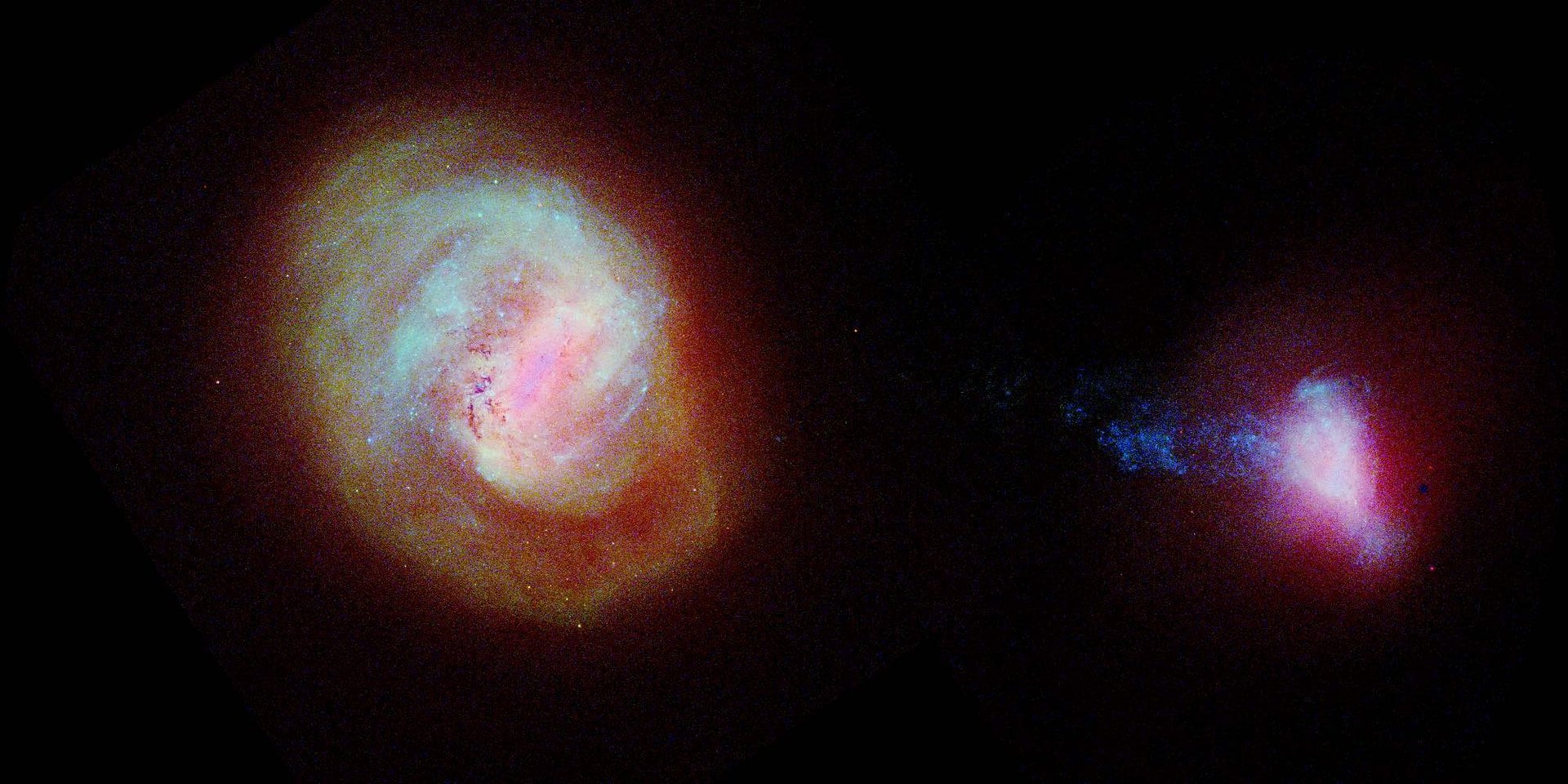 Large and Small Magellanic Clouds from GAIA data. Image credit: ESA/Gaia/DPAC - CC BY-SA 3.0 IGO.
Solving the Puzzle of Disrupted Stellar Orbits
The crash between the LMC and SMC did a lot of damage to both, according to Gurtina Besla, a senior author on a paper about the finding. "The SMC went through a catastrophic crash that injected a lot of energy into the system. It is not a 'normal' galaxy by any means," Besla said. To understand that crash, the team turned to computer simulations. First, they matched the known properties of the SMC and the LMC – their gas content, total star mass, and positions relative to the Milky Way. They paired the simulations with theoretical calculations of how collision affected the SMC's gas as it plowed through the LMC's dense gas environment. They also developed new methods for reading the scrambled star motions in a post-collision galaxy, tools that can now be used to properly interpret what telescopes actually measure in the SMC.
That matters because the SMC is small, gas-rich and low in heavy elements, which are properties that made it a standard yardstick for the kinds of galaxies that existed early in the Universe. A galaxy still reeling from a collision may not be a clean reference point, Besla said. However, it can give information about the effects collisions and interactions have had on galaxies throughout time.
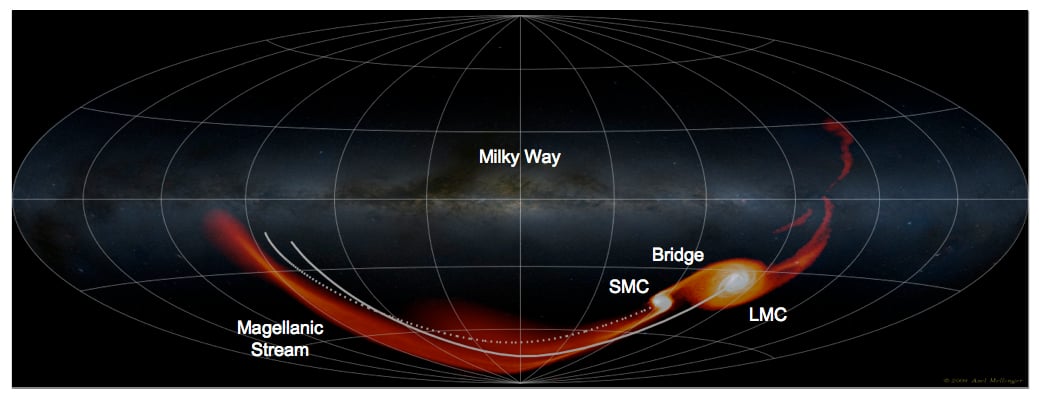 This plot shows the simulated gas distribution of the Magellanic System resulting from the tidal encounter between the Large Magellanic Cloud (LMC) and Small Magellanic Cloud (SMC) as they orbit our home Milky Way Galaxy. The solid line shows the calculated path of the LMC and the dotted line is the path of the SMC. Plot by G. Besla, Milky Way background image by Axel Mellinger (used with permission)
Other Effects of a Collision
Another study published by the team in 2025 showed that the collision also left a physical mark on the LMC that could help scientists probe dark matter. The LMC has a bar-shaped structure at its center, and that bar is tilted out of the plane of the galaxy because of the collision. Rathore, the 2025 study's lead author, said the degree of the tilt is tied to how much dark matter the SMC contains, giving researchers a new way to measure a substance that has never been directly detected, only inferred from its gravitational effects.
"We are used to thinking of astronomy as a snapshot in time," Rathore said. "But these two galaxies have come very close together, gone right through one another, and transformed into something different."
In addition, the interaction between the LMC, SMC, and the Milky Way affects our galaxy's shape. It appears that the LMC is causing a warp in the shape of the Milky Way's stellar disk. It's also pulling on the core of our galaxy, disturbing the halo, and accelerating its velocity through space. The SMC also contributes to this warping and pulling, and helps create the Magellanic Stream. That's a trail of gas and stars that's helping to populate the Milky Way.
For More Information
A Galactic Transformation — Understanding the SMC's Structural and Kinematic Disequilibrium
A Galaxy Next Door is Transforming, and Astronomers can see it Happening