 Universe Today
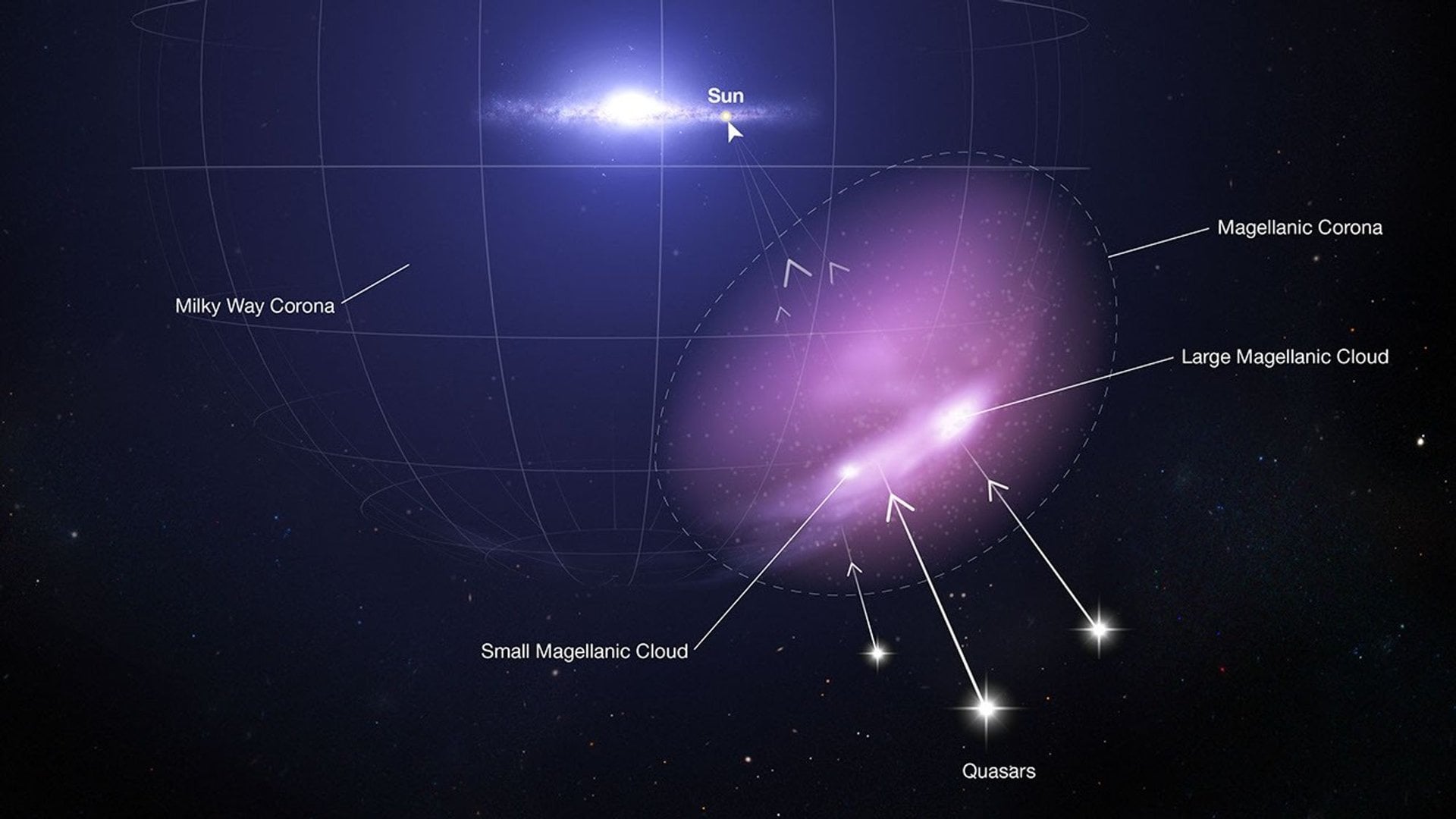
Our most massive satellite galaxy, the Large Magellanic Cloud (LMC), has been the center of a heated debate in the astrophysics community over the last few years. That debate centers on whether this is the LMC’s first or second “pass” by the Milky Way itself - and it has huge implications for the evolution of our galaxy given the disruption such a large grouping of stars has. A new paper from Scott Lucchini, Jiwon Jesse Han, Sapna Mishra, and Andrew J. Fox and his co-authors, currently available in pre-print on arXiv, provides what they claim to be definitive evidence that this is, in fact, the first time LMC has encountered the Milky Way.
To understand the debate, it’s best to look at its history. For decades, there was an ongoing debate about the orbital path of the LMC. The discussion centered around a collisionless N-body dynamics model that tracked stars and their gravity. But back in 2024, physicist Eugene Vasiliev released a stunning paper that presented an argument that the LMC might have first passed the Milky Way 6-8 billion years ago at a distance of roughly 100 kiloparsecs.
Upon release of that paper, the debate was reignited. Vasiliev posited that, if the Milky Way’s dark energy halo was anisotropic (meaning the velocities of dark matter particles are skewed in certain directions), the current speed and position of the LMC would align perfectly with a “second pass” orbit. Dr. Lucchini and his co-authors are firmly on the other side of that argument.
Anton Petrov discusses the Large Magellanic cloud and what it means for the future of our own galaxy. Credit - Anton Petrov YouTube ChannelThey released two papers directly tackling the idea. First was paper tracing trajectories of “hypervelocity stars” that had been previously ejected by the LMC’s central black hole. They found that the stellar dynamics of these fast-moving stellar objects aligned with both a first pass and second pass model. In other words, it did nothing to settle the argument.
So they began looking for a second, more definitive option. That option presented itself through an unexpected avenue - hydrodynamics. Using a software simulation package known as GIZMO, they combined rigid, analytical dark matter models of both the LMC and Milky way with “live” gas particles representing the mediums surrounding the two galaxies. Once they ran the simulations, they used another software package called Trident to generate mocked up data that would be expected in the ultraviolet spectroscopic observations of the simulated gas.
After they had their simulated data, they began to compare it to observational data - specifically Carbon IV and Hydrogen II absorption data from background quasars, located past the LMC itself. The results were conclusive - the simulation beautifully reproduced the observed velocity and column density profiles of the modern LMC. Just as conclusively, the model of a second-pass does not fit as well. Specifically, the LMC’s time spent “swimming” through the Milky Way’s gas in this scenario results in a much smaller “corona” - the massive halo of warm, ionizing gas surrounding the galaxy.
Video describing how the LMC could survive a collision with the Milky Way’s halo. Credit - European Space Agency YouTube ChannelWhile those results seem very cut and dry, there are a few simplifications the authors took in the interest of saving computing capacity. The Small Magellanic Cloud (SMC) was completely excluded from the simulation, and it actually contributes a majority of the neutral gas in the Magellanic Streams that both galaxies trail. Ignoring this could significantly alter the gas profile, the authors note. Also, the simulations massively simplified the Corona itself, using a warm-hot, single-phase model instead of the massively complicated multi-phase reality - largely in a nod to saving computational power.
Ultimately, these two papers together offer a brilliant tie-breaker in this debate. However, they weren’t the only ones contributing to the debate. A few weeks before these two papers were released, an independent team utilizing the Subaru Hyper Suprime-Cam published a paper that showcased stars sitting around 30kpc out in the Milky Way’s halo. This tidal debris aligns well with Vasiliev’s second-passage model, and is recent enough that the other side of the debate hasn’t yet had time to process counter arguments.
In other words, it's still not clear whether or not this is our first rodeo with the Large Magellanic Cloud. Hopefully upcoming missions, such as NASA’s Aspera mission, will allow us to look directly at the morphology and distribution of the Magellanic gas more closely. But until then, the debate will continue in the pages of academic journals.
Learn More:
S. Lucchini et al. - The LMC Corona Favors a First Passage
S. Lucchini & J.J. Han - Threading the Magellanic Needle: Hypervelocity Stars Trace the Past Location of the LMC
UT - Our Galaxy Has a Hot Side and Now We Know Why
UT - The Large Magellanic Cloud Survived its Closest Approach to the Milky Way

