Universe Today

The Orion Nebula provides a master class in the study of stellar formation. Yet, many of its youngest stellar objects are still swaddled in their birth crèches, hidden by clouds of gas and dust. The Very Large Baseline Array (VLBA) radio telescopes have managed to punch through the dusty obscuring veil to study a pair of young binary systems called Brun 656 and HD 294300 born in the Nebula.
The result of the observations is a very accurate calculation of the masses of the stars in those systems. Lead researcher on the observations, Dr. Sergio Abraham Dzib Quijano, from the Max Planck Institute for Radio Astronomy pointed out how important this measurement is. “Stellar mass is the most fundamental property of a star," he said, "yet it is notoriously difficult to measure for young, embedded systems.”
VLBA solved the difficulty by observing at radio wavelengths of 5 GHz using the full array of telesscopes. That 5 GHz is a region where dust is transparent, and radio wavelengths can get through. The high resolution capability of the array was able to resolve the tight binary pairs more easily than telescopes at other wavelengths can achieve.
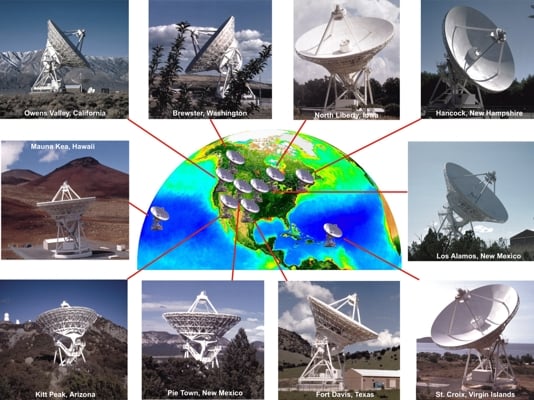 A montage of VLBA locations and their antenna installations. Credit: Image courtesy of NRAO/AUI and Earth image courtesy of the SeaWiFS Project NASA/GSFC and ORBIMAGE
Probing the Orion Starbirth Region
The Orion nebula lies about 400 parsecs (~1300 light-years) away from us. Over millions of years, it has birthed a diverse population of stars, ranging from massive hot ones to the binaries being studied to brown dwarfs (objects too cool to be stars but too hot to be planets). In addition, it's populated by hundreds of young stellar objects (YSOs) that are in all stages of early evolution.
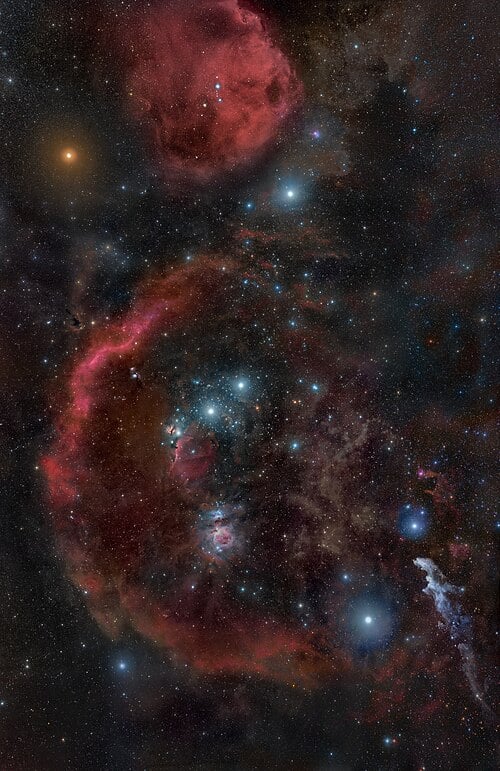 An October 2010 image of the Orion Molecular Cloud region, the site of a number of young stars, brown dwarfs, and young stellar objects still in the process of formation. Courtesy Rogelio Bernal Andreo and Wikimedia Commons.
Stars are born in batches, and many end up in binary pairs, triplets, and smaller clusters. Determining their masses is an important step in figuring out their stage of evolution as well as the existence of any protoplanetary systems. Many of those remain hidden from the view of optical telescopes, but can be "seen" in infrared wavelengths and radio frequencies. Radio measurements can also detected evidence of magnetic fields and activity in some regions where stars are forming or are newborn. In particular, the team used VLBA to study the quadruple star system V* NU Orionis. They found that its C component as an intermediate-mass (~7 solar masses) star with nonthermal radio emission. It also offers rare evidence of magnetic activity in a star that's close to being a high-mass star.
The VLBA observations are an important step in understanding the early epochs of stars' lives. “These accurate mass measurements now turn Orion into a precision laboratory for testing how young stars form and evolve,” said Dr. Jazmin Ordonez-Toro, postdoctoral Orquídeas fellow at the Astronomical Observatory at the University of Nariño, who co-led the study of the binaries, “These measurements vastly expand our understanding of how stellar neighborhoods like our own are built.”
VLBA Monitors Dynamics and Positions
In its sampling of binary stars in the Orion nebula, the VLBA watched as the partners orbited each other. The characteristics of those orbits gave a very good measure of the masses of each of the stellar partners. The VLBA's abilities allow it to detect even the smallest shifts in position of a celestial object. This means measuring tiny shifts in a star’s apparent position on the sky over months and years. The VLBA can repeat its observations of the same area of the sky and coordinate the observations between all of its member telescopes. They're scattered across the world, from the U.S. to Hawai'i and out to the Virgin Islands. This gives astronomers a star's position with millisecond accuracy. By comparing how that position changes from epoch to epoch, the subtle orbital motion caused by the gravity of a companion star becomes quite obvious. Astronomers then use that motion to infer the mass of each star in the system.
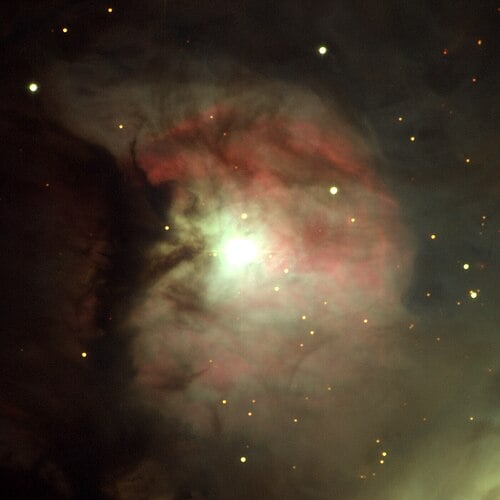 M43 is part of the larger Orion Nebula. The central star is a young irregular variable designated NU Orionis or HD37061. It was part of a study of young stars in the Orion Nebula made by the VLBA. Courtesy N.A.Sharp/NOIRLab/NSF/AURA
The VLBA measurements are the first such characterizations of multiple YSOs in the Orion birth complex. The data provided show that VLBA astrometry (the precise measurements of stellar distances, motions, and positions) demonstrates a powerful tool for measuring stellar masses and other characteristics in young multiple-star systems. That information can be fed into models of stellar formation and evolution, and enable further studies into the magnetic activity involved in these infant systems.
Why Care About Mass?
Astronomers characterize stars by their masses. A given star's mass foretells its entire evolutionary history. It tells us what's happening in its nuclear furnace as it forges new elements over time. Eventually, its mass will determine how it dies, as a planetary nebula (as our Sun will do in some 10 billion years) followed by billions of years as a white dwarf. Or, if it's massive enough, it could explode as a supernova, leaving behind a neutron star or even a black hole. So, measuring the mass of a star, particularly those youngsters in the Orion Nebula is an important contribution to our understanding of stellar evolution. Not only that, but given the heavy elements all stars leave behind, stellar mass also plays a role in the formation of planets around stars, and influences the characteristics of those worlds.
Astronomers use mass measurements as part of developing a standard model of young-star formation. The VLBA observations were compared with those models with some mixed results. Some observations matched quite well, while at least one observed pair didn't match at all. That could mean that the model needs some tweaking before it accurately reflects the reality of young-star formation. Interestingly, the VLBA observations found a few previously hidden close companions, as well as compelling evidence that strong magnetic activity can persist in relatively massive young stars.
For More Information
Unraveling the Mass Mystery of Orion’s Young Stars
Dynamical masses of young stellar objects with the VLBA: DYNAMO-VLBA