Universe Today
If you have ever pushed your finger against the hole of a bicycle pump and felt the air grow warm as you compressed it, you already understand the physics at the heart of a new discovery about our own Galaxy. Because it turns out the Milky Way has a hot side and a cool side and the reason why comes down to exactly the same principle.
Astronomers have known for some time that our Galaxy is surrounded by an enormous halo of hot gas. This vast, invisible sphere extends far beyond the familiar disc of stars we think of as the Milky Way, and is around two million degrees, several hundred times hotter than the visible surface of the Sun. What puzzled scientists was why one half of this halo appears to be warmer than the other. Data from the eROSITA X-ray observatory, released in 2024, showed that the southern half of the halo runs up to twelve percent hotter than the north. Nobody could quite explain why.
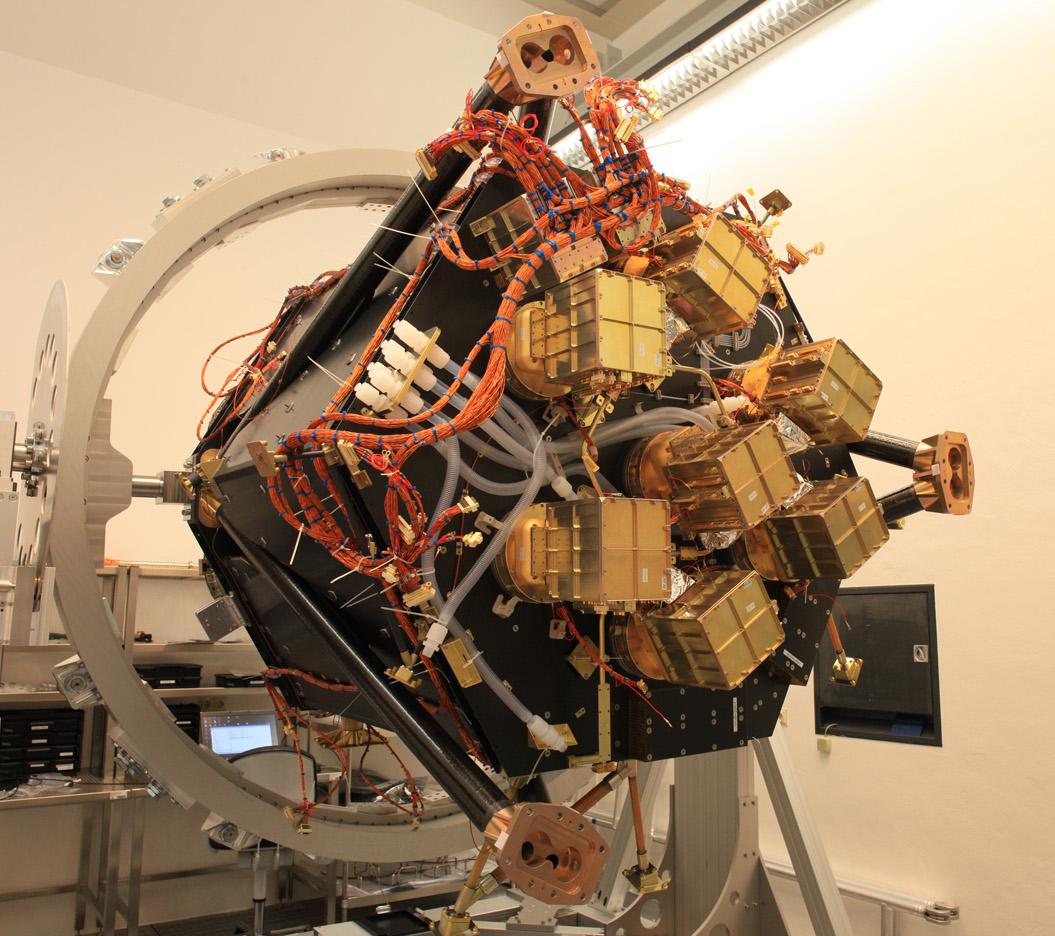 The X-ray detectors of the eROSITA X-Ray observatory (Credit : JohannesBuchner)
Now a team at the University of Groningen think they have the answer and it involves a neighbour that has been quietly nudging us for billions of years. The Large Magellanic Cloud, the small satellite galaxy visible from Earth's southern hemisphere is a smudge of light in the night sky. It orbits the Milky Way, and its gravity is enough to tug our entire Galaxy slowly in its direction. The Milky Way is currently drifting southward toward it at around forty kilometres per second. That might not sound dramatic, but over vast timescales and distances, it adds up to something significant.
As the Milky Way moves, it presses into the gas on its southern side. The Galaxy acts like a piston, compressing the gas in its path and that compressed gas heats up. It is precisely the same effect that warms the air in your bicycle pump, just scaled up to something almost incomprehensibly large. The computer simulations show this compression heating the southern halo by thirteen to twenty percent, neatly matching what eROSITA actually measured and remarkably, the whole effect has only developed in the last 100 million years.
 ESO's VISTA image of the Large Magellanic Cloud (Credit : ESO/VMC Survey)
The research may also solve a second puzzle at the same time. Astronomers have long noticed that mysterious fast moving clouds of cooler gas appear far more frequently in the northern halo than the south. The new model suggests that is because the north, being less compressed and slightly cooler, provides conditions where those clouds can form and survive more easily.
It is a beautiful reminder that the Milky Way is not a fixed, static structure floating serenely in space. It moves, responds, and is shaped by its surroundings in ways that leave measurable marks across the entire Galaxy.
Source : Galactic warming: The 'car engine-like' effect heating our Milky Way