 Universe Today
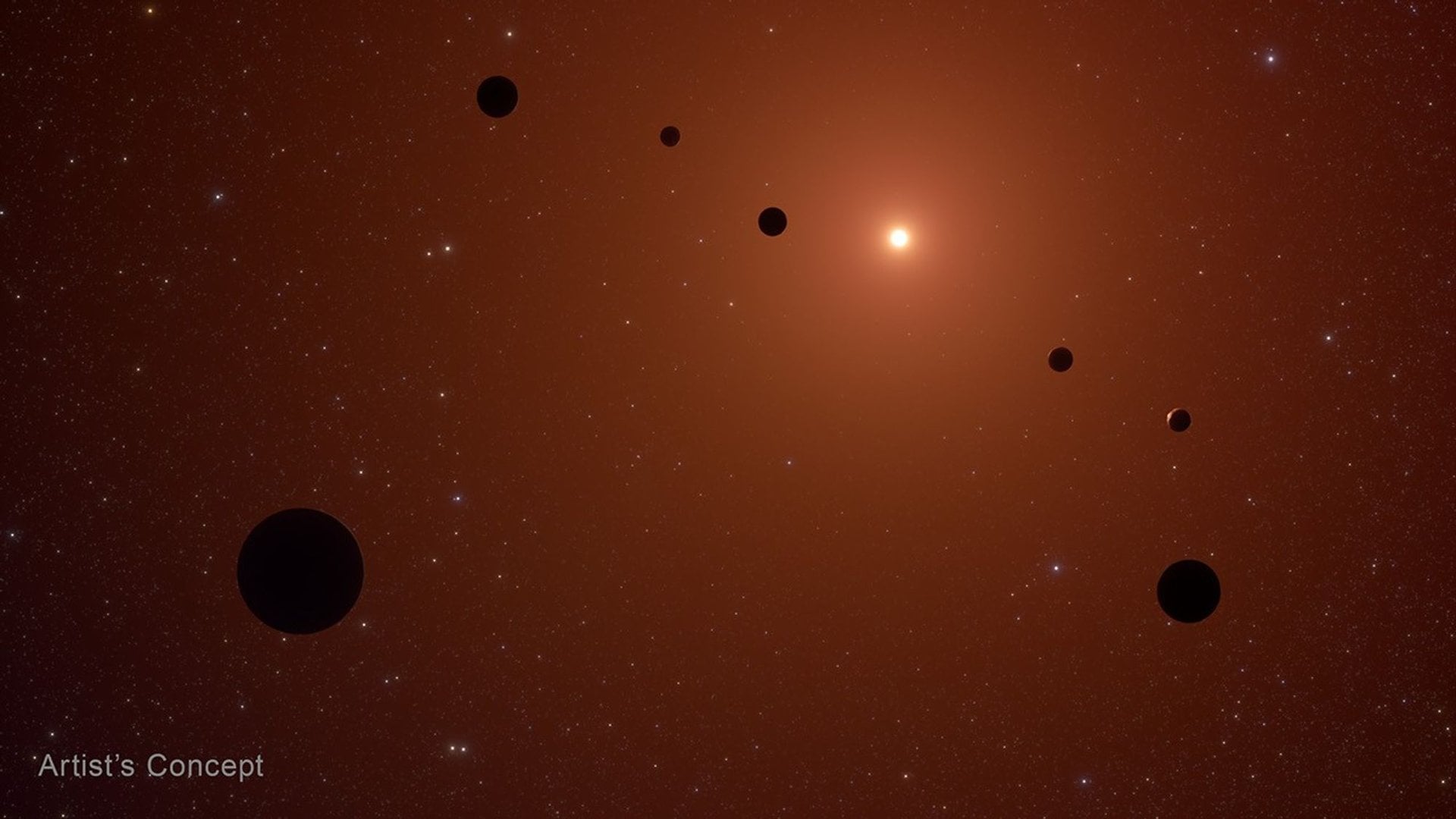
Anyone familiar with the search for alien life will have heard of the “Goldilocks Zone” around a star. This is defined as the orbital band where the temperature is just right for liquid water to pool on a rocky planet’s surface - a good approximation for what we thought of as the early conditions for life on Earth. But what happens if that life doesn’t stay on an Earth analog? If they, like we, start to move towards their neighboring planets, the idea of a habitable zone becomes much more complicated. A new paper from Dr. Caleb Scharf of the NASA Ames Research Center, and one of the agency’s premier astrobiologists, tries to account for this possibility by introducing the framework of an Interplanetary Habitable Zone (IHZ).
While the traditional Goldilocks Zone can be thought of as a simple yes/no question, an IHZ is more multi-dimensional. In fact, there are four dimensions in all, according to the paper: power availability, radiation risk, difficulty of transport, and material resources. In the main equation that Dr. Scharf uses, two of those (power availability and material resources) are net contributors to the habitability zones, while two (difficulty of transport and radiation risks) are net detractors. Let’s look at each in turn.
Power availability seems relatively self-explanatory - how much energy does the star output and how can it be converted into the processes necessary for life. But there’s a trade-off. Solar panel efficiency drops as temperature rises (i.e. when it gets nearer to the star). So while a closer-in solar panel might be able to collect more light, it is also less efficient at converting it to useful electrical energy.
Fraser discusses the concept of a habitable zoneRadiation is a two-edged sword. Close to a star life is bombarded by highly energetic particles from fusion reactions going on in the star’s core. But farther away, life is subjected to galactic cosmic rays, which increases the farther out in the solar system you go. So ultimately radiation is simply a trade-off between solar radiation and galactic, and there is no right answer.
Difficulty of transport is familiar to anyone interested in orbital mechanics. From one point in the solar system to another requires a change in velocity, commonly known as “delta-v” after the mathematical symbol for it. Several factors go into calculating this, including the distance between any two bodies. Higher accelerations and decelerations can make the travel time in between them shorter, but at the cost of energy. But perhaps the biggest factor affecting this is the gravitational pull of the body itself. It's much harder to get off of a larger planet, making them act almost as a trap for more advanced civilizations.
Material resources, while they have their own gravitational pull, also have the benefit of being the building blocks of any space economy. Asteroids are the major factor here, as the ease of access to their resources combined with their low gravitational pull make them highly desirable early exploration targets.
Lots of considerations go into the formation of a habitable zone, including where the system is in the galaxy, as Fraser explains.So what does all of this mean in practice? Dr. Scharf created a simulation that took these factors into account and watched how a technological civilization would evolve in several scenarios. One thousand digital “agents” were lost into the simulation and given a choice between staying put, harvesting resources, reproducing, or migrating every six months. On Earth, that actually took us first to Mars, then to the asteroid belt, then to the Moon (which is an interesting insight into one of the most hotly debated questions in space exploration). However, the paper also has bad news for one of the planetary systems that was originally thought to be a promising location for life.
The TRAPPIST-1 system hosts seven Earth-sized rocky planets around a red dwarf star. But according to Dr. Scharf’s calculations, any advanced civilization there is doomed to extinction within 45 years, primarily due to radiation exposure. In fact, the only way the civilization survived was if the radiation was artificially halved. So unfortunately the likelihood of an advanced civilization evolving there is almost negligible.
But this model of interplanetary habitability would be useful in far more than just these two systems. Understanding how the dynamics of stars, planets, and space interact with the evolution of technological life will become increasingly important as we continue to find more and more exoplanetary systems. For now, the current trajectory of human expansion seems to be on track. Hopefully we don’t end up with a fate like that found in TRAPPIST-1.
Learn More:
C. Scharf - The Interplanetary Habitable Zone
UT - Two New Exoplanets And The Need For New Habitable Zone Definitions

