 Universe Today
At the beginning of the exoplanet age, the goals were fairly simple. The first was to find as many of them as possible to flesh out our understanding of the exoplanet population. The second was to determine if any were in the habitable zones around their stars. The definition of a habitable zone was necessarily simple in the beginning. Any planet in the right distance range from its star to allow liquid surface water was considered to be in the habitable zone.
But now, as astronomers find more and more exoplanets, the definition of habitable has become more nuanced. Scientists often refer to an optimistic habitable zone and a conservative habitable zone. The optimistic habitable zone is a wider zone that takes into consideration things like geothermal heating that could extend its outer limit, and things like rotation that could prevent greenhouse conditions, extending its inner limit. The conservative habitable zone is more limited. Its inner edge is where a planet might suffer from the greenhouse condition, and a more restricted outer limit defined by CO2 condensation out of the atmosphere that could restrict the warmth needed to maintain liquid surface water.
New research submitted to the Monthly Notices of the Royal Astronomical Society adds more nuance to the definition of habitable zone by working with the idea of a temperate zone. The research is titled "Two temperate Earth- and Neptune-sized planets orbiting fully convective M dwarfs.." The co-lead authors are Madison Scott from the School of Physics & Astronomy at the University of Birmingham, and Georgina Dransfield, an exoplanet scientist from the University of Oxford.
"As the diversity of exoplanets continues to grow, it is important to revisit assumptions about habitability and classical HZ definitions," the authors write. Previous research has used the word temperate to describe some exoplanets. But some researchers didn't actually define the term, while others came up with own definitions. Some used it interchangeably with the word habitable. "In this work, we introduce an expanded ’temperate’ zone, defined by instellation fluxes between 0.1 < 𝑆/S⊕ < 5, thus encompassing a broader range of potentially habitable worlds," the authors explain.
An exoplanet's instellation flux, or insolation flux, describes the amount of solar energy that reaches the exoplanet's surface. It's measured in watts per square meter (W/m²). In the paper, the expression 0.1 < 𝑆/S⊕ < 5 defines a range of insolation flux relative to Earth's solar constant. So it translates to a range between about 136 W/m² and about 6805 W/m². Earth's solar constant is around 1361 W/m² at the top of the atmosphere, so that gives an idea of what the term is describing.
The temperate zone is intentionally a broader definition than the conservative habitable zone. The conservative habitable zone is based on a planet's ability to foster liquid water on its surface. But the temperate zone categorizes planets that receive moderate levels of instellation.
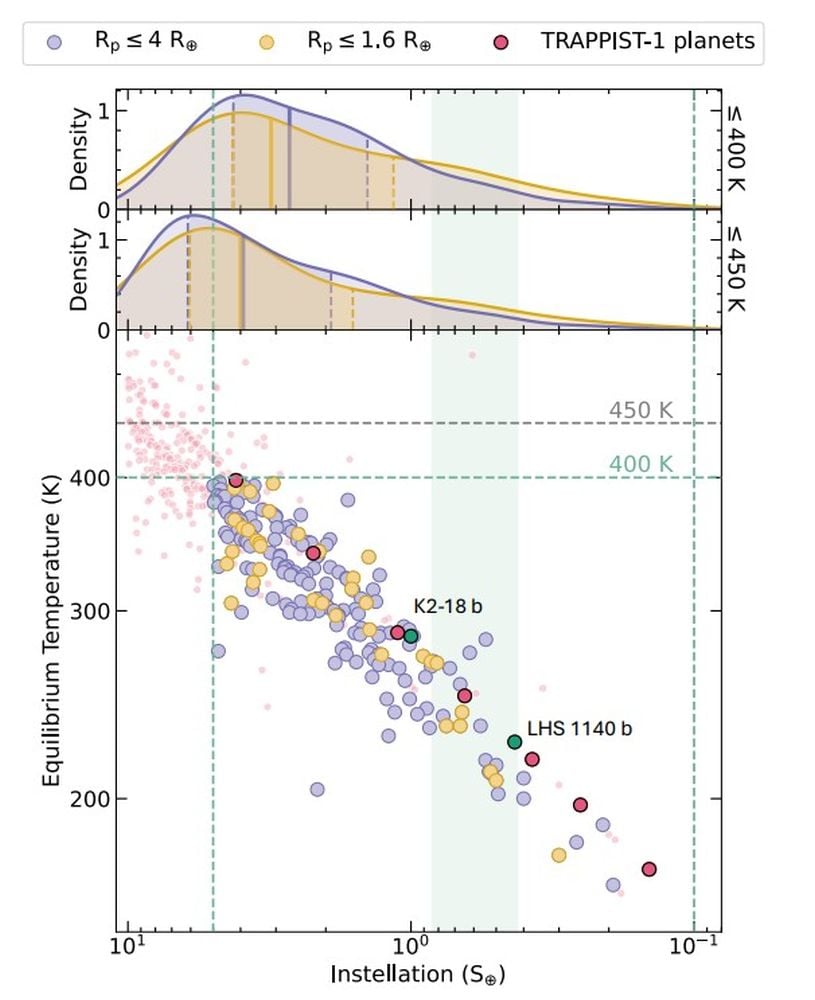 This figure illustrates the authors' definition of the temperate zone. It distinguishes between two regions, the Conservative Habitable Zone (CHZ) and the Temperate Zone (TZ). The Green shaded area is the CHZ, and the region between the vertical dotted lines is the TZ. The pink points are a baseline sample of detected transiting exoplanets. The purple points represent sub-Neptunes and smaller exoplanets, some that may have thick H/He atmospheres. The brown points are most likely rocky planets, and are the main targets in studies of habitable exoplanets. Red points are the TRAPPIST-1 exoplanets, considered prime targets in the temperate planet regime. Green points are K2-18 b & LHS 1140 b, which are canonical exoplanet types: a potential Hycean world and a massive rocky/water-world candidate, respectively. Image Credit: Scott and Dransfield et al. 2026.
The paper is also an introduction to the TEMPOS (Temperate M Dwarf Planets With SPECULOOS) survey. SPECULOOS stands for the Search for habitable Planets EClipsing ULtra-cOOl Stars, and its goal is to find Earth-like planets around tiny, dim stars. The TEMPOS survey aims to produce a catalog of the precise radii of temperate exoplanets that transit mid to late-type M dwarfs, or red dwarfs.
These types of stars are important because temperate exoplanets orbiting these types of stars are more likely to transit, and thus to be detected. "This is because planet equilibrium temperature scales with both semimajor axis and stellar effective temperature," the authors explain in their research. "Thanks to the lower effective temperatures of M-type stars, and in particular mid- to late-type M dwarfs (≤ 3400 K), temperate planets orbiting such stars are far more likely to transit, and therefore become more accessible in transit surveys."
As the paper's title mentions, two new exoplanets are described as temperate, putting them and the stars they orbit into a small, fairly exclusive club. "TOI-6716 and TOI-7384 join the select club of mid-type, fully convective M-dwarfs known to host temperate planets," the authors explain.
The pair of temperate planets are TOI-6716 b, an Earth-sized planet between about 0.91 and 1.05 Earth radii, which is most likely a rocky planet. The other is TOI-7384 b, a sub-Neptune measuring about 3.35 to 3.77 Earth radii. It may have a rocky core with a thick H/He envelope.
"While neither of these planets fall even within the optimistic HZs of their stars, these planets populate an otherwise sparse region of temperate planet parameter space, offering opportunities for future studies as definitions of exoplanet habitability broaden," the authors write.
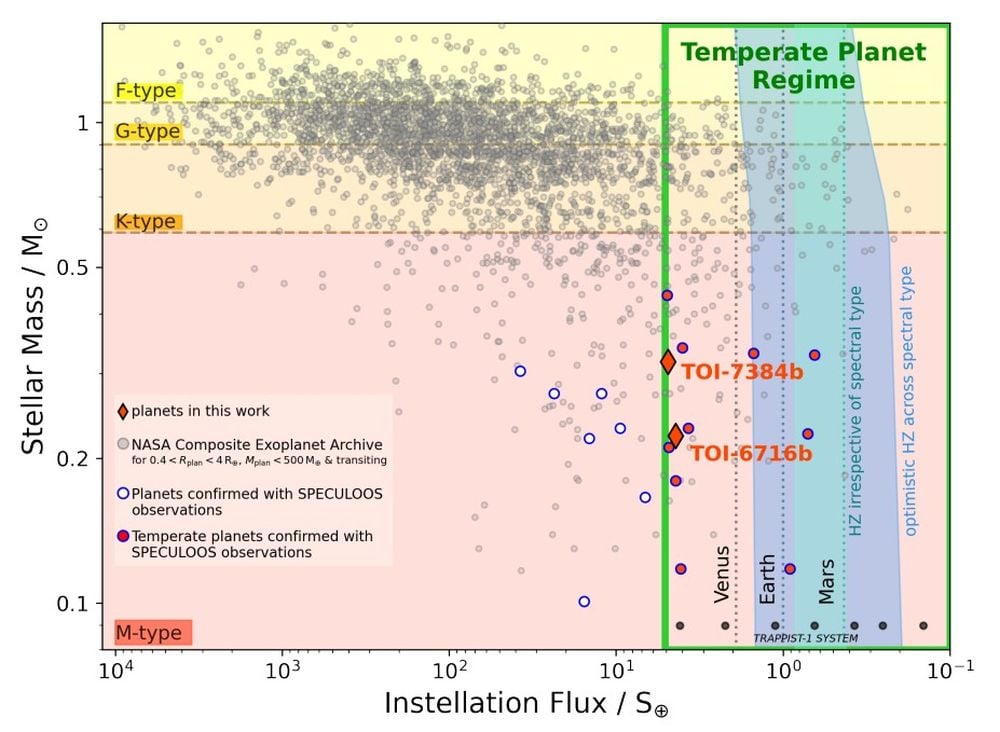 This figure shows TOI-6716 b and TOI-7384 b within the current population of exoplanets in NASA's Exoplanet Archive Composite Database, for planets ranging from about Mars-sized up to the upper range for sub-Neptunes. The green box highlights planets that lie inside the temperate regime, where TOI-6716 b and TOI-7384 b are at the inner (hotter) edge. It also highlights planets which had SPECULOOS observations that aided in their validation/confirmation. The planets in this work also add to this sample. Image Credit: Scott and Dransfield et al. 2026.
The goal of all of this work is to identify temperate exoplanets that are good candidates for atmospheric studies.
"We find these planets to have instellation fluxes close to the inner (hotter) edge of the temperate zone," the authors write. "Also, with a predicted Transmission Spectroscopy Metric (TSM) similar to the TRAPPIST-1 planets, TOI-6716 b is likely to be a good rocky-world JWST target, should it have retained its atmosphere." They also explain that TOI-7384b's size and predicted mass also make it a desirable target for atmospheric characterization with the JWST, and with other upcoming facilities.
"Together these discoveries show the power of combining TESS with coordinated ground-based efforts to build a catalogue of temperate planets around fully convective M dwarfs for atmospheric studies in the coming decade," the researchers conclude.

