 Universe Today
It's strange that a dying star is at the heart of this glowing cloud of gas, ionizing it and lighting it up almost like a living structure, but that's Nature for you. An aging Wolf-Rayet star, which has exhausted its hydrogen core, illuminates the Cat's Eye Nebula from within. The star, catalogued as HD 164963, has suffered episodic mass loss as it ages. Each complex layer in the gaseous nebula represents one episode of mass loss driven by the star's extremely powerful winds.
The star's death convulsions created the shells of gas shed by the star thousands of years ago, and it's radiation turns them into natural artwork.
The Cat's Eye Nebula, also known as NGC 6543, is about 4,300 light-years away in the constellation Draco, according to the ESA's Gaia mission. When first observed in 1786, it looked like a planet in the telescopes of that age, and was called a planetary nebula. Almost a century later, it was the first nebula to have its spectrum studied, showing that it was stellar, not planetary, in nature. Now, of course, we know that planetary nebulae like NGC 6543 have nothing to do with planets at all.
The nebula is one of the most popular objects in astronomy. It's also a popular target in astrophotography, though it's more challenging to image than some other targets.
Many telescopes have captured its portrait. The Chandra Observatory and XMM-Newton space telescopes have both observed it in x-rays. The Herschel Telescope and the Subaru Telescope have both studied it from the ground. The gold standard for Cat's Eye Nebula images is a combined image from the Hubble and Chandra. That image makes NGC 6543 look organic in nature.
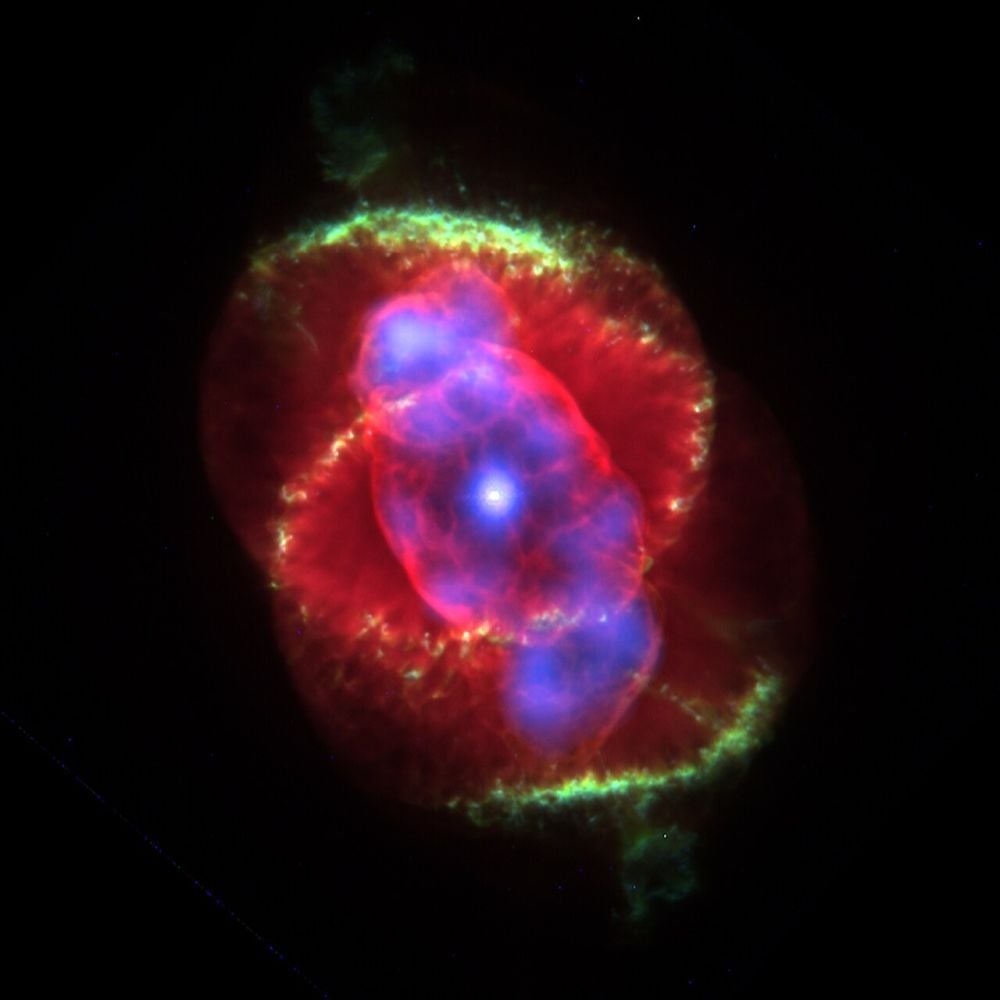 This image of the Cat's Eye Nebula is a composite image made from Hubble data and Chandra data. In this image, red is hydrogen alpha, blue is neutral oxygen, and green is ionized nitrogen. Image Credit: By J.P. Harrington and K.J. Borkowski (University of Maryland), and NASA - HST's Greatest Hits, Public Domain, https://commons.wikimedia.org/w/index.php?curid=36064
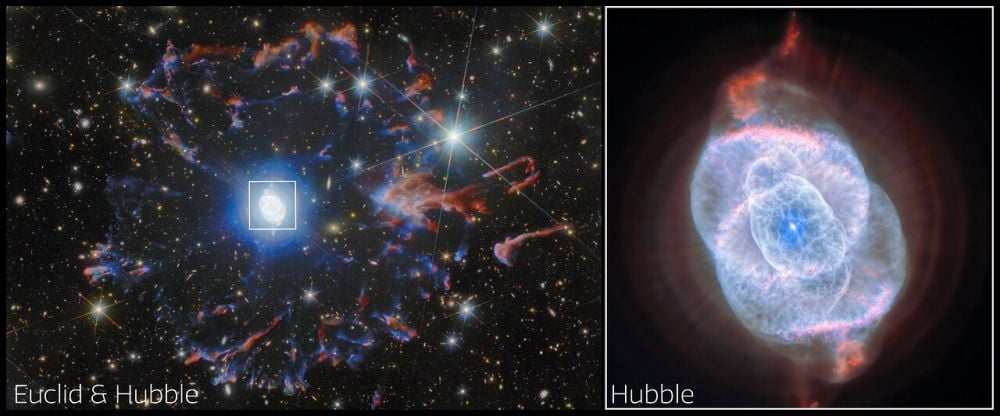
This new combined image from the ESA's Euclid Space Telescope and the Hubble doesn't show the internal detail as well as other images, but it places the stunning nebula in context. Euclid is a wide-field telescope whose main job is to study dark energy and dark matter. It shows how the Cat's Eye Nebula is sitting in a field full of distant galaxies.
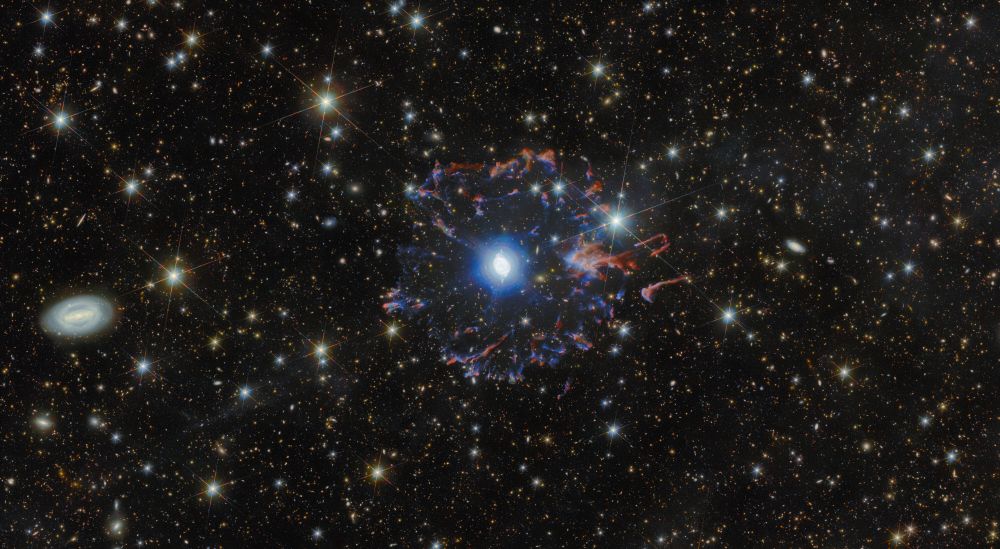 Euclid's wide field of view places the Cat's Eye Nebula in context. While it doesn't put the nebula's internal structure on display as well as other telescopes, it shows a halo of clumps and streamers of gas moving rapidly away from the nebula. This halo was ejected long ago, before the Wolf-Rayet star at the center of it all ejected the gas shell that makes up the nebula itself. Image Credit: ESA/Hubble & NASA, ESA Euclid/Euclid Consortium/NASA/Q1-2025, J.-C. Cuillandre & E. Bertin (CEA Paris-Saclay), Z. Tsvetanov. Licence: CC BY-SA 3.0 IGO or ESA Standard Licence
The Cat's Eye Nebula gets all this attention for an obvious reason: It's one of the most, if not the most, detailed and complicated nebulae we know of.
In the Hubble's new optical light image, the inner detail is clear. Though it looks orderly, the inside of the nebula is shaped by chaotic interactions between winds and jets. These shocks create an internal turmoil, where colliding winds and and jets create what looks like a bubbling, convective surface. The billowing folds are made of gas ejected by the star, mostly hydrogen and helium, but also carbon, oxygen and nitrogen. Dense knots of gas form where winds slam into each other.
It's possible that a binary star sits in the center of the nebula and generates its complexity. If a pair of stars are interacting and transferring mass, that would create an accretion ring. That, in turn, would create astronomical jets, which would change direction over time. These jets would slam into the previously ejected gas, and may even be escaping from both ends of the nebula.
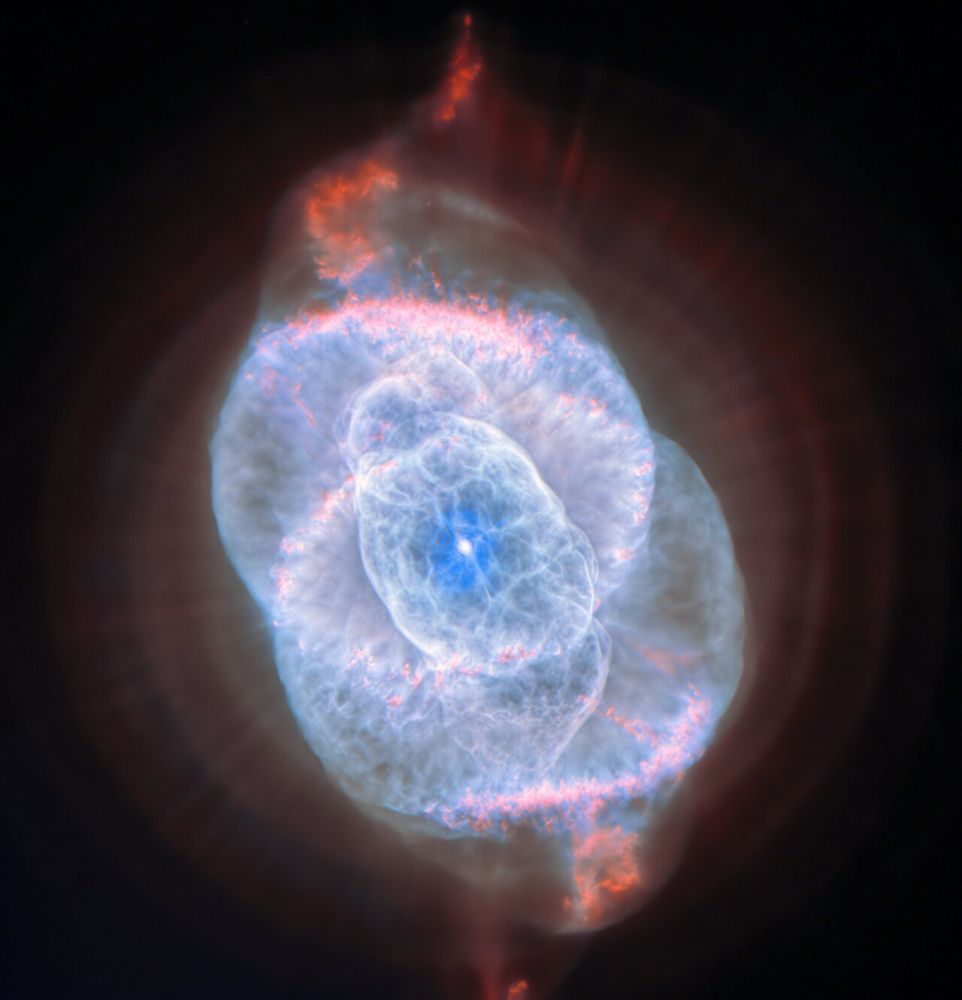 The new Hubble image shows the Cat's Eye Nebula in great detail. It's possible that a binary star sits in its center. That would explain some of the object's complexity. Image Credit: ESA/Hubble & NASA, Z. Tsvetanov
The Hubble has a long history of observing nebulae. In fact, its observations revealed their inner complexity like no previous observations had. The space telescope's images of the Cat's Eye from 1995 opened a door to understanding these objects.
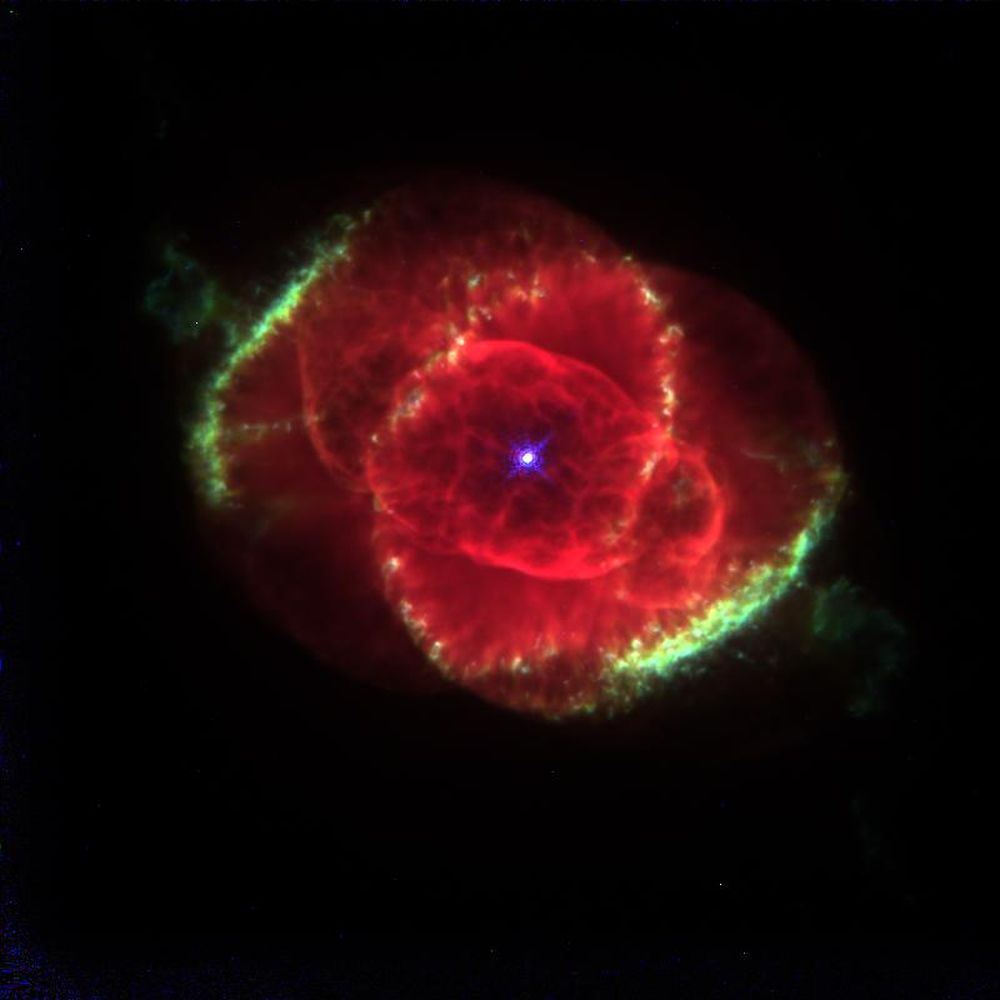 This Hubble image of the Cat's Eye Nebula is from 1995. It's a composite image made of three images captured with the telescope's Wide-Field Planetary Camera 2. Hubble's new image is much sharper and was captured with the High Resolution Channel sub-instrument on its Advanced Camera for Surveys (ACS). The ACS was installed on the Hubble in 2002. Image Credit: J.P. Harrington and K.J. Borkowski (University of Maryland), and NASA
As cosmic objects go, Cat's Eye is not very old. It's faint outer halo is thought to be between 5,000 and 7,000 years old. The brighter inner shell captured in such great detail by the Hubble is only about 1,000 years old. The concentric inner rings were probably ejected about every 1,500 years or so.
Since nebulae like these only last for several tens of thousands of years, maybe up to 50,000, Cat's Eye is not very old. It's first light reached us about 1,000 years ago, during a Golden Age of Islamic science and astronomy. Now we're observing it at what might turn out to be the end of a Western Golden Age of science and astronomy.
The Cat's Eye Nebula is destined to be observed for many more millennia, assuming humanity lasts that long. Over time it will dissipate, its gaseous shells, filaments, and clumps will become less defined. Eventually, the inner star, or stars, will become more visible. If it's a single star, it will continue to shed mass until it becomes a white dwarf, radiating only remnant heat.
The white dwarf will take tens of billions of years to cool, and will outlast humanity, Earth, the Sun, and our entire Solar System. So we might as well enjoy it while we can.

