Universe Today
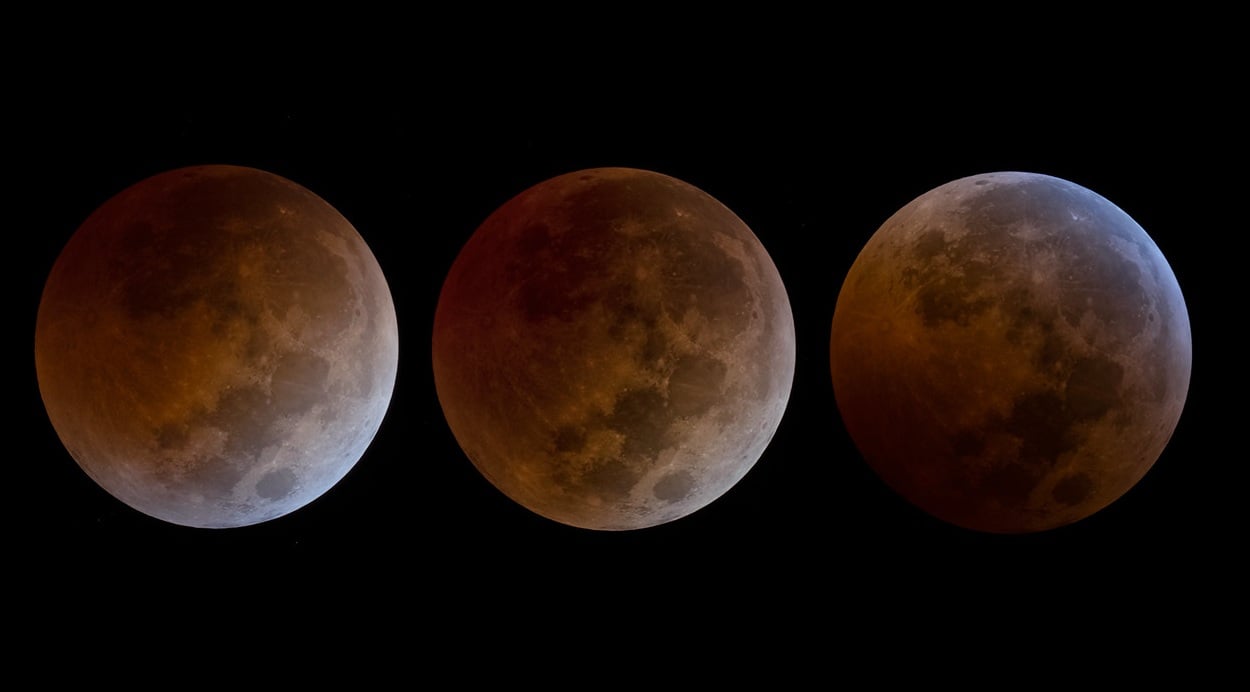
Don’t miss the only total lunar eclipse of 2026, this coming Tuesday.
If skies are clear, don’t miss one of the top astronomical events of the year this coming Tuesday, March 3rd, as the Moon passes through the Earth’s shadow in a total lunar eclipse. This will be a fine leisurely affair centered around the Pacific Ocean region, with totality lasting almost an hour in duration. For many observers worldwide, this is the last total lunar eclipse until late 2028 and mid-2029.
Tuesday’s eclipse is the climax for the first of two eclipse seasons for 2026. The season kicked off with the annular solar eclipse across Antarctica on February 17th.
This is also the only total lunar eclipse in 2026. The second season features a total solar eclipse across Greenland, Iceland and Spain on August 12th, and a 93% partial lunar eclipse on August 28th for the Americas and the Atlantic region. The last total lunar eclipse occurred on September 7th, 2025, and the next one favoring the Americas isn’t until June 26th, 2029.
This eclipse series juuuust misses completing a lunar eclipse tetrad of four total lunar eclipses in succession, with two in 2025 and one (plus a deep partial) in 2026. Remember the hype around the ‘Blood Moon’ tetrad way back in 2014-2015?
Times and Circumstances for the Eclipse
Tuesday’s eclipse is centered on the Pacific region, crossing the International Date Line. This means that Australia and eastern Asia sees the eclipse transpire at sunset/moonrise on the evening of March 3rd, while most of the Americas sees the eclipse go down late Monday night on March 2nd into early Tuesday morning March 3rd for eastern North America at moonset/sunrise.
Eastern Australia, New Zealand, Japan, far eastern Russia, Hawaii, Alaska and NW North America all see the eclipse in its entirety. Across the remainder of the US and Canada totality is either underway or ends just before moonset.
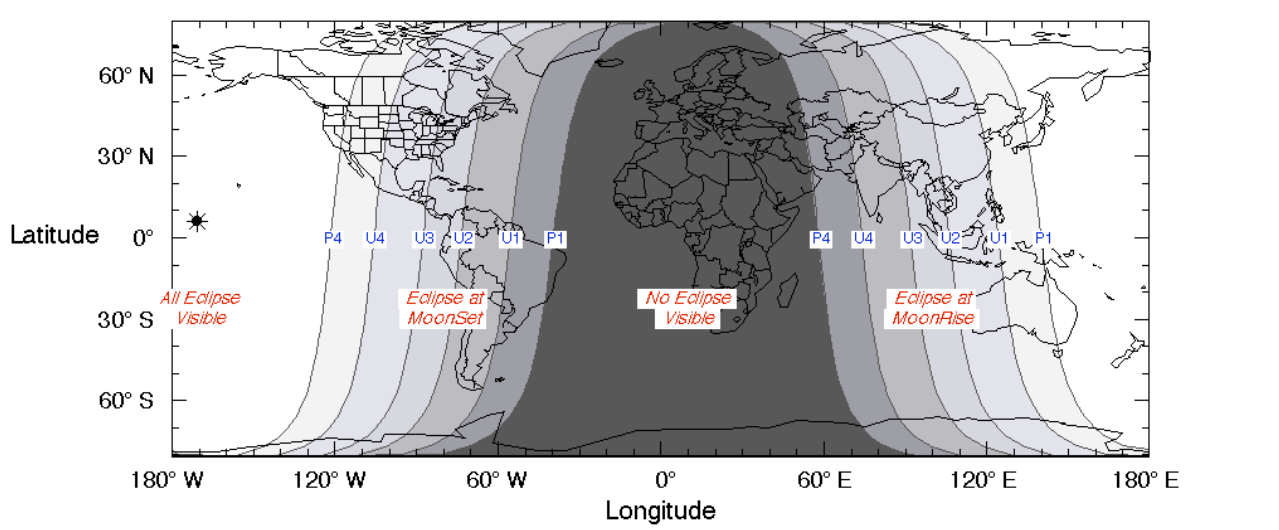 The visibility regions for Tuesday's total lunar eclipse. credit: NASA/GSFC/Fred Espenak.
The very start of the eclipse (P1) denotes the Moon’s first contact with the bright outer penumbral shadow of the Earth. Don’t expect to see much more than a tea-colored shading on the Moon 30 minutes or so into the show. Would you even notice the impending eclipse, if you didn’t know better?
First contact with the inner umbral shadow (U1) marks the start of partial phases of the eclipse. The Earth’s shadow is three times the size of the Moon at the same distance. You’re seeing the curve of the Earth revealed in its shadow, visible proof that the planet you’re standing on is indeed round.
Full immersion (U2) of the Moon inside the umbral shadow is where the show really begins. The Moon dims, and may turn any shade from a bright cherry to dull brick red. This color is known as the lunar eclipse's Danjon number, and can vary considerably based on the amount of dust and aerosols currently suspended in the Earth’s atmosphere. This is the ‘Blood Moon’ of modern eclipse -meme fame, the red of a thousand sunsets around the rim of the Earth, refracted into the cone of the planet's shadow and cast back on the Moon.
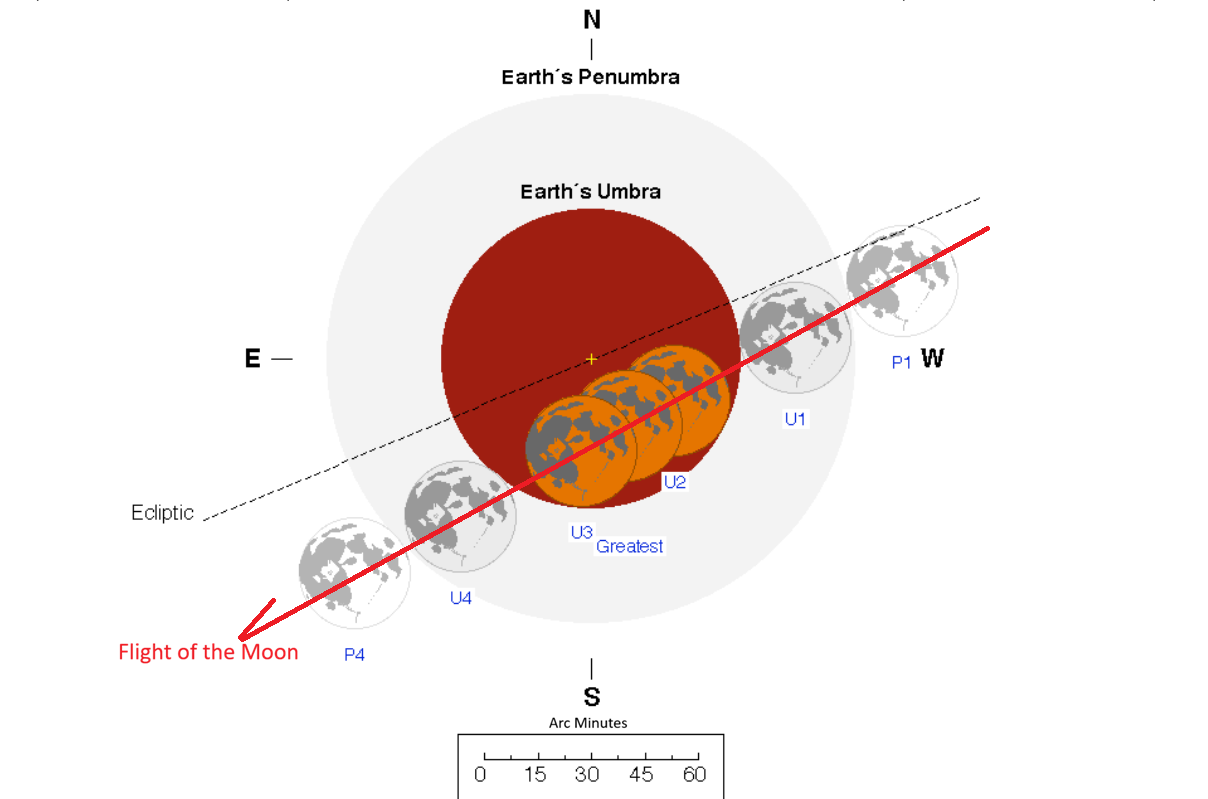 The path of the Moon through the Earth's shadow during the March 3rd eclipse. Credit: NASA/GSFC/Fred Espenak.
Standing on the lunar surface during totality Tuesday, you’d see a total solar eclipse. Though no human has yet to witness this view from the lunar surface, Blue Ghost caught the scene during the total lunar eclipse on March 14th, 2025.
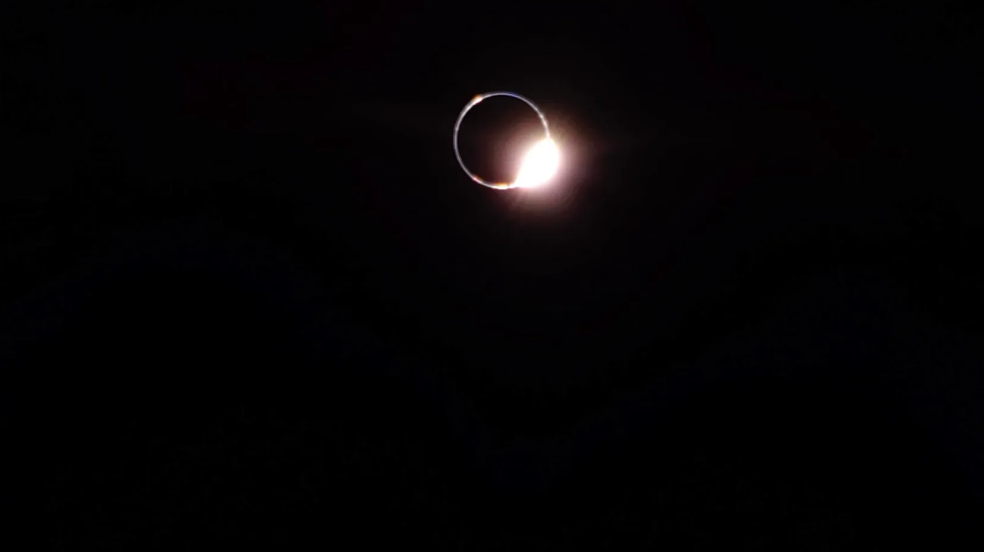 Blue Ghost witnesses totality from the surface of the Moon. Credit: Firefly Aerospace.
Artemis II just missed its chance to see the same from cis-lunar space, as the launch has now slipped to April 1st.
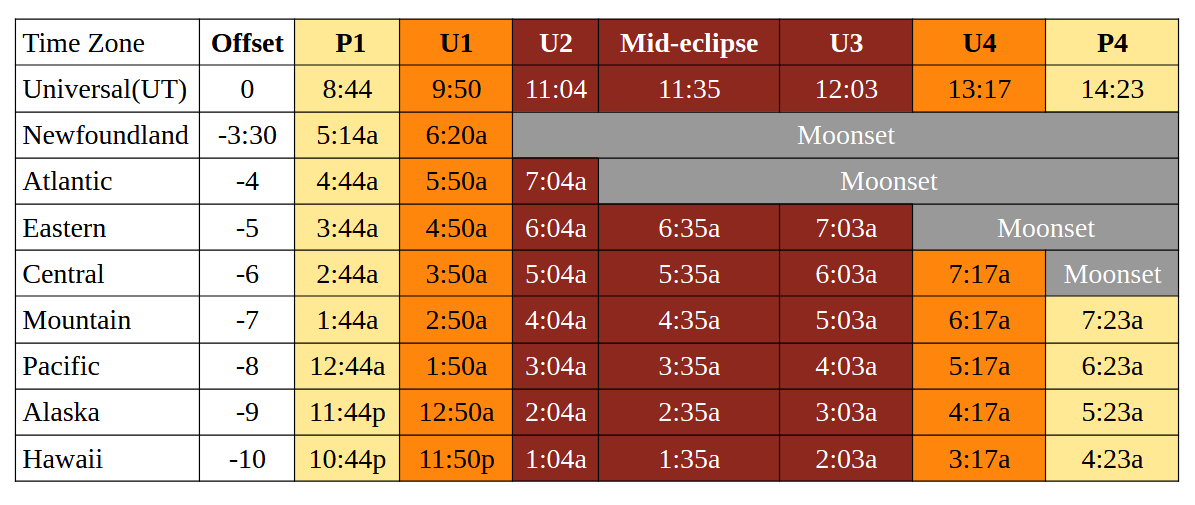 Times for key events for Tuesday's total lunar eclipse. Credit: Dave Dickinson.
The entire eclipse, from the start until the end of the penumbral phases is 5 hours 38 minutes 37 seconds long, while totality is 58 minutes 19 seconds in duration.
Eclipses are the happy result of our single large Moon. There isn’t another spot of solid ground in the inner solar system that you could stand on and see totality, though you could see fast total solar eclipses from the surface of Jupiter’s major moons as they pass one in front of the other during mutual transit eclipse season.
The Moon actually sits in the corner of the non-zodiacal constellation Sextans the Sextant when Tuesday’s eclipse occurs. Fun fact: the Moon’s orbit is inclined five degrees versus the ecliptic, which is the plane of the path of Earth’s orbit around the Sun. This is why eclipses happen in biannual seasons; otherwise, we’d see a solar and lunar eclipse every lunation. But this also means the Moon can stray into six extra constellations in addition to the 12 zodiacal constellations: Orion, Auriga, Ophiuchus, Corvus, Crater and Sextans.
Unlike many astronomical events, lunar eclipses are easy to observe. You don’t need any special gear to simply look at the Moon, though a telescope or binoculars will certainly enhance the view. You don’t even need a pristine dark clear sky, just a good view of the Moon peeping through gaps in the clouds will do. And unlike a total solar eclipse which happens over a narrow and often remote track, the whole hemisphere of the Earth that’s currently turned Moonward gets to enjoy a total lunar eclipse.
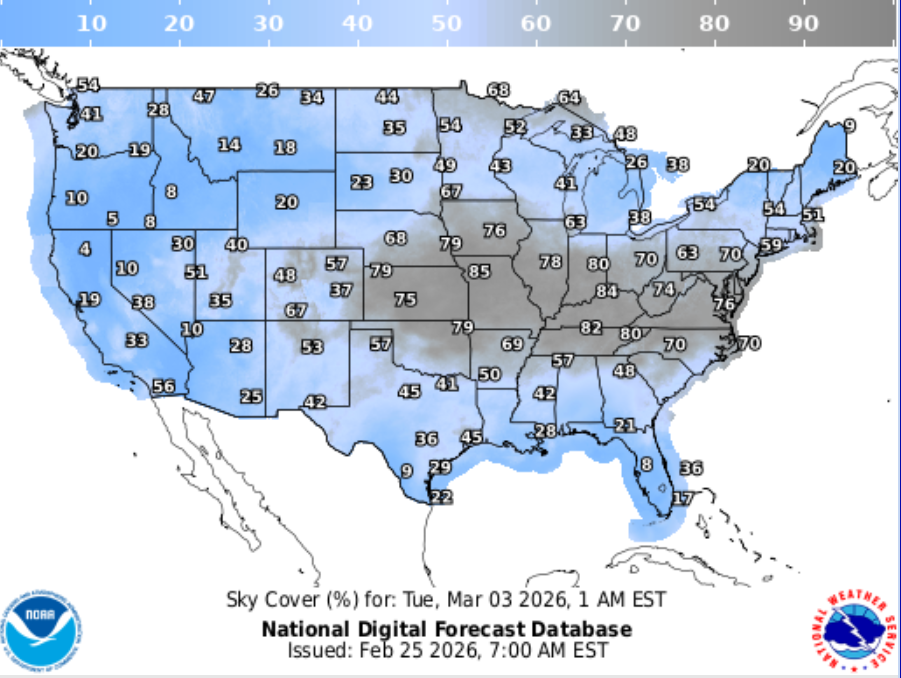 Cloud cover prospects for the CONUS, leading up to Tuesday morning's total lunar eclipse. Credit: NASA/NOAA
Regions around the edge of the visibility area also have a chance to witness something special: a chance to see the eclipsed Moon linger just above the horizon along with the rising or setting Sun hanging opposite in the sky. This is known as a selenelion. A few factors such as refraction are at play here, but this works primarily due to the fact that the Earth’s shadow is larger than the Moon, giving it a few extra minutes of hang time. You'll need an elevated site and a low unobstructed horizon to catch this rare sight.
Tales of the Saros
This eclipse is member 27 of the 71 lunar eclipses in saros series 133, which started all the way back on May 13th, 1557. This particular saros began producing total lunar eclipses on December 28th, 1917. If you caught the February 21st, 2008 total lunar eclipse, then you saw the last member 26 of the same cycle.
The last total lunar eclipse for the cycle occurs on August 3rd, 2278, and the saros wraps up for good with a barely perceptible penumbral eclipse on June 29th, 2819 AD.
Tales of Totality
Total lunar eclipses were always seen as omens of ill will, though civilizations going all the way back to the Greeks and the Babylonians had working knowledge of how to predict eclipses. One famous example was the partial lunar eclipse of May 22nd, 1453 which preceded the Fall of Constantinople by a just a few weeks, and was said to fulfill prophecy. Of course, with multiple eclipses a year, its always easy to pin your Earthly problems on the Moon.
Clouded out, or simply live in the wrong hemisphere? Astronomer Gianluca Masi and the Virtual Telescope Project will carry the eclipse live early Tuesday morning starting at 8:30 Universal Time (UT).
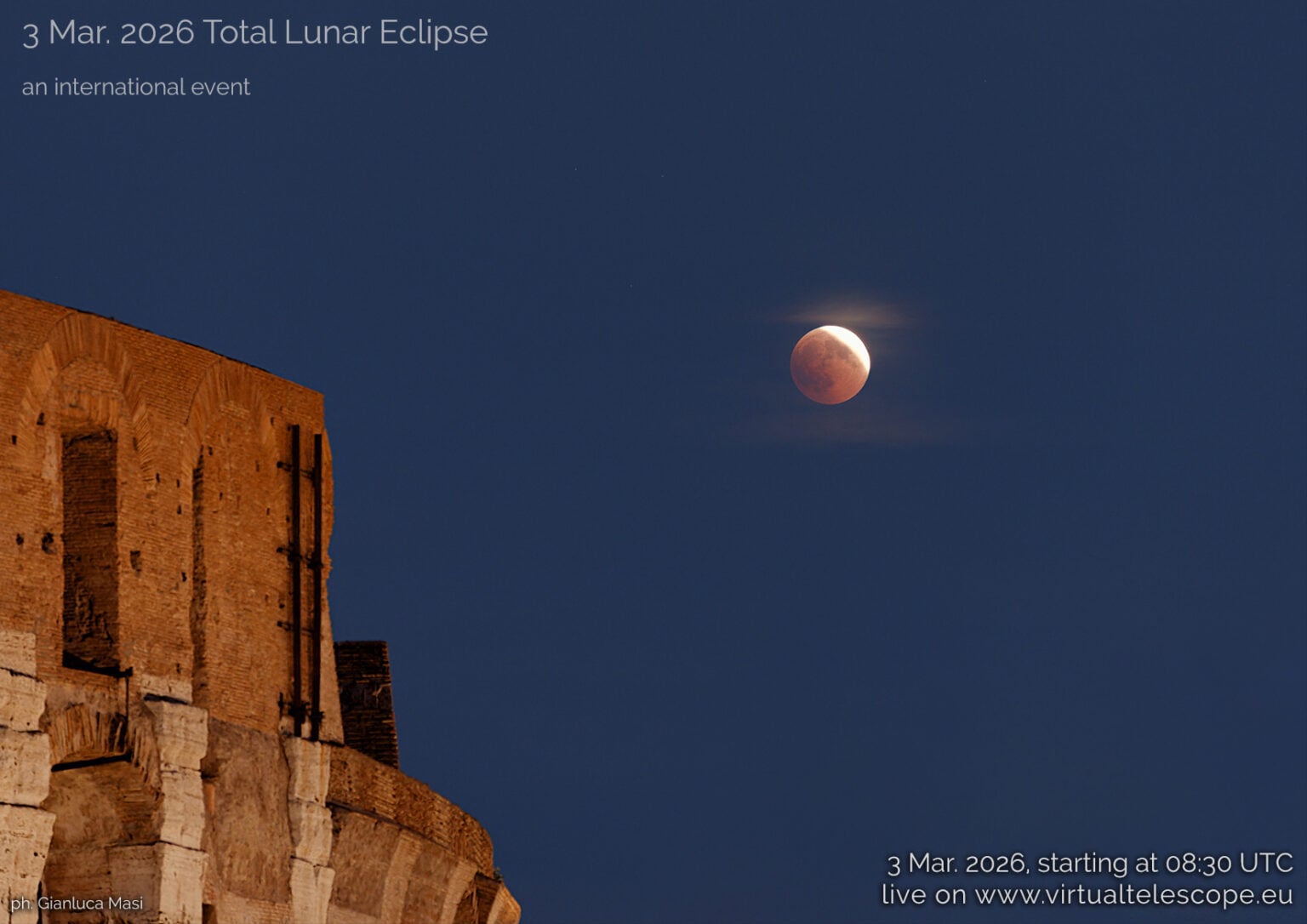 An eclipse over Rome. Credit: Gianluca Masi.
A total lunar eclipse is a free celestial show for all, definitely worth staying up late or getting up early for. Don’t miss the show!