Universe Today
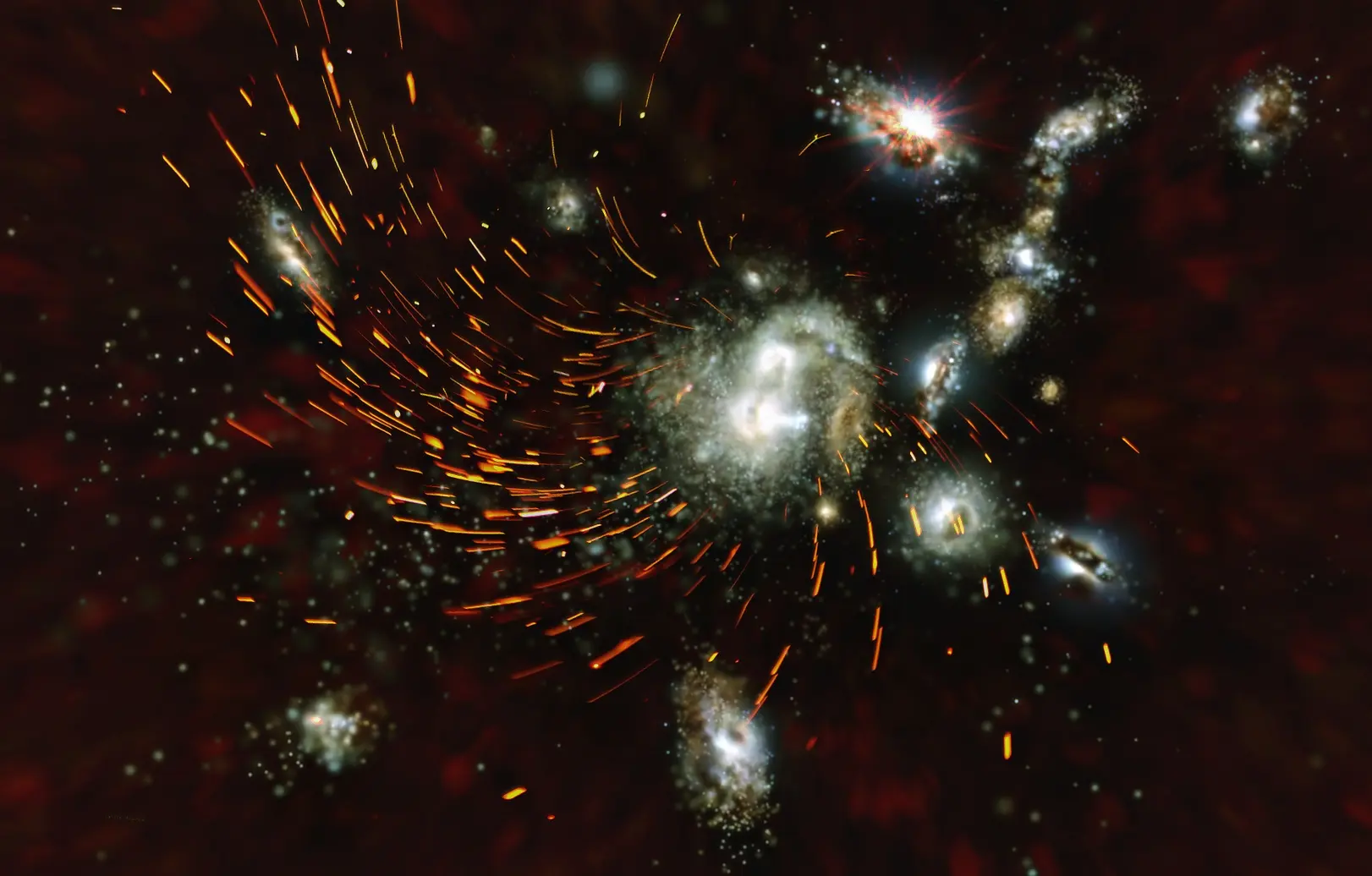
When the venerable Hubble Space Telescope made its Deep Fields studies of the early Universe, it discovered something that would puzzle astronomers to this day. When the Universe was just a few billion years old, it was already populated by several large galaxies. This mystery only deepened with the deployment of the James Webb Space Telescope, which observed an abundance of bright galaxies that existed even sooner. For astronomers, this begged the question of how such massive and evolved galaxies could exist shortly after the Big Bang.
To address this mystery, a team from the Max Planck Institute for Radio Astronomy (MPIfR) used data from the Atacama Large Millimeter-submillimeter Array (ALMA) to observe the center of SPT2349-56. This extremely massive protocluster of galaxies was observed by the Atacama Pathfinder Experiment (APEX) just 1.4 billion years after the Big Bang. There, they observed four tightly-interacting galaxies that were forging new stars at a prodigious rate. Their findings suggest that giant elliptical galaxies may have formed through the rapid collapse of infant galaxy clusters.
The team behind this discovery was led by Nikolaus Sulzenauer, a PhD researcher at the MPIfR and the University of Bonn. He was joined by an international team from universities and institutes worldwide, including the Herzberg Astronomy and Astrophysics, the Harvard-Smithsonian Center for Astrophysics, the Flatiron Institute's Center for Computational Astrophysics, the Enrico Fermi Institute, the European Southern Observatory (ESO), NASA's Jet Propulsion Laboratory, and multiple universities. Their study, "A massive core for a cluster of galaxies at a redshift of 4.3," appeared in the journal Nature.
According to conventional thinking, astronomers expected to find only young stars and galaxies with high levels of star formation so early in the Universe. Instead, they observed many elliptical galaxies with older stellar populations and little new star formation. Predominantly accepted cosmological models suggest that there has not been enough time for massive, elliptical galaxies to form. Nikolaus Sulzenauer, a PhD researcher at the MPIfR and University of Bonn and the lead author on the study, explained in an MPIfR press release:
In a Universe where larger galaxies grow hierarchically through gravitational interactions and mergers of smaller building-blocks, some giant ellipticals must have formed completely differently than previously thought. Instead of slowly assembling mass throughout 14 billion years, a massive elliptical galaxy might swiftly emerge in just a few hundred million years.
It can form through the collapse and coalescence of a major primordial structure, in the time it takes the Sun to orbit around the Milky Way’s center once. We find that the structures with the very highest densities must have decoupled first from the Universe’s expansion at only 10% of the current cosmic age, and then rapidly assembled entire protoclusters.
SPT2349-56 offers astronomers a rare glimpse of the earliest galaxy clusters, as it holds the record for the highest rate of stellar formation in the early Universe. Using ALMA, the team observed the cold gas and dust in the center of the protocluster, the material from which new stars form. There, they observed four tightly interacting galaxies ejecting giant tidal arms of ionized gas clouds at velocities of around 300 km/s (186 mi/s), stretching over an area much larger than the Milky Way. In the submillimeter wavelength, the brightness of these arms was boosted tenfold by shock-heated waves that excited the ionized carbon atoms in the clouds.
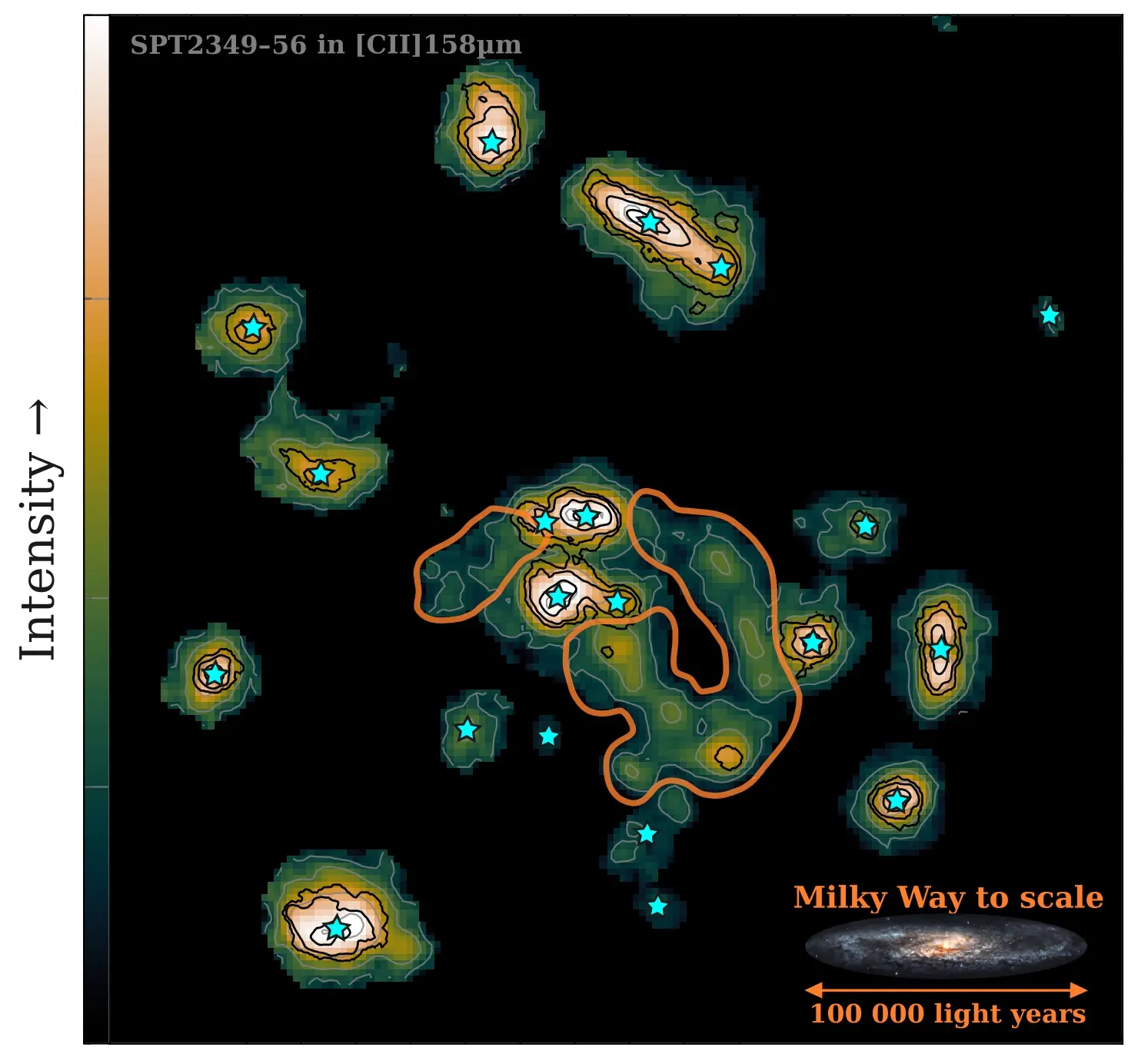 This radio image of the protocluster SPT2349-56 shows the intensity of ionized carbon (CⅡ) emitted at a wavelength of 158 micrometers. Credit & ©: N.Sulzenauer/MPIfR
To their surprise, they observed new stars forming at a rate of 1 every 40 minutes, whereas it takes a full year for a handful of new stars to form in the Milky Way today. As Sulzenauer noted:
This bright emission allowed us to precisely measure the motion of gas in this gravitationally ejected spiral, resembling beads on a string encircling the protocluster core. To our surprise, clumps of tidal debris link to a chain of 20 additional colliding galaxies in the outer parts of the collapsing structure.
This hints at a common origin. For the first time, we are witnessing the onset of a cascading merging transformation. Most of the 40 gas-rich galaxies in this core will be destroyed and will eventually transform into a giant elliptical galaxy within less than 300 million years – a mere blink of an eye.
The team was aided by detailed numerical simulations run by two undergraduate students from the University of British Columbia. These matched the ALMA observations with previous studies of older galaxy clusters, indicating that simultaneous major mergers have occurred throughout cosmic history. Their findings may also help explain how heavier elements, such as carbon (one of the fundamental building blocks of organic chemistry and life), are heated and transported throughout early galaxy clusters. Said Scott Chapman, a researcher from Dalhousie University and a lead author of the study:
While our findings offer exciting new insights into rapid elliptical galaxy assembly, the various interactions between the merger shocks, gas heating from the growth of supermassive black holes, and their effect on the fuel for star-formation, remain big mysteries. It might be too early to claim a full understanding of the ‘early childhood’ of giant ellipticals, but we have come a long way in linking tidal debris in protoclusters to the formation process of massive galaxies located in today’s galaxy clusters.
Further Reading: MPIfR