 Universe Today
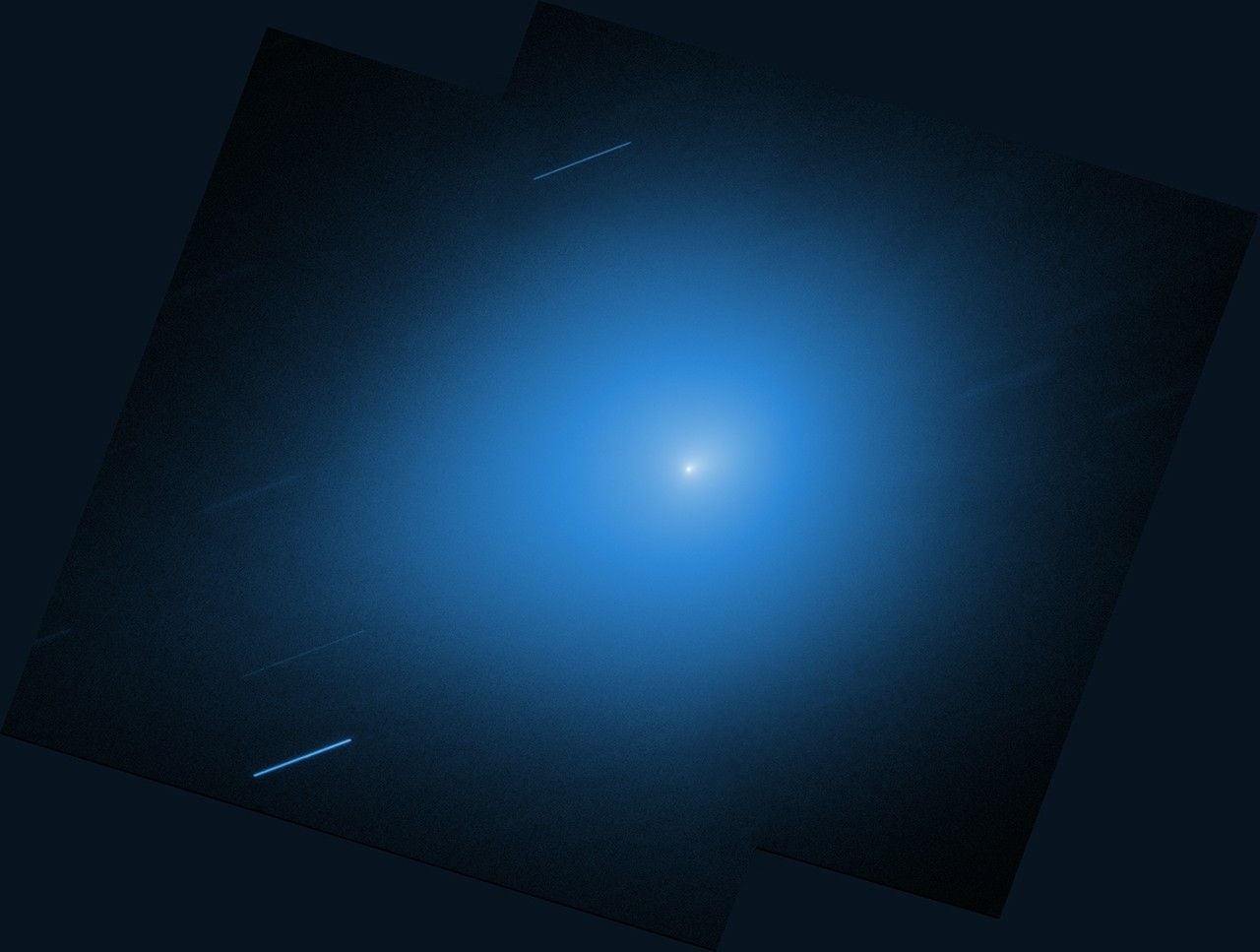
There’s been plenty in the news about 3I/ATLAS over the course of the past 8 months. Our third confirmed interstellar visitor went behind the Sun during its closest approach, but reemerged in December with plenty of eyes watching it. Papers describing what it looks like following its closest brush with the power of a star in probably billions of years are starting to come out, including a new one available in pre-print on arXiv from Carey Lisse of Johns Hopkins University and his co-authors, which shows how much the comet - and it is definitely a comet - has changed in the matter of only a few months.
Their observational tool of choice is NASA’s SPHEREx observatory, which launched in March last year only a few months before 3I/ATLAS’s discovery. Its primary mission is to map the entire sky in near-infrared every six months, but it has a secondary mission of tracking “targets of opportunity”. 3I/ATLAS is one such object - and a great test of SPHEREx’s observational capability of a fast moving target.
During a preliminary observational run in August last year, SPHEREx was watching 3I/ATLAS closely - and not seeing much. The interstellar visitor showed very little activity, with only minor outgassing and very little to no water being released at all. The paper mentions that is most likely due to the cosmic rays that had been bombarding the comet in interstellar space for the last few billion years. They would have created a “shell” of process material devoid of volatile ices that would easily sublimate.
Fraser goes into all the latest science on 3I/ATLAS - as of October 2025But the Sun had begun blasting this rock with more than just cosmic rays, and as it seems to have finally cracked it open. During SPHEREx’s next observational run at the comet, around December of last year, it showed significant changes that proved the thermal wave of energy from our star broken through its protective crust.
One of the most notable features was water - it skyrocketed to nearly 40 times what the water production level was when it was observed in August. Carbon dioxide was another outlier, with production jumping to 80 times the original reading. Even the ratio of carbon monoxide to carbon dioxide changed to 2.5 - a more typical reading of the carbon-monoxide dominant comets we see in our own solar system.
But it wasn’t just the regular water and carbon/oxygen combinations. There were other volatiles too - most notably a rich soup of organic molecules, which likely included methanol, formaldehyde, methane, and ethane, which are hard to distinguish in the spectrographic signature of SPHEREx’s data. A new feature, that wasn’t present at all in the August data, was a spectral line at 0.925um - which shows that the comet is also outgassing cyanide.
Fraser discusses 3I/ATLAS’s perihelion, and what it means for the comet.The levels of this outgassing are such that the authors think the comet is evaporating before our eyes as it passes as close to as star as it has, possibly in its billions of years of existence. The shape of the outgassing appears :”pear-shaped” - literally in this sense rather than figuratively. The “stem” of the pear is pointing toward the Sun, but there is no anti-sunward tail, which normally forms when small particles are pushed via radiation pressure. The authors believe this is because the particles that form the comet’s halo aren’t actually small enough to be pushed around by radiation - and are likely on the order of centimeter or even decimeter size.
So this really is what it’s like watching a mult-billion year old comet die. It doesn’t seem likely the 3I/ATLAS will completely disintegrate before it leaves the solar system to carry on its interstellar journey. It is, at this point, traveling away from the Sun, and our star’s energy directed toward it will slowly diminish. It should escape intact, but not before SPHEREx itself will have one final observational window to watch our retreating visitor in April. There’s sure to be plenty more papers to come about this unique observational opportunity.
Learn More:
C.M. Lisse et al. - SPHEREx Re-Observation of Interstellar Object 3I/ATLAS in December 2025: Detection of Increased Post-Perihelion Activity, Refractory Coma Dust, and New Coma Gas Species
UT - 3I/ATLAS's Coma Is Largely Carbon Dioxide
UT - Hubble Catches Another Glimpse of 3I/ATLAS
UT - NASA Finally Releases Images of 3I/ATLAS Taken by Its Missions at Mars

