Universe Today
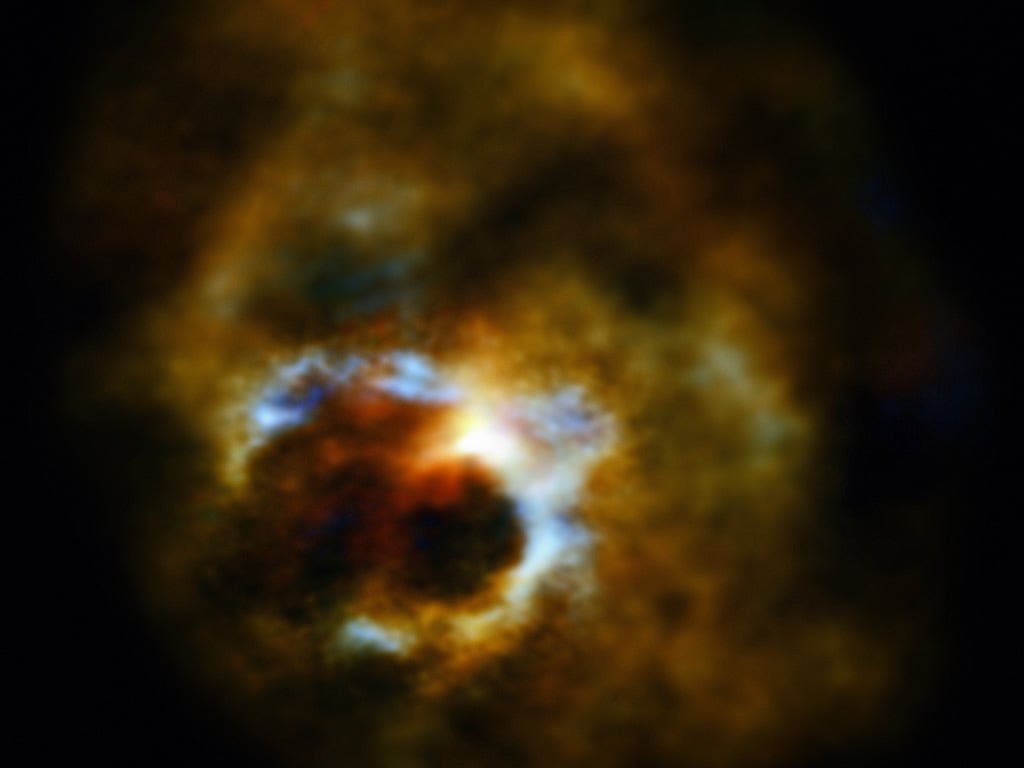
Just a few hundred light-years from Earth, the famous variable star Mira A is huffing and puffing its outer layers to space. Its most recent mass-loss event ejected more material at higher velocity than in past events. A team of astronomers led by Theo Khouri of Chalmers University in Sweden discovered two large asymmetrical clouds of material expanding away from Mira A.
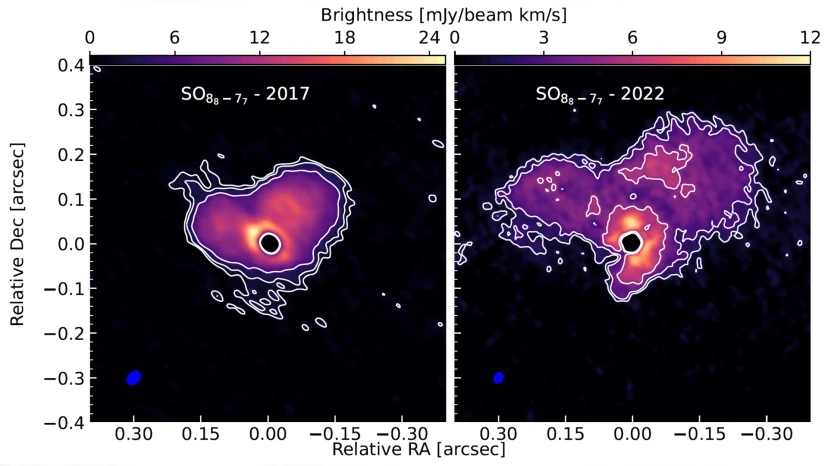
These appeared in observations done by the Very Large Telescope and ALMA telescopes in South America in 2015 and 2023. Those clouds form two lobes of a cosmic "heart" shape surrounding the star. That structure is basically a cloud of dust at the edges, filled by gas from the star, and astronomers are studying the cloud material and the star itself to understand why it's so large, thick, and asymmetrical.
That cloud contains about seven times the mass of the Sun, which is several hundred times more than the star's usual mass-loss ejections. The density of the cloud came as a surprise. “We know that stars like Mira lose mass as they age, but we did not expect it to happen in such large and sudden bursts,” said Theo Khouri, who headed up the study and is lead author on a paper detailing his team's observations. Their aim was also to characterize the star's recent mass ejections using observations of the inner envelope of gas inside the two lobes of the cloud in order to get more details of the mass ejection process.
Exploring Mira A and its Cloud
Mira A is an easy-to-spot star in the tail of the constellation Cetus, the Whale. It's a variable red giant, and the changes in its brightness are due to regular pulsations of its surface. It's also the prototype of other old, red stars that pulsate in much the same way. Astronomers dub them "Mira variables." As part of its death throes, Mira periodically ejects material to space. The clouds of "star stuff" contain heavy elements considered the building blocks of planets and potentially of life. Mira A has a companion, called Mira B. The cloud expanding from Mira A should be interesting to watch as it spreads out. “We will keep monitoring the expanding cloud around Mira A, as it is becoming so large that it may start to affect its companion star, the white dwarf Mira B. It is already gathering some of the material ejected by Mira A”, said Khouri,
 Gas forms a heart-shaped cloud around the star Mira A, while dust seems to be confined almost exclusively to the outer edges. Courtesy Theo Khouri.
Mira A's outburst can give more information about how stars like Mira A and others between 1 and 8 solar masses change as they evolve into old age. The recent unusual outburst gives astronomers a lot to think about. “We were very surprised to see this structure. We also see that the star’s illumination of the surrounding dust varies in an unexpected way, which implies that the star acts like a lighthouse – illuminating its environment unevenly”, said Khouri.
Two Scenarios for Mira A's Outburst
In their paper, Khouri and colleagues suggest that if ejection events like this one are periodic and indeed contribute to the overall mass loss that Mira A has experienced, the associated timescale would be between 50 and 200 years between outbursts. Diving deeper into the chemistry and physics of these outbursts should provide further insight into stars in the asymptotic giant branch as their mass loss events continue. Their outbursts make major contributions to the enrichment of the interstellar medium and its chemical evolution. The cause of the outbursts is well-accepted as radiation pressure acting on dust grains in the immense atmospheres of these stars. Convection in the star and stellar pulsations provide conditions where those grains can form in the outer layers of the star.
In their analysis of the cloud expanding away from Mira A, Khouri and his team looked at two scenarios to explain what's happening. The first scenario tries to account for all the mass that Mira A has ejected so far, which is about equivalent to one Earth mass every decade. Interestingly, the star also has a tail of material made primarily of gas and dust) that stretches out across 13 light-years. That tail has been 30,000 years in the making, which helps put some constraints on how often and how long Mira has been losing mass. Khouri and colleagues suggest that ejections from Mira A that created the two-lobed heart-shaped cloud were probably from the same event and began somewhere between 2010 and 2012. A second scenario implies a very explosive ejection, possibly coincidental to an X-ray outburst around the same time frame. There's still a lot of work to do to understand which scenario is actually occurring. Eventually, Mira A will blow off its entire outer structure and settle down to become a slowly cooling white dwarf star. Until then, its outbursts will continue to provide clues to the process that stars like Mira A experience as they die.
Implications for the Sun
Red giant stars like Mira A give a premonitory look at what our Sun will become in a few billion years. As it exhausts the hyd rogen in its core, the Sun will start to fuse helium into heavier elements. That will heat up the Sun, causing it to swell and eventually experience its own mass-loss through ejections of gas and dust. It will join the ranks of previous stars who went through the same aging process, scattering their chemical elements to interstellar space for the next generations of stars and planets.