Universe Today
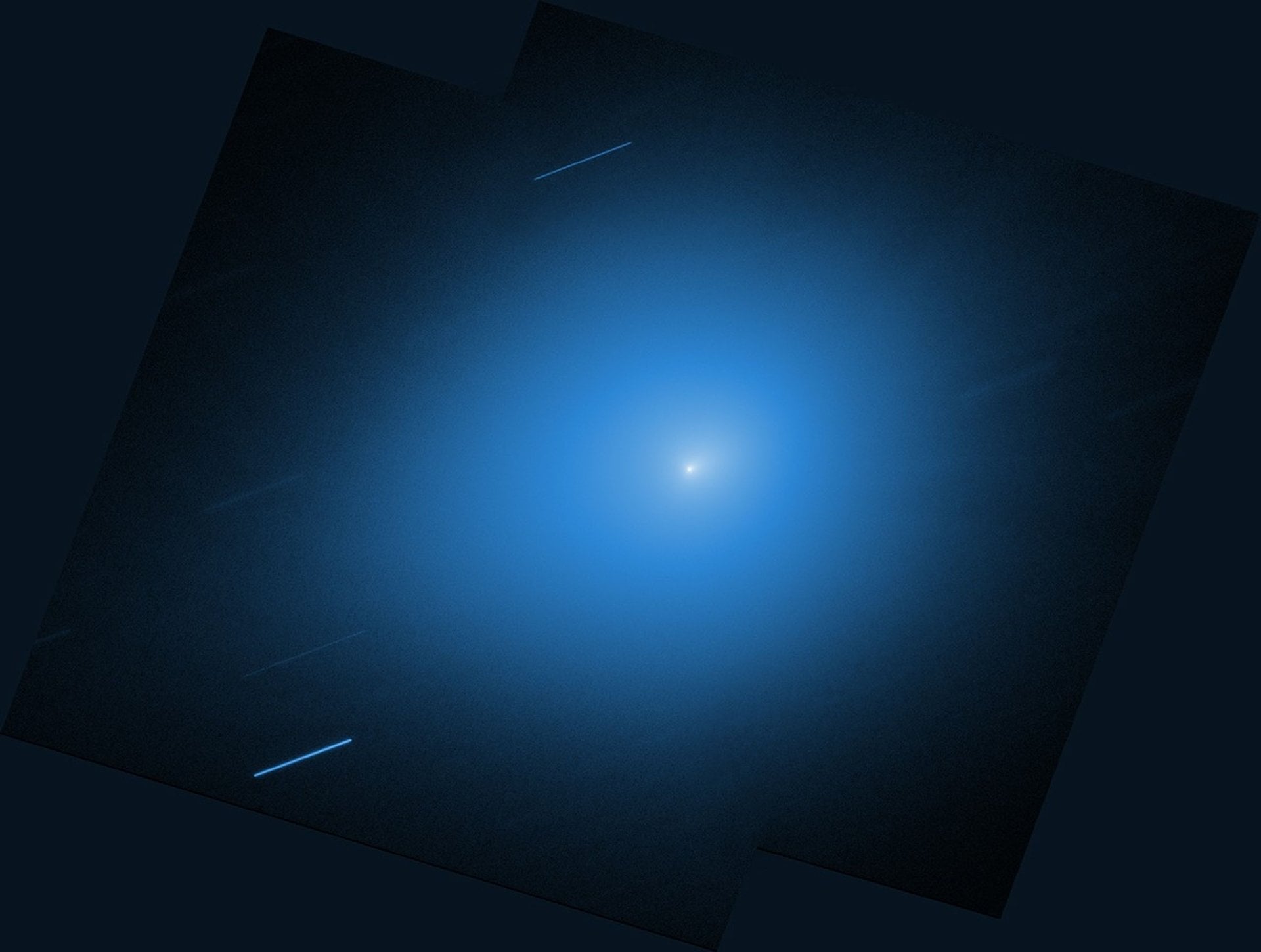
On July 1st, 2025, the third interstellar object (ISO) ever detected was seen making its way through our Solar System. Shortly after being alerted by automated detection systems, astronomers at the European Space Agency (ESA) began using observatories in Hawaii, Chile, and Australia to get a better look at the interstellar interloper. Since then, 3I/ATLAS has been observed by multiple space observatories, including the venerable NASA/ESA Hubble Space Telescope. On Nov. 30th, Hubble viewed the ISO again, which is about to make its closest approach to Earth.
Observations made since early November, when 3I/ATLAS emerged from behind the Sun, have provided an even better look at the comet as its outgassing has increased. During these most recent observations, Hubble tracked the comet from a distance of about 286 million km (~178 million mi) using its Wide Field Camera 3 (WFC3). In one week (Dec. 19th), it will make its closest pass to Earth, coming within a distance of 269 million km (167.1 million mi), roughly 1.798 times the distance between the Earth and the Sun.
Astronomers at the ESA have been monitoring 3I/ATLAS with every observatory and mission at its disposal. This has included the ESA's XXM-Newton, JAXA's X-Ray Imaging and Spectroscopy Mission (XRISM), and the NASA/ESA/CSA James Webb Space Telescope (JWST). When the ISO flew past Mars in October, the ESA dedicated observing time from its Mars Express, ExoMars Trace Gas Orbiter (TGO), and the Jupiter Icy Moons Explorer (Juice) to gather more data.
While confirming that 3I/ATLAS is indeed a comet, these observations have also revealed some unusual features. These include a composition that is rather high in carbon dioxide, low concentrations of water, and atomic nickel vapor. Its large size and near-ecliptic trajectory were also curious, but still within the confines of known comet behavior. 3I/ATLAS is currently on an outbound trajectory and is expected to cross Jupiter's orbit in the spring of next year, and is expected to be out of range of Hubble and the JWST by the end of 2028.
Further Reading: ESA