Universe Today
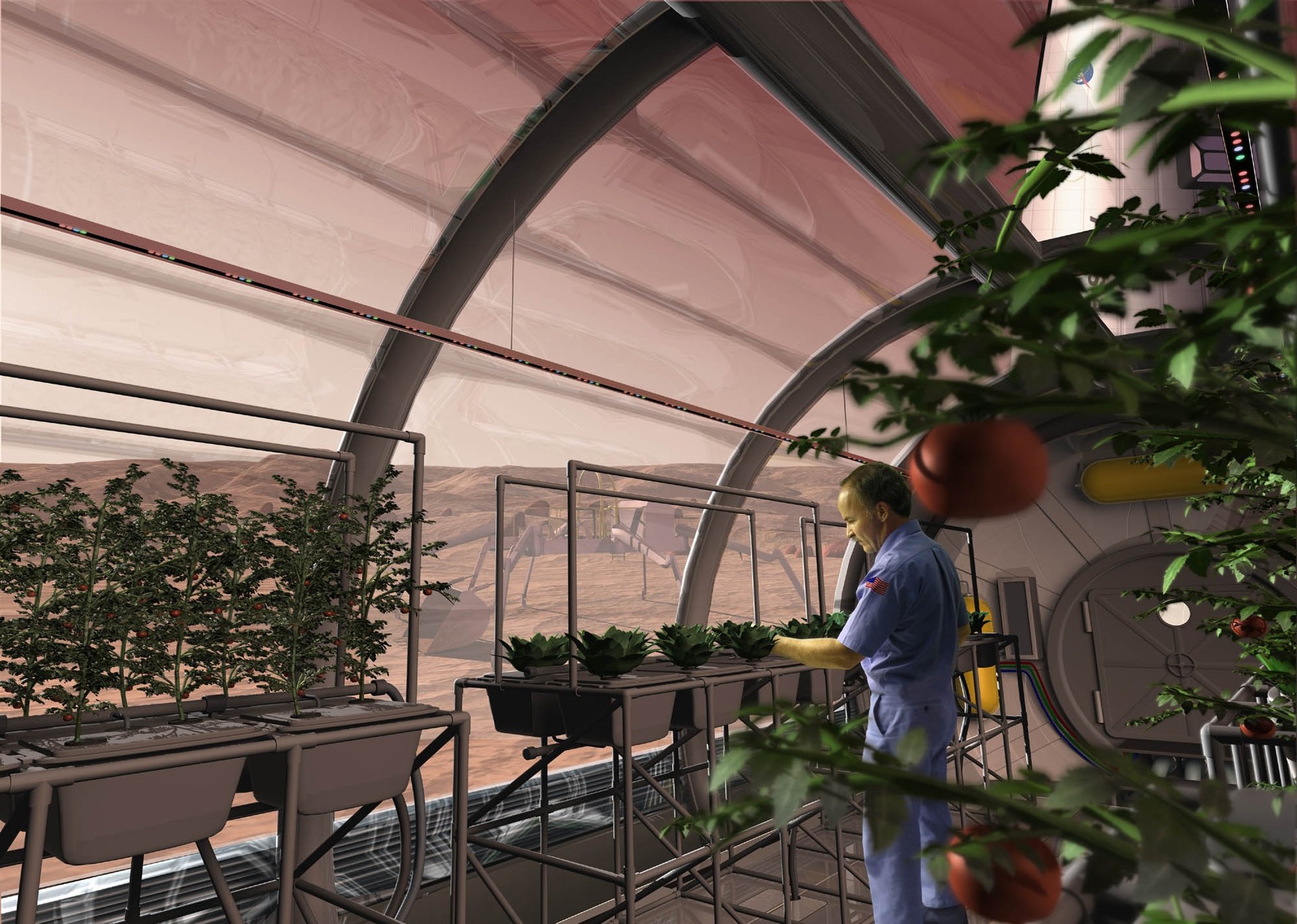
In the future, farmers on the Moon and Mars will have a big challenge: how to grow healthy food in two extremely unhealthy environments. That's because the soil on both worlds isn't at all hospitable to plants and animals. Neither are other conditions. Both are irradiated worlds, Mars has a thin atmosphere and the Moon has none at all. So, how will future colonists on either world grow their food?
We could look toward the example shown by Matt Damon in "The Martian". There, a stranded Marsnaut figures out how to grow potatoes using his own sewage, which turns out to be do-able according to experiments run by the International Potato Center and NASA few years ago. More recently, researchers led by Harrison Coker of Texas A&M worked with a team at NASA, tested a solution of recycled sewage products and how they interacted with simulated lunar and Mars regolith (soil). The NASA team, headquartered at Kennedy Space Center, is taking a deep look at what are called bioregenerative life support systems (BLiSS). These bioreactors and filters turn an artificial form of sewage into a solution rich in the kinds of nutrients that plants need to thrive. This work has immediate implications for people who will be living and working on the Moon and Mars in the future. That's because people can easily furnish the waste products needed. With the upcoming Artemis missions to the Moon, the question of food production is assuming a high priority for long-term inhabitants.
“In lunar and Martian outposts, organic wastes will be key to generating healthy, productive soils, said Coker, the first author on a study of such systems. “By weathering simulant soils from the Moon and Mars with organic waste streams, it was revealed that many essential plant nutrients can be harvested from surface minerals.”
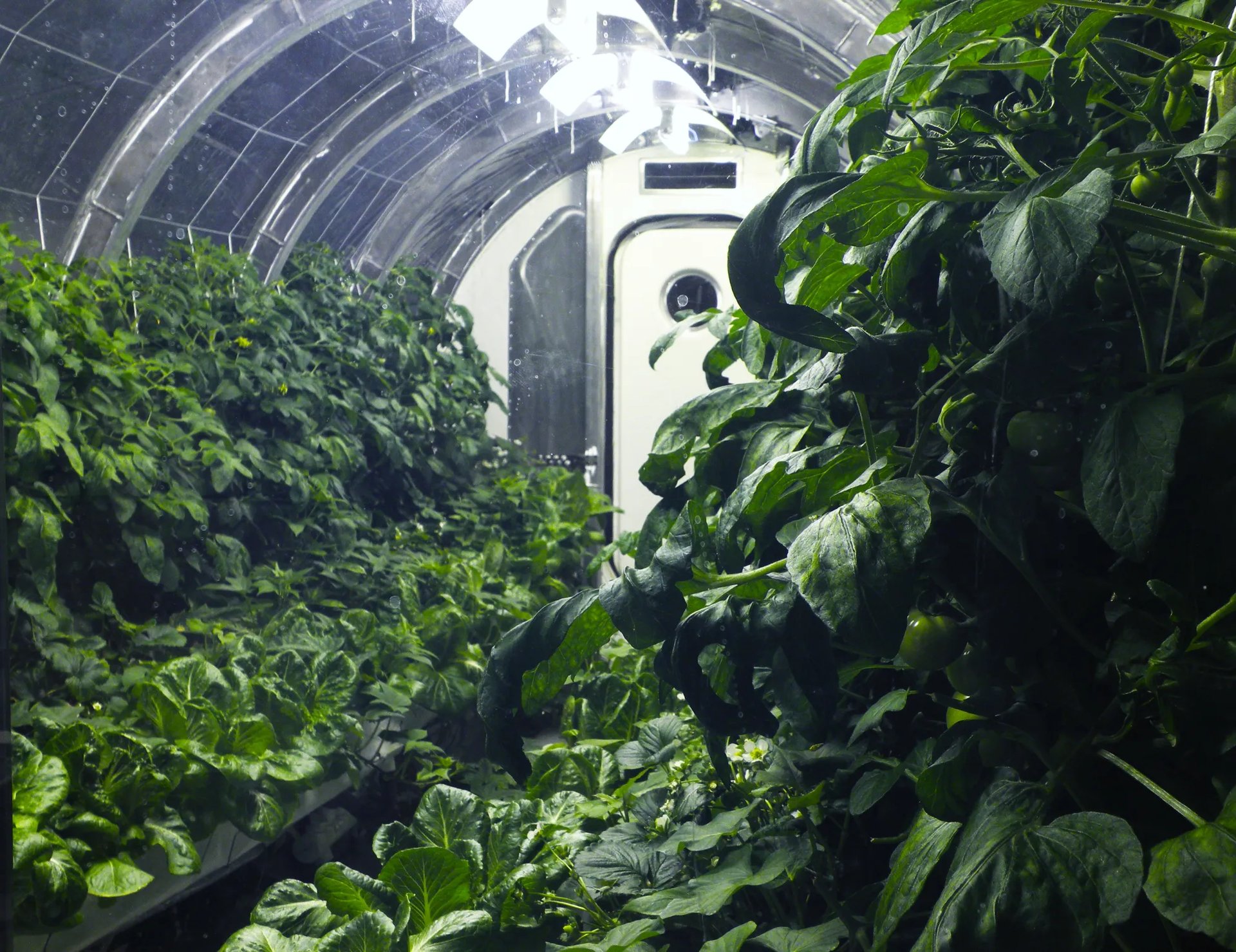 A simulated lunar greenhouse at NASA Kennedy Space Center is helping scientists solve the problem of growing food on the Moon, and ultimately Mars. Courtesy NASA.
What Do Plants Need?
The plant life on Earth needs a complex set of nutrients to thrive. For example, corn needs a great deal of nitrogen. Peas like potassium and phosphorus. Potatoes like both phosphorus and nitrogen. And, all planets need water. The researchers looked at what it would take to "enrich" Martian and lunar regoliths. It turns out, they need a lot. That's because the soils are irradiated and in the case of Mars, rich in sulfur, ferric oxide, silicon dioxide, and magnesium. It's also laced with high levels of perchlorates, which are toxic.
The first inhabitants of these worlds will need to bring their own food and sewage systems, and then work on making the local soils habitable for plants. That will take time and a lot of work, in addition to all the other projects they'll need to fulfill, such as exploration and habitat building.
Of course, the future inhabitants could rely on hydroponics for a growth medium, and there have been a great many studies of such water-based systems. However, you do need a lot of water and the nutrient loads need to be quite high to produce food in great quantities. On the Moon, at least, astronauts could send back to Earth for supplies, but that's going to be expensive and time-consuming. So, it's likely that the first sets of explorers will depend on food from "home". However, that can't be a permanent solution, which is why scientists are looking at ways to make local soils good for farming in the long run.
 Studies of food growth in space go back many years. A variety of red potatoes called Norland were grown in the Biomass Production Chamber inside Hangar L at Cape Canaveral Air Force Station in Florida during a research study in 1992. Credit: NASA
Better Farming Through Sewage and Chemistry
In the research led by Coker and the folks at NASA, scientists combined the BLiSS effluent they created with simulated Martian or lunar regolith (each called a simulant). Then, they stored the two different solutions in a shaker for 24 hours. The goal was to determine if the BLiSS effluents could essentially "weather" the regolith and provide a nutrient-rich growing solution.
It turns out that the weathered simulants supplied large amounts of essential plant nutrients. They including sulfur, calcium, and magnesium, and other metals, when interacting with both water and BLiSS solutions. In addition, looking at the simulant particles under a microscope revealed weathered features such as tiny pits forming in the lunar simulant and the Martian simulant becoming covered in nanoparticles. Both helped make the sharp minerals in the simulant less abrasive, showing successful weathering and a step toward a more soil-like material.
So, is recycling human sewage the solution for better off-world gardens? Not quite. Despite promising initial results, the next steps would need to include tests on actual lunar and Martian regoliths. They're quite different from the simulants the scientists tested. It's a good start, though, and provides crucial insights into a process that will be critical for sustaining human colonies in outer space. It may not be long before lunar citizens are snacking on watercress sandwiches and Mars colonists are growing their own corn, beans, and yes, potatoes, thanks to their own effluent products.
For More Information
How Recycled Sewage Could Make the Moon or Mars Suitable for Growing Crops
Human Exploration Beyond Low Earth Orbit: Staged Evolution of BLiSS Technologies