 Universe Today
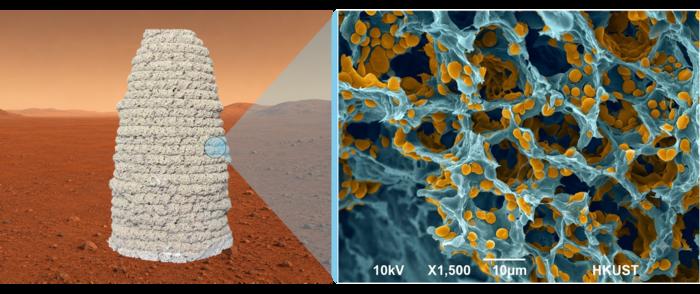
If we are ever to have a permanent presence on Mars, we will have to learn to build there. Shipping the material from Earth to build something as simple as a pressurized habitat is prohibitively expensive, so we will have to make sure of the materials available on Mars’ surface. A research team led by Ning Liu at the Hong Kong University of Science and Technology recently published a paper in Chem Circularity that uses biology to do much of the heavy lifting for the structural materials we would typically use concrete for. If their method is adopted, we might quickly find another Earth-based lifeform in abundance on Mars - yeast.
Traditional methods for building Martian infrastructure uses structural materials created through a process called sintering - basically blasting loose Martian regolith with lasers, microwaves, or even sunlight, in order to heat it to around 1,000℃. This creates a material that is mechanically sound, however, it is extraordinarily power intensive. Rough calculations estimate that it would take multiple days of an entire solar panel’s output to sinter together one cubic meter of sintered regolith.
The paper’s concept is simple - instead of using high powered lasers, use yeast to create an Engineered Living Building Material (ELBM). The authors define this as a bio-composite form of concrete using local sand, gelatin, and genetically modified baker’s yeast. One of the most important features of it is that, instead of evaporating into the harsh Martian quasi-vacuum, it actually uses it to cure.
Fraser talks about self-sustaining space habitats with Dr. Annika RollockIn typical terrestrial concrete, Portland cement binds rocks and sand together using water. That approach is obviously not feasible on Mars, as water exposed to the Martian surface will immediately freeze and then sublimate, breaking apart the concrete in the process. Hence why sintering and similar processes that don’t involve water at all are considered necessary alternatives.
But with ELBM, the recipe has a biological twist. The researchers used engineered yeast cells to turn into a type of structural glue. Three major genetic modifications were key to making the ELBM work. First was forcing the yeast to create Mussel Foot Proteins. These proteins, which mussels use to hang on to rocks in the face of ocean tides, act like chemical anchors, giving the yeast the ability to stick directly on the aggregate grains. Second was known as a SpyTag/SpyCatcher system, where different strains of yeast were given a gene to create a molecule “lock-and-key” protein pair, forcing them to create covalent isopeptide bonds that were almost indestructible.
A third modification acted similar to natural anti-freeze proteins. During the freeze cycle that happens when exposed to the Martian vacuum, this ensures any water in the system doesn’t form ice crystals that simply destroy the material’s structure, but instead create a uniform 5-micrometer pore system through the entire material. This has an obvious downside that we’ll get to later, but it does allow the material to use the freeze-drying cycle to cure rather than break apart.
Fraser talks about how to grow habitats on Mars - a NIAC proposal from three years ago.The ELBM isn’t created in the cold vacuum, though. First it has to be mixed at a workable temperature and pressure (37℃). Then, when exposed to the Martian atmosphere, the water used in its mixing leaves the structure, leaving behind the biopolymer skeleton that locks the sand grains in place.
In the paper, the authors describe some prototype testing they did. Notably, the new material had a compressive strength of around 12 MPa - not quite on the level of traditional concrete, but not too far off. But it does have flexural strength of 6 MPa, which is much more than traditional concrete, and crucial for withstanding Martian dust storms. It also noted that the yeast was a critical component, as a control prototype simply peeled away from the sand grains.
This technique has some major technical advantages over the sintering process - most notably it uses almost two orders of magnitude less energy. Since energy is going to be a major constraint for early human infrastructure on the red planet, that is an extremely important feature. Additionally, the resulting material is extremely recyclable - again another useful feature when lacking access to significant amounts of material. The researchers cycled their prototype samples up to four times by warming them to around 45℃ to reliquify the gelatin and then recast them . They didn’t lose any of their structural integrity, and the yeast cells even seemed to survive the Martian freeze-drying cycle.
However, that brings up some of the technique’s weaknesses. Freeze-drying isn’t the only hazard on Mars. Notably, it's unclear whether the yeast would be able to survive in Martian soil, especially because perchlorates and other chemicals that are extremely toxic to biological life are abundant in it. It's also unclear how well the material would stand up to continual ultraviolet radiation Mars is constantly subjected to. Notably, the resultant structural material is porous, meaning it won’t hold air by itself, and will have to act simply as a structural material and meteor protection, but will require an internal membrane to keep air inside any habitat that is built out of it.
Fraser talks about how a realistic Mars colonization scenario would play out.Perhaps most crucially, one of its critical components still must be shipped from Earth. While yeast can, at least in theory, reproduce indefinitely on Mars, gelatin, at this point, must be made on Earth and shipped from it. The authors did run an experiment using just yeast without a gelatin binder, but its strength was notably lower than the hybrid approach.
Admittedly, we’re still a long way off from actually building any structures on Mars itself, no matter what some enthusiastic billionaires will tell you. It remains to be seen what trade-offs will be made in terms of mission mass, structural strength, and other critical features of whatever infrastructure material we decide to use. But knowing there are options isn’t a bad thing - and this technology offers a very new take on what we could potentially use to build on the Red Planet.
Learn More:
EurekAlert / Cell Press - Scientists want to 3D print houses on Mars with the help of yeast
N Liu et al - Engineered living building material for low-energy construction on Mars
UT - Astronaut Blood and Urine Could Help Build Structures on the Moon
