 Universe Today
Gravitational wave astronomy has seen plenty of improvements since the original signal was captured in 2015. Despite that, it remains an engineering challenge to actually create the detectors needed for the precise measurements that gravitational waves require. A new NASA Innovative Advanced Concepts (NIAC) grant is funding a concept from a team led by Paul Stankus at Brookhaven National Laboratory that could potentially solve some of those engineering problems - by using quantum mechanics.
Current gravitational wave detectors fall into one of two categories. Ground based detectors, such as LIGO, which first detected a wave back in 2015, can sense relatively high frequency gravitational waves, in the 10-10,000 Hz range, which are caused by stellar mass black hole and neutron star collisions. Pulsar Timing Arrays (PTAs), on the other hand, detect nano-Hertz level background hums by watching the timing of dead spinning stars over the course of decades. The field is also about to gain a new entrant covering some of the gap between those two extremes - LISA is a space-based interferometer that will detect milli-Hertz waves from supermassive black hole mergers.
But that still leaves a pretty large gap between LISA and the PTAs - somewhere on the order of micro-Hertz. In theory, space-based interferometers like LISA can reach that level of sensitivity. In practice, though, they are an engineering nightmare. Interferometers typically require a physical or optical connection - in the case of a space-based one, that takes the shape of a laser beam. However, that beam has to bounce off of precisely floating mirrors millions of km apart from each other. Maintaining a flawless, continuous physical laser link at those distances is nigh on impossible.
Fraser covers the latest topics in gravitational waves.Stankus’ proposal throws the laser link right out the window - or airlock as the case may be. Instead of measuring the distance between spacecraft and watching for any variation on that distance, the team proposes instead to watch the astrometric signature of the gravitational waves themselves - in other words, they want to watch stars wobble almost imperceptibly based on the gravitational wave rolling through our solar system.
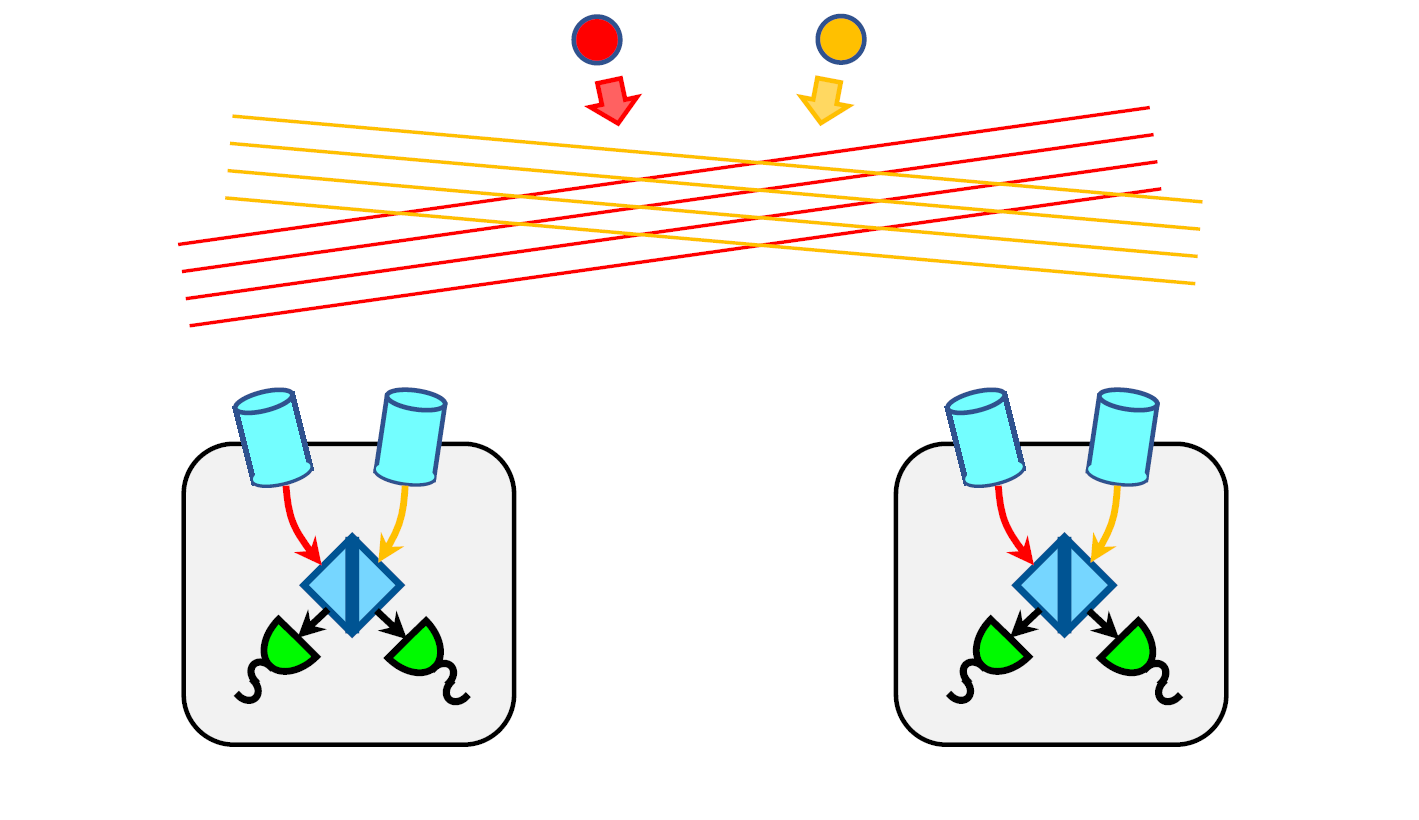
When a gravitational wave approaches, it momentarily warps spacetime, causing all the background stars in the sky to appear to wobble in a tiny, coordinated dance. To measure that wobble, you still need an interferometer, like LISA, but Stankus and his team propose using a quantum phenomena known as the Hanbury Brown and Twiss (HBT) effect, which the team recently reduced to practice in what they’re calling a “two-photon amplitude interferometer”.
To set up this quantum machine, first you have to launch two moderately sized spacecraft into free-fall orbits - with a key feature that they don’t need to be connected by lasers, they can fly entirely independently. Both spacecraft watch a set of stars at the exact same time, and keep very accurate time stamps of everything detected by their ultra-fast single-photon detectors. Those timestamps and photon counts are then sent back to Earth, where supercomputers compare their arrival times. According to the rules of quantum mechanics, photons arriving at the two separate spacecraft will show microscope correlations, known as “quantum bunching”.
Fraser explains how PTAs work.The supercomputers should be able to calculate the phase interference of starlight without the light (i.e. the two separate photons) ever actually touching each other. If the phase shifts, the star’s apparent position wobbles. And if a bunch of them do it in the right pattern, that’s indicative of a gravitational wave.
As with many NIAC proposals, this one sounds like science fiction, with quantum mechanics and single-photon detectors involved. But the team already produced a tabletop version in the lab that works, according to a 2023 paper. Over the next 9 months of their NIAC funding, their goal is to prove the concept is scalable to satellites floating in the void of space. If they manage to pull it off, their technology could underlie an entirely new way to probe some of the darkest secrets in the universe.
Learn More:
Paul Stankus / NASA - Precision Astrometry Using Optically Independent Spacecraft for Graviational Wave Detection
UT - How a Perfect Gravitational Wave Tests Einstein

