Universe Today
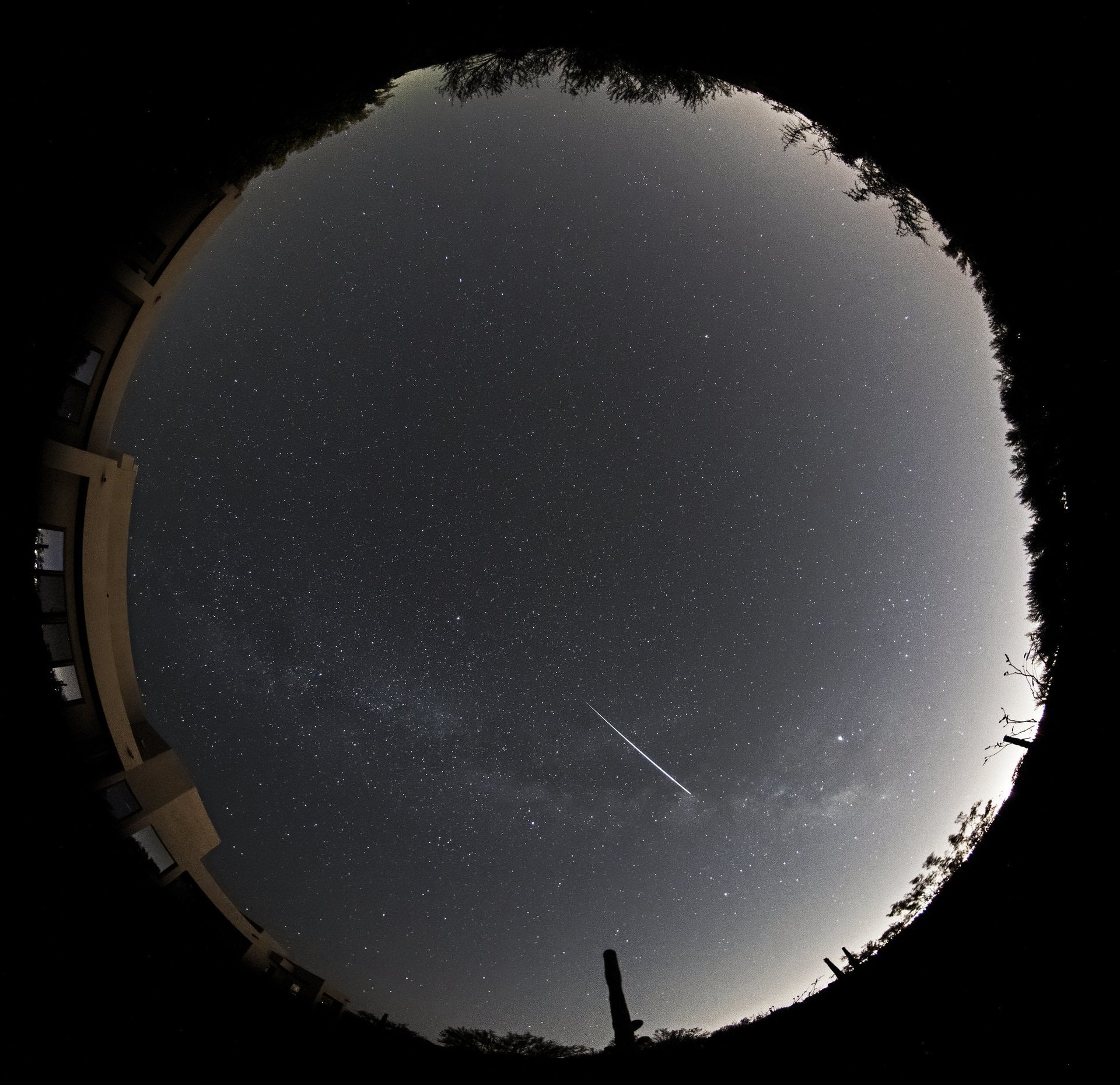
Keep an eye out this coming week for the venerable Lyrid meteor shower.
April flowers mean one thing to springtime sky-watchers: it’s time for the Lyrid meteor shower. The Lyrids are always a good bet, and always make the top ten list for annual meteor showers. And to top it off, 2026 is a favorable year for the Lyrids, with the waxing crescent Moon mostly out of the way.
The shower takes its name from the constellation Lyra the Lyre, the musical instrument wielded by Orpheus in Greek mythology in his ill-fated journey into the Underworld of Hades. The radiant for a meteor shower is the point in the sky where meteors seem to come or ‘radiate’ from. In actuality, this is the point where the meteor stream intersects the orbit of the Earth. The stream is an ancient path of tiny dust particles laid down by a progenitor comet long ago. This is why showers such as the Geminids, Perseids or the Lyrids turn up annually around the same date.
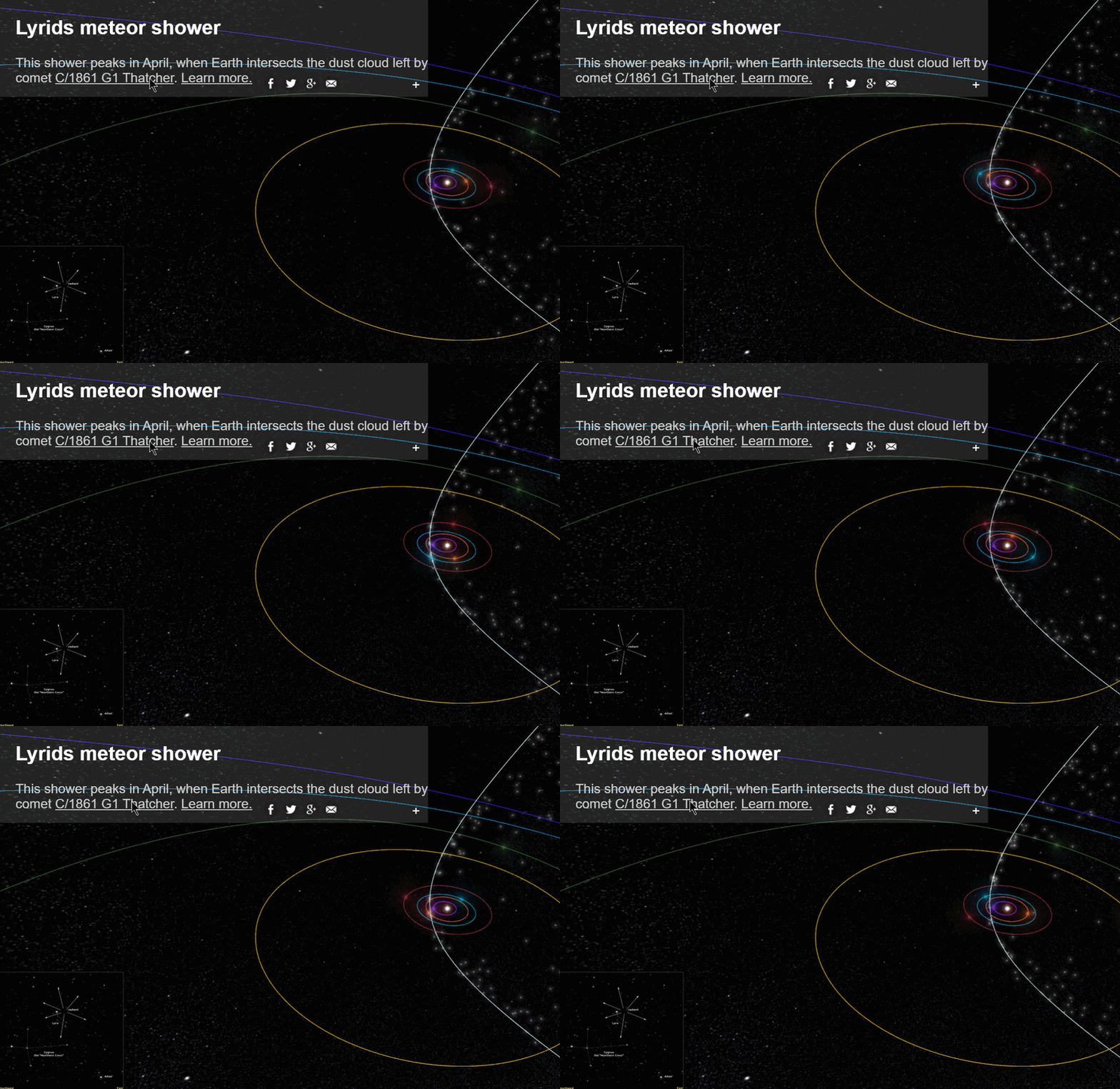 An animation of the Lyrid meteor stream. Credit: MeteorShowers.Org
In modern times, the shower radiant for the Lyrids is actually located across the border of Lyra in the constellation Hercules, very near what's known as the Apex of the Sun’s Way, sometimes known simply as the Solar Apex. Look just a few degrees south of the bright star Vega, (Alpha Lyrae), and you’re staring directly towards the point that the solar system (and Earth along with it) is currently hurdling towards on our journey around the Milky Way Galaxy. We’re moving at 13.4 kilometers per second versus the local standard of rest and the local stars in our galactic neighborhood, Combined, we’re moving at a speed of 220 kilometers per second overall versus the galactic center. Even at that rate, it still takes us about a quarter of a billion years to complete one orbit around our host galaxy.
Prospects for 2026
Feeling dizzy yet? Meteor showers offer a great study of the sky and the cosmos in motion. The 2026 Lyrid meteors night are active from April 14th through April 30th, with a peak set for the night of April 21st-22nd. The Lyrids typically top out at a zenithal hourly rate (ZHR) of 18-20 per hour. The exact peak is set for 20:00 Universal Time (UT)/4:00 PM EDT on April 22nd. This favors eastern Asia at dawn, but keep in mind, the radiant has a high declination of 80º. I’d watch for an uptick in Lyrid activity on April 20th through the 24th, in the late evening through morning.
Like the January Quadrantids, the April Lyrids have a narrow peak, rising above the sporadic background rate (ZHR=5) for just a day or so on either side of the shower’s peak.
The Moon presents a +27% illuminated waxing crescent on the 22nd, setting about four hours after the Sun at just past local midnight. That’s good news for meteor watchers, meaning you won’t have to contend with a dazzling bright Moon during your vigil.
The source for the Lyrids is Comet C/1861 G1 Thatcher. Discovered in 1861, Comet G1 Thatcher is on a 415-year orbit and will reach perihelion again around 2283 AD. The Lyrids are approaching the Earth at a near perpendicular angle with a terminal velocity of about 40-30 miles a second, a medium-to-slow speed compared to other meteor showers. This means that not only will the Lyrids start to pick up before midnight local, but the shower can produce slow, stately meteor trains versus quick flashing streaks. The radiant for the Lyrids rises to the east around 9 PM local.
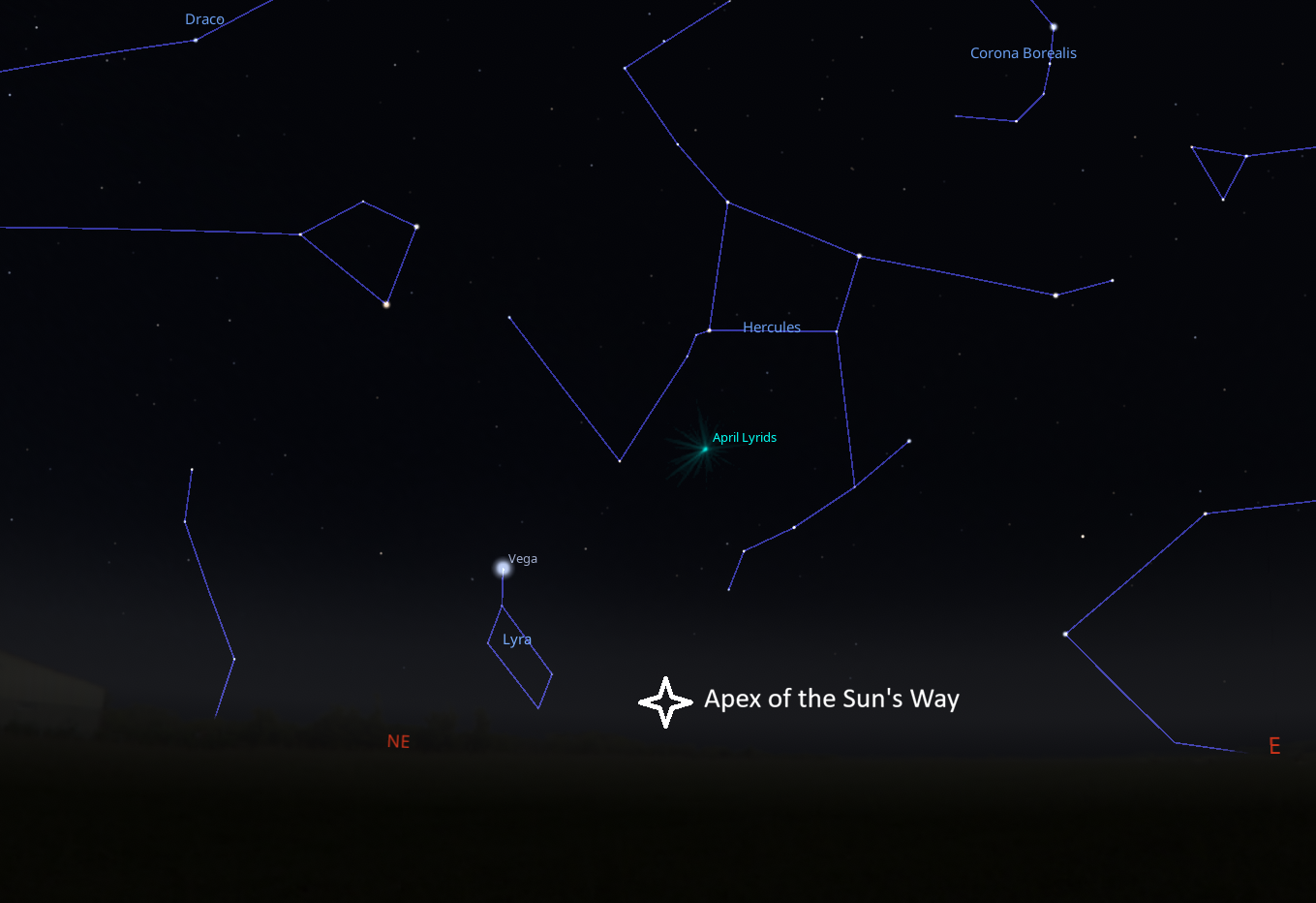 The rising Lyrid radiant. Credit: Stellarium.
Records for the Lyrids go way back. In fact, the shower is one of the oldest meteor showers noted. A Chinese chronicle mentions the shower in 687 BC, back when precession had moved the shower's peak to March. In modern times, the Lyrids have produced outbursts in 1803, 1922 (nearly a 100 per hour) and most recently, 250 per hour in 1982. A journalist based in Richmond, Virginia witnessed the 1803 Lyrid storm, and wrote:
“Shooting stars: this electrical (!) phenomenon was observed on Wednesday morning last at Richmond and its vicinity, in a manner that alarmed many, and astonished every person that beheld it. From one until three in the morning, those starry meteors seemed to fall from every point in the heavens, in such numbers as to resemble a shower of sky rockets.”
Note that the journalist’s report reflects the thinking at the time, that meteors were a purely atmospheric phenomenon.
Clearly, there are other great swarms of meteors out there deep in the Lyrid stream, waiting to reach the Earth. Streams do evolve over time. One example is the now obscure December Andromedids which once produced great meteor storms up until the late 19th century. On the other hand, the annual December Geminid meteors seem to be on the rise, surpassing the August Perseids in recent years as the best annual shower of the year. Whichever direction they’re trending, the Lyrids seem to be a long term and persistent annual shower.
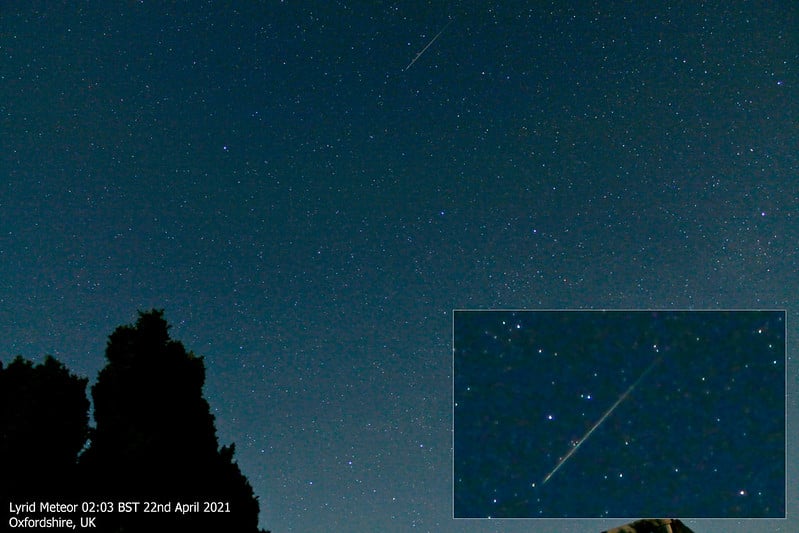 A Lyrid meteor over Oxfordshire, United Kingdom from 2019. Credit: Mark and Mary McIntyre/The Global Meteor Network.
Observing the Lyrids requires nothing more than clear skies and patience. The darker your site is, the more meteors you’ll see. Be sure to scan the sky, as meteors can appear anywhere. Tracing a meteor’s glowing path back to the radiant very near Vega identifies it as a Lyrid.
Bright meteors may even leave persistent trains, lingering for several minutes before fading from view. Though these might seem to be huge fireballs, the very largest meteors in the stream are pea-sized. To date, no meteorite recovered on the ground has ever been linked to a meteor shower.
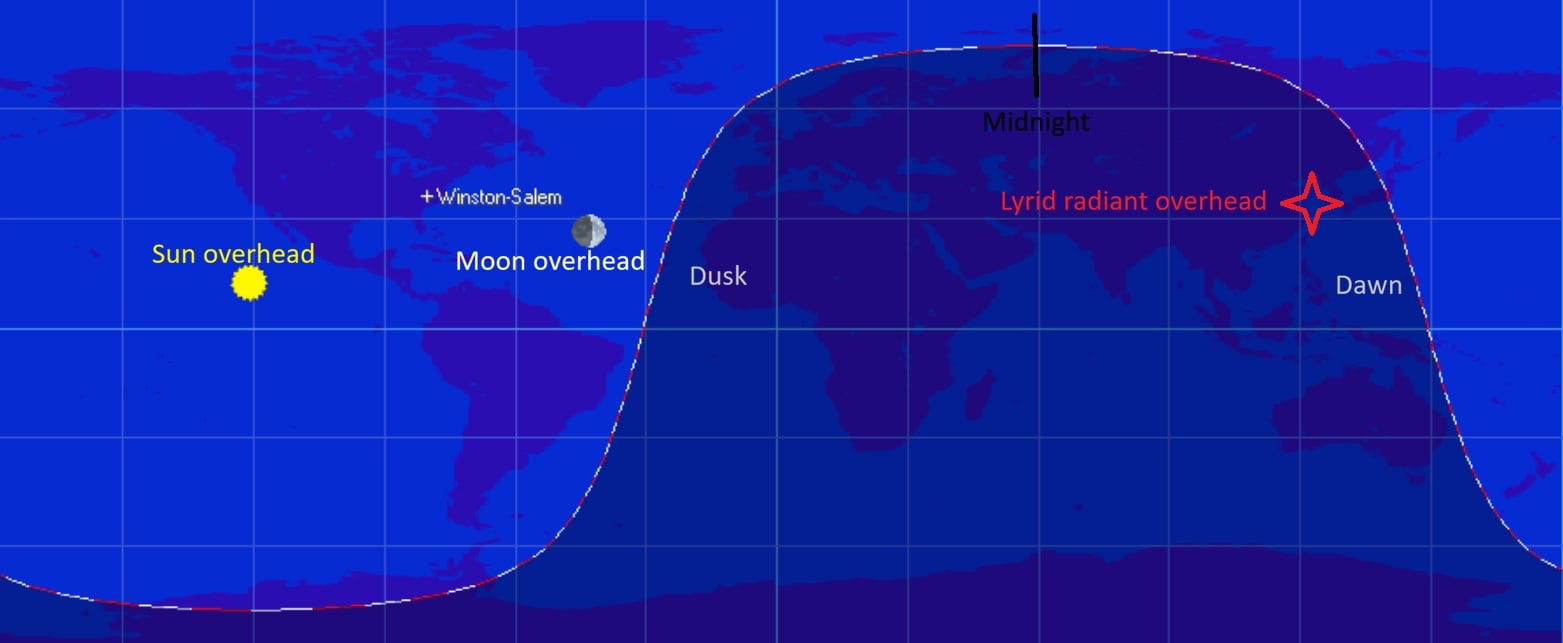 A global map showing the circumstances for the 2026 Lyrids at the shower's peak. Credit: Created by the author using Orbitron.
Also, keep ‘an ear out’ for audible meteors courtesy of a strange phenomenon known as electrophonic sound. Like lightning during a thunderstorm, you can also hear meteors ‘ping’ on the FM dial.
Imaging Lyrids or any meteor shower is also pretty straight forward. Simply set a DSLR camera equipped with a wide field of view lens on a tripod, and take a series of long exposure shots 30 seconds to a few minutes in duration. The goal is to simply ‘get lucky’ and see what turns up. Aim about 45 degrees from the shower radiant to catch the meteors in profile, and take a series of test shots first to get the combination of exposure times versus the ISO/f-stop correct for the current sky conditions. You’ll be shooting in the manual (bulb) mode, meaning that focus is manual as well. I like to use an intervalometer to automate the process, leaving me free to simply sit back and watch the show.
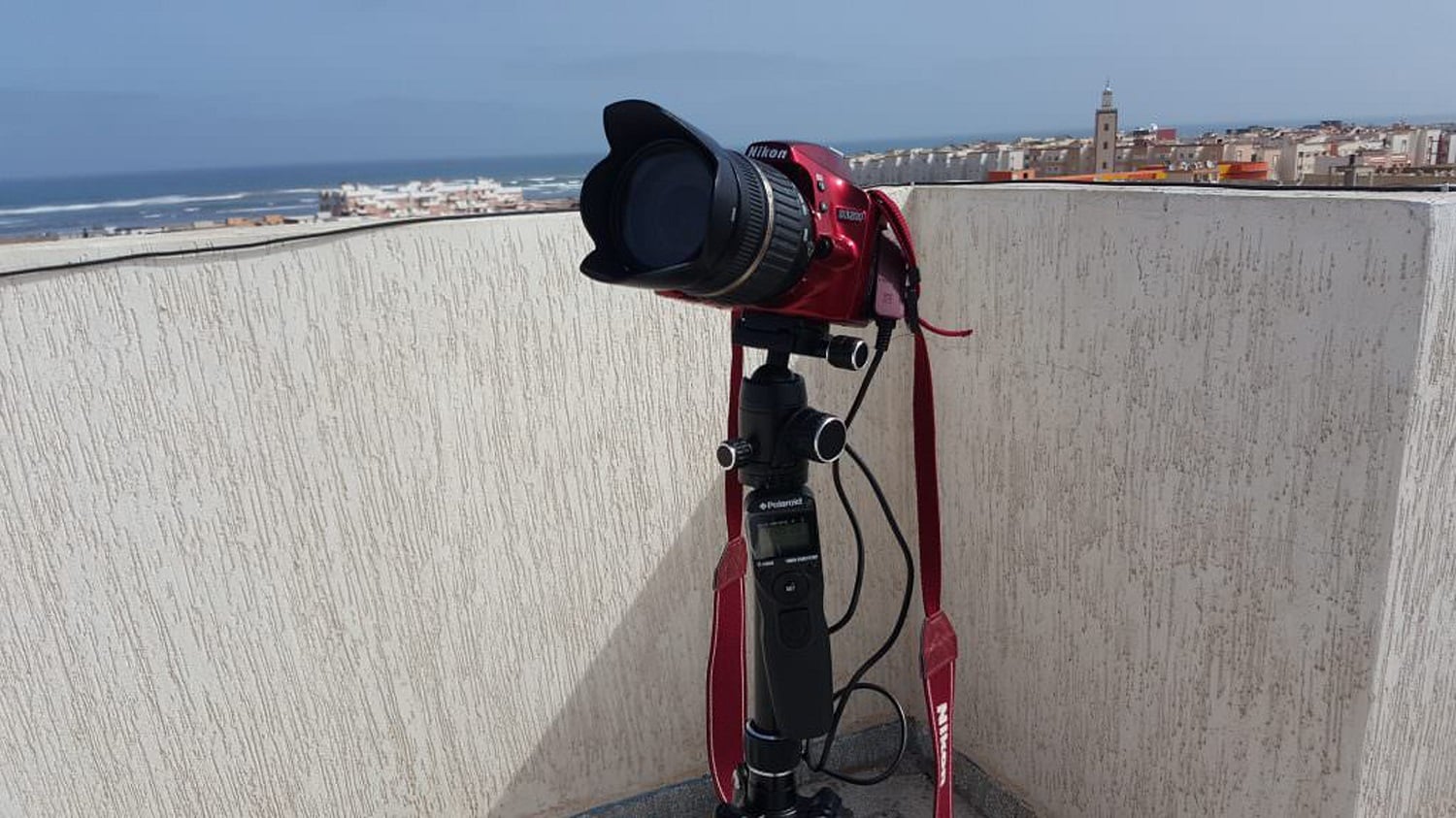 Our humble meteor imaging rig. Credit: Dave Dickinson.
Finally, don’t forget to count meteors and report what you see to the International Meteor Organization. Meteor shower science is still one aspect of astronomy where amateur astronomers can make meaningful contributions.
One thing’s always for certain in skywatching: you won’t see any meteors if you don’t try. If skies are clear, be sure to set your alarm and be vigilant for the April Lyrid meteors.