 Universe Today
Ingenuity, the Mars helicopter, which performed the first controlled, powered flight on another planet, was an excellent demonstration of human ingenuity. But it was just that - a demonstrator. The intention with Ingenuity was simply to prove that we could, in fact, fly on another planet. But now we’ve proved that we can, it’s time to do something more useful with that new ability - like do actual science. A new mission designed to do just that recently passed a critical testing milestone, opening the way for future Mars helicopter missions that will make Ingenuity look like our very first steps.
The mission, known as SkyFall (and hopefully named after the amazing James Bond movie) is designed to use much bigger helicopters. And not just one of them - three helicopters will actually split off from a descent craft and power their own way down to the surface. This both eliminates the need to design and maintain complicated landing systems and gives the three craft an opportunity to spread far apart from one another and enable exploration of different areas of the planet.
While they spread apart, they will be carrying actual scientific payloads - likely including ground penetrating radars and cameras - which is more than Ingenuity ever did. But to carry heavy things requires lots of force, and applying that force to the right place. Doing so in the Martian atmosphere, which is only around 1% the density of Earth’s, is not an easy challenge.
Fraser talks about some of the new helicopters potentially heading to Mars.Engineers designing the Skyfall helicopters have two options to get more lift - either spin the rotors faster or make them longer. Spinning them faster seems obvious, but there’s a caveat. Things get “squirrelly” around the sound barrier - even on another planet. Ingenuity never even got close to spinning its rotors at a speed approaching Mach 1 - it only ever hit around 70% of the speed needed to on Mars. That was in part due to the constant threat that a rogue wind gust could push the speed over that threshold and destroy the rotor itself.
And to be clear, breaking the sound barrier on Mars is different than on Earth. Since the atmosphere is so much less dense, the speed of sound itself drops down to 869 kph compared to 1,223 kph on Earth. In fact, most long-haul commercial aircraft on Earth would actually be traveling breaking the sound barrier on Mars simply traveling as far fast as they already do.
One of the most critical components when dealing with the sound barrier on a helicopter are the rotors. If they are able to sustain the physics of the sonic boom in a test facility here in the US, there’s a good chance, there’s a good chance they will be able to replicate that success on Mars. So, NASA decided to do just that.
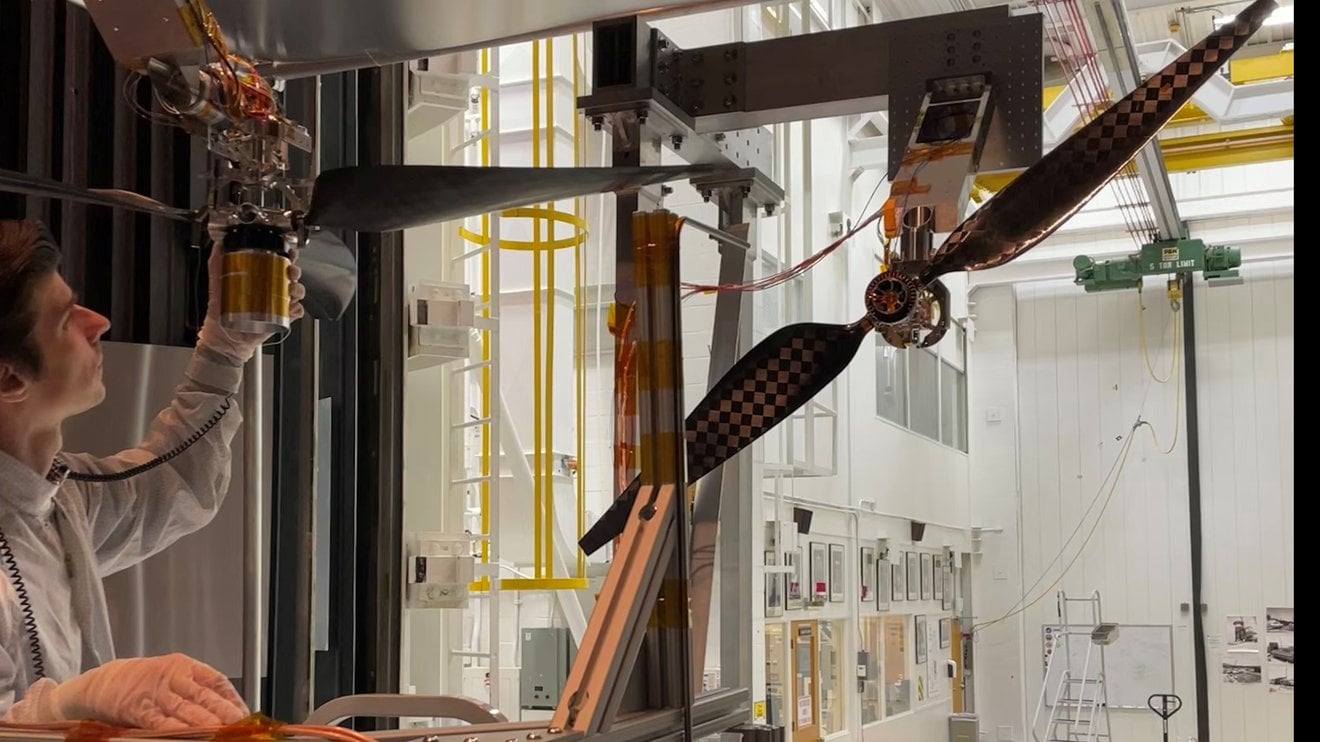
Fraser discusses the different air-based forms of transportation on Mars.The rotors for the Skyfall helicopters are supplied by AeroVironment, NASA’s commercial payload partner for Ingenuity. They were brought to the 25-foot Space Simulator on the Jet Propulsion Laboratory’s (JPL’s) campus in Pasadena to undergo environmental testing. The chamber was filled only with a wisp of carbon dioxide to mimic the Martian atmosphere, and then it was reinforced with steel to ensure that, if the blades did break, they didn’t injure any of the test engineers.
After being installed, the rotors were brought up to 3,750 rpm - or equivalent to Mach 0.98 at the blade tips. This was significantly faster than Ingenuity ever went - it had topped out at 2,700 rpm during its 72-hop lifetime. After establishing a baseline right below the sound barrier, the rotor blades were gradually brought up above it - eventually topping out at Mach 1.08. This breakthrough boosts the vehicle's lift capability by 30%. But the engineers didn’t stop there.
This first test focused on a three-bladed rotor design. They also wanted to test a two-blade design, which was slightly longer. Due to its longer rotation, it could hit Mach 1 at around 2,570 RPM, and while they didn’t quite push the two-rotor configuration over that threshold, they did capture plenty of good data on it - during the course of the test engineers gathered data on 137 different test runs.
Fraser discusses the progress on an even bigger version of the Mars helicopter.Ultimately, this is another step forward for the deployment of a full function, payload-carrying helicopter system - or three of them. While the completed tests were passed successfully, there are still plenty of other tests various parts of the mission need to undergo, including something as simple as adding dust to the atmosphere in the rotor test to make sure the carbon fiber rotors themselves don’t degrade away.
It will still be awhile before we can see these rotors fully in action. Currently, NASA is planning on a mission launch in one of the upcoming Mars transfer windows in December 2028. But that will require a herculean effort by the Mars Exploration team, and, given all the budget cuts and uncertainty surrounding the future of the program lately, it's unclear how realistic that time window is. If they do manage to pull it off, Ingenuity will have officially paved the way to a much more capable successor - and we’ll finally be able to get plenty of new in-situ data from a fleet of flying helicopters on Mars that would have seemed the realm of science fiction only a few years ago.
Learn More:
NASA JPL - NASA Pushes Next-Gen Mars Helicopter Rotor Blades Past Mach 1
UT - NASA Tests its Next-Generation Mars Helicopter Blades
UT - New Image Revealed by NASA of their New Martian Helicopter.
UT - Ingenuity Won't Fly Again Because It's Missing a Rotor Blade

