Universe Today
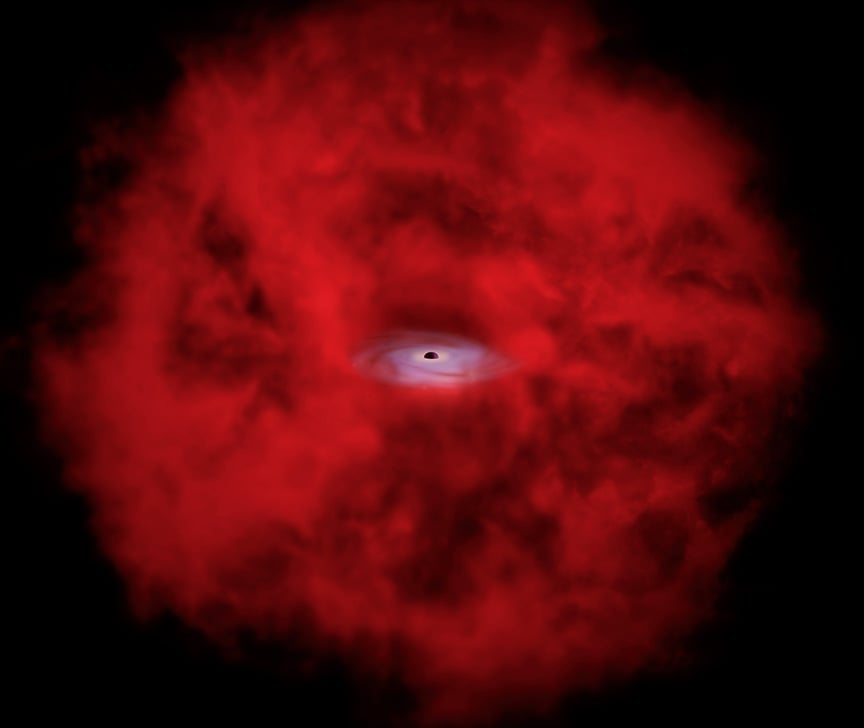
Ever since JWST first began peering out at the early Universe a few years ago, astronomers have been spotting strange "little red dots" (LRDs) in its infrared images. There are hundreds of these compact blobs at very high redshifts at distances of about 12 billion light-years. Astronomers think they began forming some 600 million years after the Big Bang. That makes them players in the infancy of the cosmos. They appear red in optical light and blue in the ultraviolet. So, what are these strange objects?
There are a bunch of suggestions about their origins and characteristics. For one thing, LRDs could be the light emitted from the regions around supermassive black holes hidden by dense gas clouds. It's an interesting idea, but doesn't quite square with the appearance of rapidly growing supermassive black holes of the same era because most (so far) don't appear to be hidden by gas clouds. Some have suggested that the LRDs are some form of an early galaxy, as yet unexplained. It might also be a species of active galactic nucleus (which are almost always powered by black holes). Their emissions certainly point to that conclusion. Yet another explanation suggests that the LRDs are some kind of supermassive metal-deficient stars that lived fast and died young (by stellar standards). Astronomers call that a "black hole star".
Recently, a multi-national team of astronomers examining Chandra X-ray Observatory data in comparison to a JWST deep survey, found something weird in the LRD regime: an X-ray-emitting one about 11.8 billion light-years away. It was a surprise because other LRDs don't seem to emit X-rays. Dubbed 3DHST-AEGIS-12014, it's bright in X-rays, which other LRDs don't emit, but black hole accretion disks and jets do. It's very possible that this weird object is a link between black hole stars and the type of growing supermassive black holes that took root and grew in the early Universe.
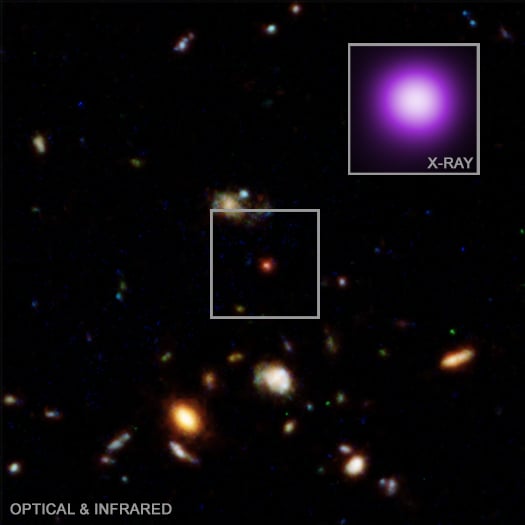 An optical and infrared view of an X-ray bright little red dot (XRD in the inset). If this is a black hole, then it's possible that gas clouds surrounding the get consumed through the accretion disk, leaving behind "holes" in the clouds where X-rays can shine through. This may be a transitional form of little red dot. Courtesy NASA/JWST/Chandra X-Ray Observatory.
What Exactly Is 3DHST-AEGIS-12014?
The X-ray LRD is small, appears red (like the others), and exists in the very early Universe, like its siblings. But, unlike them, that X-ray emission tells astronomers that this one is somewhat different. The best explanation so far is that it could be a transitional object that belies the existence of a black hole. “Astronomers have been trying to figure out what little red dots are for several years,” said Raphael Hviding of the Max Planck Institute for Astronomy in Germany. He is the lead author on a paper describing the finding. “This single X-ray object may be — to use a phrase — what lets us connect all of the dots.”
Of course, if it is a transitional form of LRD, that still raises a lot of questions about how it formed, what its evolutionary process is, and what its end state is. “If little red dots are rapidly growing supermassive black holes, why do they not give off X-rays like other such black holes?” said co-author Anna de Graaff of the Center for Astrophysics | Harvard & Smithsonian, in Cambridge, Massachusetts. “Finding a little red dot that looks different from the others gives us important new insight into what could power them.”
Delving into Transitional Phases
The observational team's paper suggests that the X-ray LRD may be evolving from something new to become one of the early-type growing black holes that pepper the early cosmos. It could still be embedded in gas clouds, which would typically absorb or block other forms of light. Patchy openings in the clouds would let the X-rays through at some times, but not at others. That would explain why the X-ray emissions from 3DHST-AEGIS-12014 appear to vary over time.
“If we confirm the X-ray dot as a little red dot in transition, not only would it be the first of its kind, but we may be seeing into the heart of a little red dot for the first time,” said co-author Hanpu Liu of Princeton University in New Jersey. “We would also have the strongest piece of evidence yet that the growth of supermassive black holes is at the center of some, if not all, of the little red dot population.”
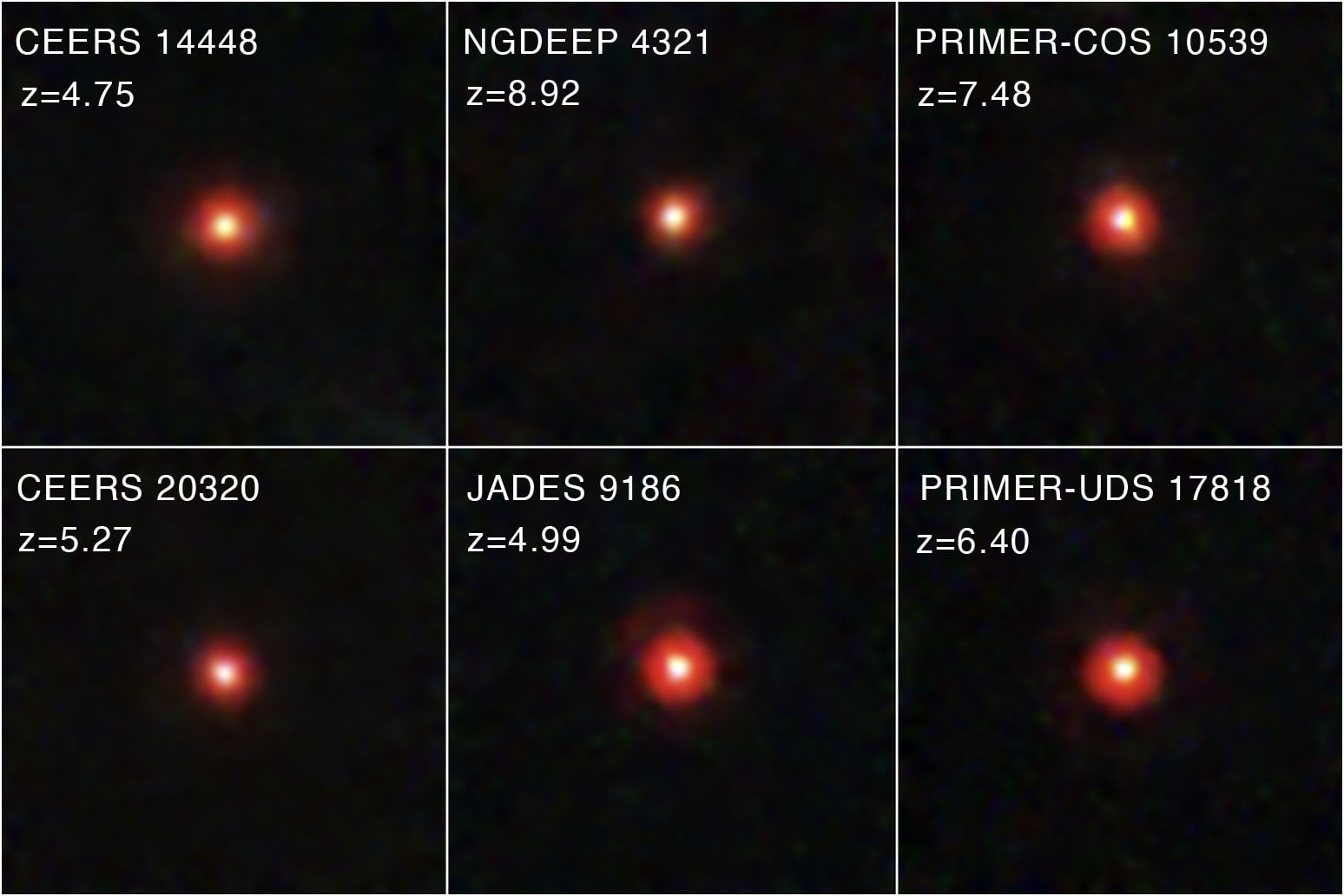 Little Red Dots are extremely compact objects recently observed by NASA's James Webb Space Telescope. Using supercomputers and LRD data from JWST, a team of astronomers compared and found good agreement with observed data to models that employed a ‘heavy seed’ vs. a 'light seed' hypothesis of black hole formation in the early universe. Credit: NASA
Because LRDS, and in particular, this one, all lie in very early epochs of cosmic time, other explanations need to be ruled out. At least one idea suggests that 3DHST-AEGIS-12014 is really a growing supermassive black hole at the heart of a forming galaxy. But, it could be shrouded in some exotic kind of dust that astronomers hadn't detected before this time. Since there are so many questions remaining about 3DHST-AEGIS-12014, it's clear that more observations need to be made to get time-variable data about its activity and evolution. Future studies could help the science team decide if this LRD (now XRD) really is a physical link between LRDs and the supermassive black hole-powered AGNs that populate the early Universe. In addition, extended studies should prove that LRDs seen so far are also contain black holes at their hearts.
For More Information
NASA Connects Little Red Dots With Chandra, Webb
The X-Ray Dot: Exotic Dust or a Late-stage Little Red Dot?