Universe Today
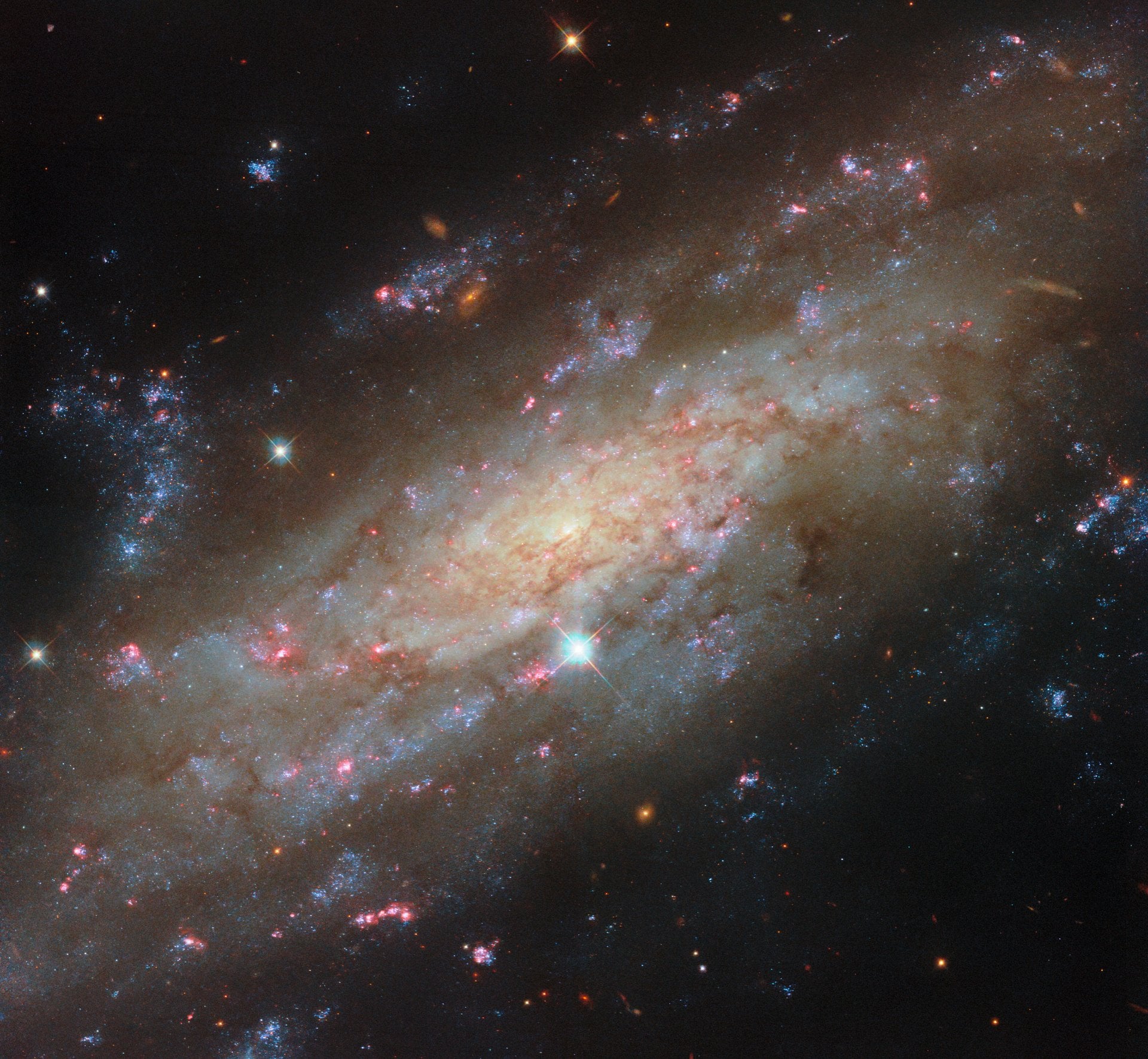
The venerable Hubble Space Telescope has taken some truly stellar (no pun!) images over its many years of dedicated service. A new image recently released by the European Space Agency (ESA) shows the spiral galaxy NGC 3137 in all its glittering glory. Located about 53 million light-years from Earth in the constellation Antlia, NGC 3137 offers astronomers an excellent opportunity to study the life cycle of stars in a galaxy similar to our own.
This is due to the many stellar clusters visible in the Hubble image, where stars are born from collapsing clouds of dust and gas in the interstellar medium (ISM). In addition, NGC 3137 is of particular interest to astronomers because it is believed to be part of a group of galaxies (NGC 3175) similar to the Local Group, of which the Milky Way is a part. This group comprises two large spiral galaxies, NGC 3137 and NGC 3175, as well as many smaller dwarf galaxies (though the total number remains unknown).
This Hubble image combines observations in six different color bands that highlight several different aspects of the spiral galaxy. This includes the network of fine, dusty clouds that surround the galaxy’s center, which hosts a black hole of an estimated 60 million Solar masses. NGC 3137, meanwhile, is highly inclined, providing a lovely perspective on the galaxy's spiral structure, while several Milky Way stars are visible in the foreground and more distant galaxies in the background.
The images were taken by the Physics at High Angular resolution in Nearby GalaxieS (PHANGS) team as part of observation program #17502. This observation campaign combines archival data from Hubble, the James Webb Space Telescope (JWST), and the Atacama Large Millimeter-submillimeter Array (ALMA) to examine star clusters in 55 nearby galaxies. This campaign has enabled the first multi-scale, multi-phase study of star formation across spiral galaxies in the local universe, providing an in-depth view of stellar lifecycles.
Newly-formed stars appear as glowing red clouds because of how they are still encased in their birth nebulae. Young stars are visible in bright blue clusters, while ancient stellar populations are large, red, and dusty.
Further Reading: ESA