Universe Today
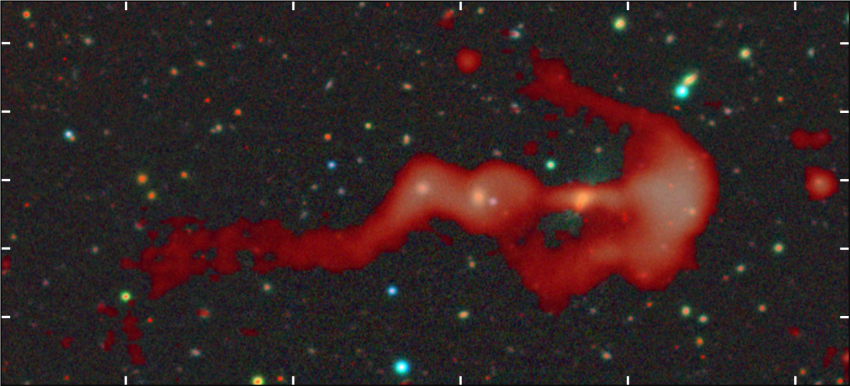
Can a galaxy leave a wake? Out in the desolate space between galaxies, the gas is so thin it makes the finest vacuum on Earth look crowded, with seemingly nothing to push against. Yet astronomers have just found a galaxy doing exactly that, ploughing through that near-emptiness so fast that it has carved a glowing arc nearly 1.8 million light years across, shaped, of all things, like a bow and arrow. Stranger still, the first person to spot it was not a professional astronomer at all, but a student working from a remote hillside in the Himalayas.
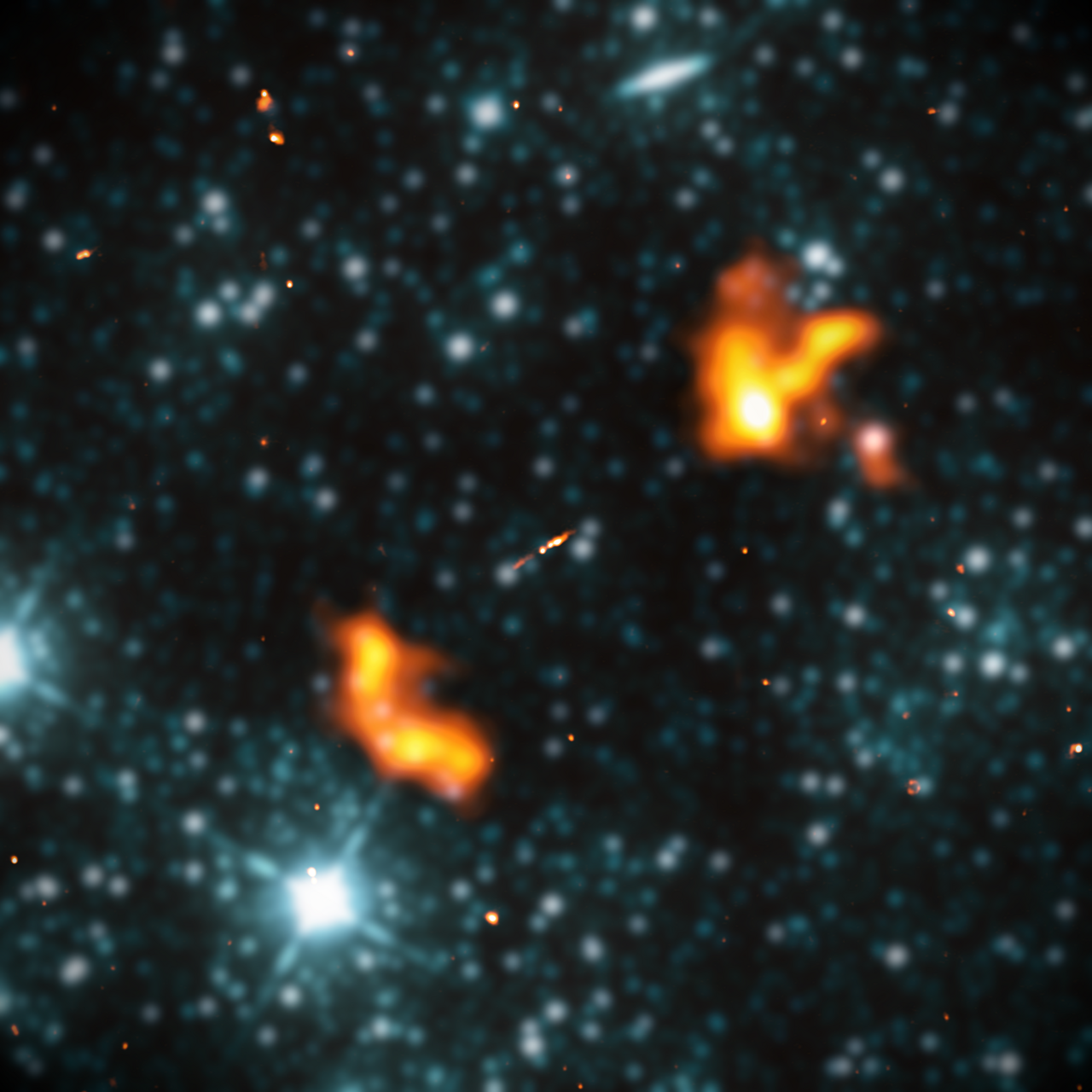 Alcyoneus, a giant radio galaxy with lobed structures spanning 16 million light years (Credit : Martijn Oei)
The galaxy, named RAD-BAARG, sits in a crowded and chaotic neighbourhood, and its structure is unlike anything in the textbooks. Most radio galaxies are tidy and symmetrical, twin jets streaming in opposite directions from a central black hole like water from a garden sprinkler. RAD-BAARG is anything but. On one side a narrow jet feeds a vast sweeping arc of radio light. On the other it twists into a distorted S shape before trailing away into a faint tail. The astronomer who led the work has spent 25 years studying these objects and says he has never seen its like.
The team believes the galaxy is falling headlong into an immense cluster, travelling faster than sound can move through the hot gas that fills the space between galaxies. Anything moving that quickly heaps the gas up ahead of it into a curved front, much as a boat cutting across a lake piles a wave ahead of its bow. It is no coincidence that astronomers call these structures bow shocks. The radio plasma pouring from the galaxy's black hole appears to illuminate this shock, revealing something they have long predicted but almost never managed to glimpse.
Capturing it took one of the most sensitive radio surveys ever made. The discovery came from the LOFAR Two metre Sky Survey, which maps the sky at low frequencies in extraordinary detail, catching faint emission that brighter surveys miss entirely. Shocks like this have been hinted at before in X-ray images, but never seen so cleanly in radio light. RAD-BAARG gives astronomers their sharpest view yet of a galaxy caught in the act of falling.
 The LOFAR 'superterp'. This is part of the core of the extended telescope located near Exloo, Netherlands (Credit : LOFAR/ASTRON)
It is also a quiet triumph for citizen science. RAD-BAARG was first noticed by Pranim Limbo, a participant in India's RAD@home project, which since 2013 has trained students and enthusiasts to comb through professional telescope data, whatever their background or wherever they live. Frontline discovery, it shows, no longer belongs only to those inside the world's great observatories.
And there may be many more bows waiting to be drawn. With the vast Square Kilometre Array Observatory now taking shape, and machine learning ready to sift through mountains of survey data, astronomers expect to turn up far more of these hidden collisions between galaxies and the space they fall through. The universe, it seems, still has plenty of surprises in store for anyone willing to look up.
Source : Bow-and-arrow-shaped radio galaxy discovered by citizen scientist