 Universe Today
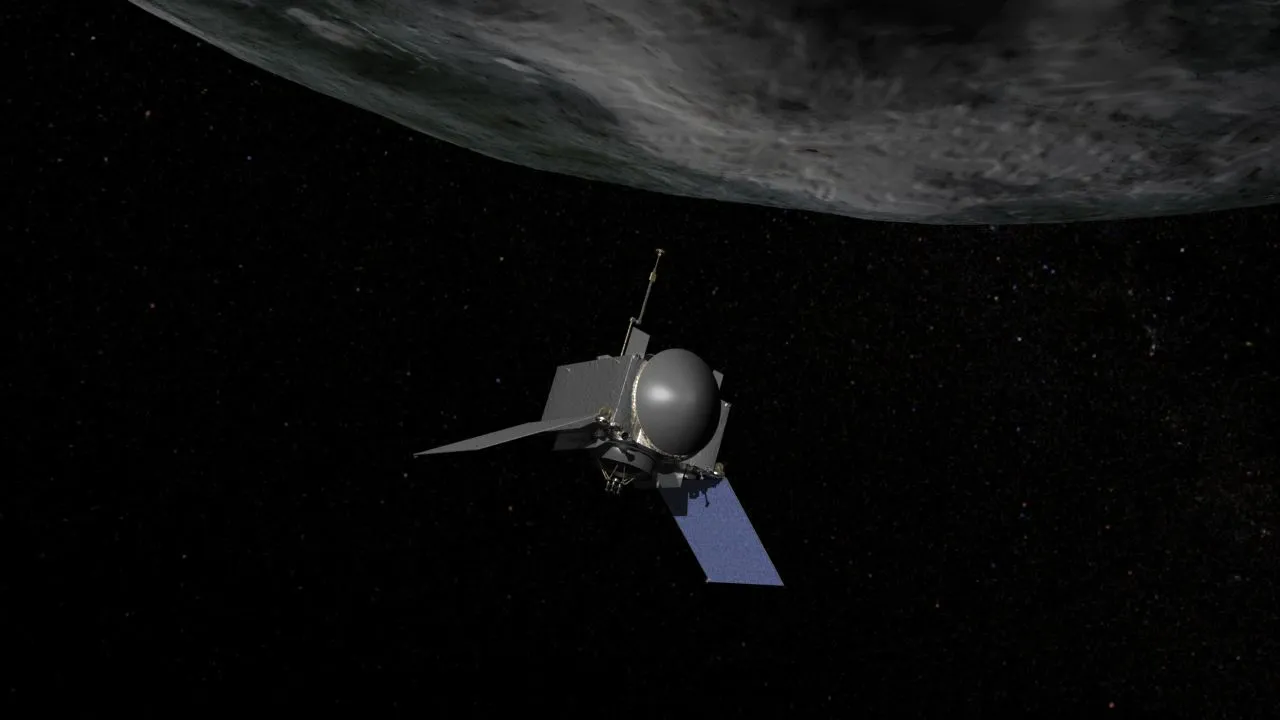
Asteroid mining seems simple in theory. A spacecraft flies up to a giant rock in space, scoops out some material, and either processes it on site or returns it back to a huge central processing facility. But in practice, it is certainly not that simple, and a new paper from some Spanish researchers, available in pre-print form on arXiv, showcases one of the reasons why - many small asteroids are spinning ridiculously fast.
First let’s set the stage for a moment. AstroForge is one of the current crop of companies actively pursuing asteroid mining as a business model. Last year, they launched their Odin mission - a 100 kg satellite that was intended to fly by asteroid 2022 OB5. This asteroid was especially selected because it appeared to potentially be metallic (i.e. a goldmine for asteroid miners) and had a very low “delta-v” in the jargon - basically a calculation of how difficult it was to get a ship there.
Unfortunately, Odin encountered some communications problems after it was launched on board a Falcon 9 in February 2025. After a few weeks trying to establish a connection, AstroForge officially declared the mission lost, noting they thought the spacecraft was tumbling uncontrollably somewhere in interplanetary space. Despite that loss, interest remained in 2022 OB5 due to its proximity and the potential riches it held.
Interview with Matt Gialich, CEO of AstroForge. Credit - Arkaea Media Group YouTube ChannelThat interest attracted other researchers to look more closely at the space rock. Odin was designed as a fly-by mission to assess what materials were easily accessible on 2022 OB5. So why not try to prospect it using a different, more remote method?
One such method is the HiPERCAM, an instrument attached to the Gran Telescopio Canarias in La Palma, Spain. This high-speed optical camera is capable of taking simultaneous photos of a subject across five different optical bands. Why is this important? Small asteroids, such as 2022 OB5, typically spin extremely quickly, so if an instrument takes one color photo then sequentially switches to another, the asteroid has already rotated a significant amount, skewing the data. HiPERCAM is able to avoid this bias - making it one of the best tools available for assessing the rotation of small asteroids.
It was a good thing too, as the data detailed in the paper show that 2022 OB5 is rotating at a speed of once every 1.542 minutes, safely classifying it as an “ultra-fast rotator”. That is not great news for asteroid mining companies, though, as it means the centrifugal acceleration at the asteroid’s equator is nearly 100 times that of the gravity holding objects onto it. Any spacecraft that attempts to land, drop anchor, or scoop material off the asteroid will have to contend with that force mismatch, or be violently flung off into the void.
Fraser talks about whether we will ever mine asteroids.Sure, it can be done - asteroid miners have for a long time known that station keeping on an asteroid would be hard, and would likely require some form of anchoring system to keep the mining robot in place. But missions like Philae offer a cautionary tale for that technology. The Rosetta mission lander, which attempted to land on comet 67P/Churyumov-Gerasimenko back in 2014, ended up coming to rest on its side, after bouncing off the comet’s surface 38 times after its harpoon anchoring system failed to deploy.
AstroForge, and the other space mining companies, would like to avoid that fate if possible, as such have learned from it. In fact, they are planning another mission sometime this year, known as Deepspace-2, which is hoping to land on a metallic asteroid. The good news from the new paper is that 2022 OB5 still might fit that bill.
It lies within the “X-complex” taxonomy group for asteroids. While this grouping does contain iron-nickel-rich metal asteroids, it admittedly also contains non-metallic highly porous space rocks. And while it might seem like any porous groups of rocks would be thrown apart by the asteroid’s rotational force, that might not be the case. The paper notes that rubble pile asteroids of 2022 OB5’s size, shape, and rotational speed could be held together by cohesive van der Waals forces between fine regolith grains.
So it remains to be seen whether 2022 OB5 is indeed a “gold mine” or not. But no matter what it is, this new paper is an excellent reminder that just because something in space is “accessible” that does not necessarily mean it's easily “exploitable”. Asteroid mining companies would do well to remember that distinction if they hope to truly start a new resource rush in space.
Learn More:
M.R. Alarcon et al. - Accessible does not mean exploitable: HiPERCAM reveals the ultra-fast rotation of 2022 OB5
UT - How Much Are Asteroids Really Worth?
UT - The Legal Void of the Asteroid Gold Rush
UT - Schweickart Prize Goes to a Plan for Managing Asteroid Mining Risks

