 Universe Today
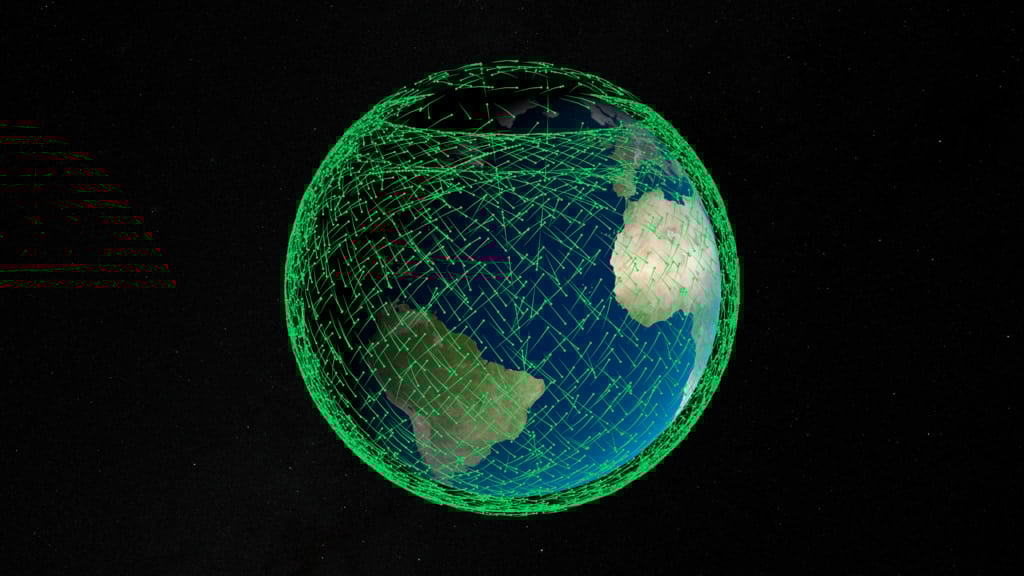
A “House of Cards” is a wonderful English phrase that it seems is now primarily associated with a Netflix political drama. However, its original meaning is of a system that is fundamentally unstable. It’s also the term Sarah Thiele, originally a PhD student at the University of British Columbia, and now at Princeton, and her co-authors used to describe our current satellite mega-constellation system in a new paper available in pre-print on arXiv.
They have plenty of justification for using that term. Calculations show that, across all Low-Earth Orbit mega-constellations, a “close approach”, defined as two satellites passing by each at less than 1km separation, occurs every 22 seconds. For Starlink alone, that number is once every 11 minutes. Another known metric of Starlink is that, on average, each of the thousands of satellites have to perform 41 maneuvers per year to avoid running into other objects in their orbit.
That might sound like an efficiently engineered system operating the way it should, but as any engineer will tell you, “edge cases” - the things that don’t happen in a typical environment, are the cause of most system failures. According to the paper, solar storms are one potential edge case for satellite mega-constellations. Typically, solar storms affect satellite operation in two ways.
Fraser discusses current methods to avoid satellites carshing into each other.First, they heat up the atmosphere causing increased drag, as well as positional uncertainty for some of the satellites. Increasing their drag causes them to use more fuel to maintain their orbit, but also to initiate evasive maneuvers if their path might cross that of another satellite. During the “Gannon Storm” of May 2024 (which, unfortunately, appears not to be named after the Zelda villain) over half of all satellites in LEO has to use up at least some of their fuel on these repositioning maneuvers.
Second, and perhaps more devastatingly, solar storms can take out the navigational and communications systems of satellites themselves. This would make them unable to maneuver out of harm's way, and, combined with the increased drag and uncertainty caused by the heated atmosphere, could least to an immediate catastrophe.
Kessler syndrome is the most famous embodiment of this catastrophe, where a debris cloud around Earth makes it impossible for humans to launch anything into orbit (or beyond) without it being destroyed. But Kessler syndrome takes decades to fully develop. To showcase the immediacy of the problem these solar storms can cause, the authors came up with a new metric - the Collision Realization and Significant Harm (CRASH) Clock.
Papaer author Sarah Thiele discusses the legal frameworks around orbital debris.According to their calculations, as of June 2025, if satellite operators were to lose their ability to send commands for avoidance maneuvers, there would be a catastrophic collision in around 2.8 days. Compare that to the 121 days that they calculated would have been the case in 2018, before the megaconstellation era, and you can see why they are concerned. Perhaps even more disturbingly, if operators lose control for even just 24 hours, there’s a 30% chance of a catastrophic collision that could act as the seed case for the decades-long process of Kessler syndrome.
Unfortunately, solar storms don’t come with much warning - maybe only a day or two at most. And even when they do, we can’t necessarily do anything about them other than trying to safeguard the satellites they could effect. But the dynamic environment they introduce into the atmosphere necessitates real-time feedback and control to effectively manage those satellites. If that real-time control goes down, according to the paper, we only have a few days to get it back up before the entire house of cards comes crumbling down.
This isn’t idle speculation either. The 2024 Gannon storm was the strongest in decades, but we already know of a stronger one - the Carrington Event of 1859. That was the strongest solar storm on record, and if a similar event happened today it would wipe out our ability to control our satellites for much longer than 3 days. Essentially, a single event, of which there has already been precedence in historical memory, could wipe out our satellite infrastructure and leave us Earth-bound for the foreseeable future of humanity.
That doesn’t sound like a future readers of this blog would like to live in. And while there are trade-offs between utilizing the technical capabilities LEO mega-constellations give us and the risk that they pose to future space endeavors, it's best to have a realistic assessment of those risks. When it comes to the potential of losing access to space for generations because of one particularly bad solar storm, it's best to at least make informed decisions, and this paper certainly helps to create those.
Learn More:
S. Thiele et al - An Orbital House of Cards: Frequent Megaconstellation Close Conjunctions
UT - How Mega-Constellations Are Learning to Manage Themselves
UT - Orbital Debris is Getting Out of Control
UT - There's a Cloud of Space Debris Around Earth. Here's how we Could get a Better Picture of it

