 Universe Today
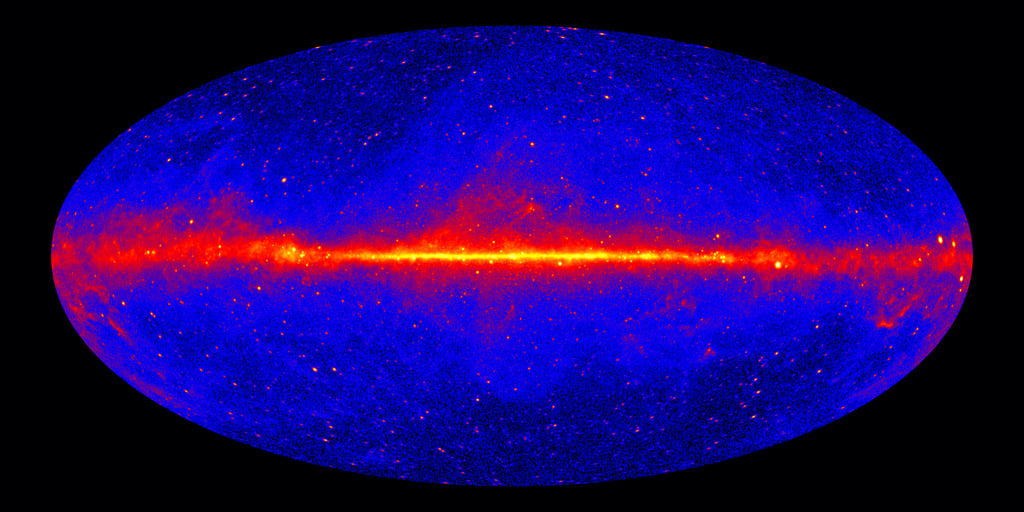
There are multiple ways to form black holes. The one most commonly taught in high school physics classes is that they are created from the collapse of a dying star. But there are another class of black holes, known as Primordial Black Holes (PBHs) that could have been created immediately after the Big Bang by matter collapsing in on it. Or that’s the theory at least. Though long theorized, we’ve never actually seen one of them, though scientists have suggested that they might account for the missing mass of the universe, which we otherwise describe as “dark matter”. But a new paper, available in pre-print on arXiv from researchers at Oakland University in Michigan and Rice University in Texas, calls that theory into question, at least for a certain type of PBH.
That certain type of PBH is an “asteroid-mass” one - one that weighs between 10^14 and 10^17 grams. Though most black holes are thought of as massively dense objects that emit no light, Stephen Hawking realized they could also be smaller (as long as they were equally as dense), and, crucially, that the smaller ones emitted thermal radiation, which we now know as Hawking radiation, over time. Emissions like that come at a cost, though, as the black hole itself eventually evaporates over time.
Mass loss from that evaporation has likely already disintegrated any black holes that are below 10^14 g - they would have already burned out. However, for those in that “asteroid-mass” range, they would be coming to the end of their lives, which means they are also emitting the most light. Specifically, that light comes in the form of gamma-ray radiation.
Fraser discusses primordial black holes.Unfortunately, they would be just one thread in the wider web of the Extragalactic Gamma-Ray Background (EGRB), a diffuse glow of gamma rays that seem to be coming from every direction towards the Milky Way. It’s made up of the emissions of countless astronomical objects, so isolating the signal from asteroid-mass PBH is a difficult task. To do so, the authors created a model to subtract most of the known sources of EGRB light, such as blazars, radio galaxies, and even the gamma rays produced when cosmic rays run into the infrared background of the cosmos.
They didn’t stop there, either. They developed a new python script called GammaPBHPlotter that modeled these PBHs in extreme detail, including their Hawking radiation, unstable particle decay, and, critically, the gamma rays produced by positrons emitted when the black hole annihilates electrons. Combining all of these potential sources allowed the authors to claim the tightest constraints possible on the contribution of these PBHs to the missing matter of the universe.
The results they found were not particularly great for the theory of asteroid-mass black holes. They found that PBHs around 10^14 g cannot make up more than 1 in 10 billion of the observed dark matter in the universe. However, there was a preference for slightly larger PBHs, around 3x10^16, which could be calculated to make up a maximum of 6% of dark matter. Still not a significant chunk, but better than 1 in 10 billion.
Fraser talks about GRBs - one of the sources of the EGRB that was eliminated as part of the paper.But to truly rule out these primordial behemoths, we need better telescopes. The authors were limited to using legacy data from the EGRET and COMPTEL instruments, both of which were collected by the Compton Gamma Ray Observatory, which was launched in 1991 and deorbited in 2000, slightly over 26 years ago. Hope is on the horizon, though. A few new telescopes are hopefully coming soon to tackle this “MeV gap” that cover where the expected gamma-rays from PBHs precisely fall.
Those missions, known as AMEGO-X and e-ASTROGAM, have yet to be picked up by any large space agency, but they continue with technical derisking and background research, waiting for their time to shine. Hopefully they’ll have a chance to do so as brightly as their observational subjects - because if they do we might be able to constrain whether larger mass PBHs are the source of the universe’s missing matter or not, and finally laying to reset the debating that has been roiling the cosmological community for decades.
Learn More:
I. Cholis, I. Krommydas, & J. Carlini - Limits on primordial black holes from the extragalactic gamma-ray background; current status and future projections
UT - What Happens to a Star That Captures A Primordial Black Hole?

