 Universe Today
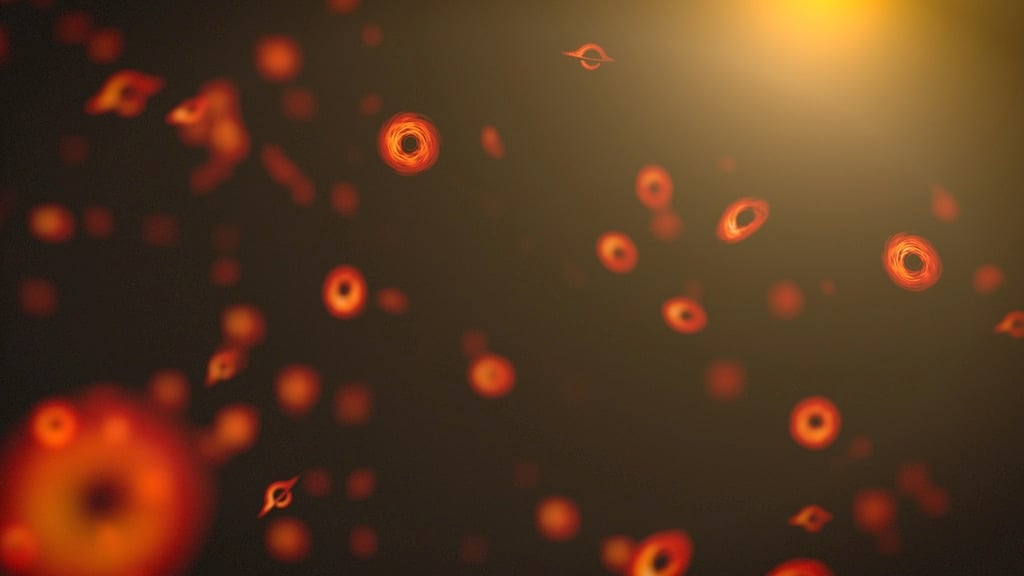
The early universe is absolutely so far outside our understanding of how the world works it's hard to describe in words. Back then, the cosmos wasn’t filled with stars and galaxies but with a boiling soup of quarks and gluons, with a few microscopic black holes thrown in, occasionally detonating like depth charges. That’s the early universe theorized by a new paper, available in pre-print from arXiv, from researchers at Vrije Universiteit Brussel and MIT anyway.
Primordial Black Holes (PBHs) are a subject of much modern-day research. They are hypothetical objects that would have formed in the very first seconds after the Big Bang, and are very different from the types of stellar-mass black holes that we can see today. In the extremely dense environment after the Big Bang, slightly more dense regions could have collapsed directly into black holes - ranging in size from microscopic to supermassive giants.
For this particular research paper, the authors focused on low-mass PBHs. While we think of black holes as absorbing light and everything else possible, they do actually leak energy into the space around them. Hawking radiation, named after Stephen Hawking, the physicist who discovered it, has a catch, though. According to the theory, the smaller the black hole, the hotter it gets, and the faster it evaporates. PBHs that weighed under 500 trillion grams (which is comparatively small by black hole standards) would have completely evaporated by our current time. But they don’t go quietly into that good night - they go out with a bang.
Fraser discusses primordial black holes and how important they might have been to the early universe.The current cosmological theory about the death of PBHs involves simply diffusing their energy outward into the universe’s plasma, creating a consistent “hot spot” in the quark-gluon soup that the early universe was made out of. But, according to the new paper, the reality of how black holes die was much more violent and dramatic. In particular, they watched the hydrodynamics of the plasma around a dying PBH and realized that the energy released by these microscopic black holes was so immense and focused that it created extreme pressure gradients.
Massive pressure gradients in a fluid (or a plasma) can cause a shockwave, and in this particular case, the researchers believe that is what happened when microscopic PBHs died. Essentially a dying PBH created a relativistic fireball that expanded rapidly outward into the cosmic soup.
According to the paper, this PBH evaporation process can be broken down into four distinct phases. In the first phase, while the PBH is still relatively massive, it slowly evaporates, creating a steady, expanding bubble of plasma. Eventually it shrinks to a small enough point that it enters the second phase, where it releases its remaining energy instantaneously, creating an ultra-relativistic blast that can be modeled using a framework known as the Blandford-McKee regime.
Fraser again discusses PBHs as the remnants of the early universe.As the shockwave expands outward, it sweeps up more of the surrounding plasma and eventually slows down into the third phase, which is modeled by a non-relativistic shockwave framework known as the Sedov-Taylor regime. Eventually, even that shockwave has its energy absorbed by the surrounding plasma, essentially dissipating its energy entirely when it enters the fourth phase.
That’s all well and good, but what does microscopic black holes dying with violence in the early universe have to do with any cosmological physics today? According to the paper, it might just hold the answer to baryogenesis.
Baryogenesis is the fancy term for why there is physical matter at all. According to our best theories of the big bang, matter and anti-matter should have been created equally - which means they also should have annihilated each other perfectly. But somehow, what we know today as “matter” somehow won that war, which is what we now call baryogenesis, or the creation of baryons (the subatomic particles (protons and neutrons) normal matter is made up of).
Fraser discusses where all the antimatter went.Our best guess is that, somewhere in the early universe, there was a violent departure from thermal equilibrium that caused more matter than antimatter to survive. The authors of the current paper point to a property of the early universe called the Electroweak (EW) symmetry as a possible explanation. If the temperature of the early universe’s plasma dropped below 162GeV (and yes, cosmologists measure temperature in electron-volts - but that’s a story for another time), EW symmetry would have been broken.
The authors believe that the shockwaves from PBH explosions could have temporarily pushed the temperatures back up above that threshold, creating pockets of EW symmetry within a moving “bubble” of plasma. That’s exactly the kind of out-of-equilibrium mechanism that would be needed to produce the universe’s matter-antimatter imbalance - and is interesting enough that the same research team is exploring the implications of that in a companion paper.
In short, according to this new theory, the early universe might have been shaped by the violent explosions of tiny black holes, and that literally everything we can see in the universe, including ourselves, are made up of the matter created by those explosions. So instead of saying we’re made of star-stuff, maybe we can start saying that we are made of black hole shockwaves - though that doesn’t quite have the same ring to it.
Learn More:
M. Vanvlasselaer et al. - Shocks from Exploding Primordial Black Holes in the Early Universe
UT - A Signal From Before the Stars
UT - Where are All the Primordial Black Holes?
UT - Is There A Link Between Primordial Black Holes, Neutrinos, and Dark Matter?

