 Universe Today
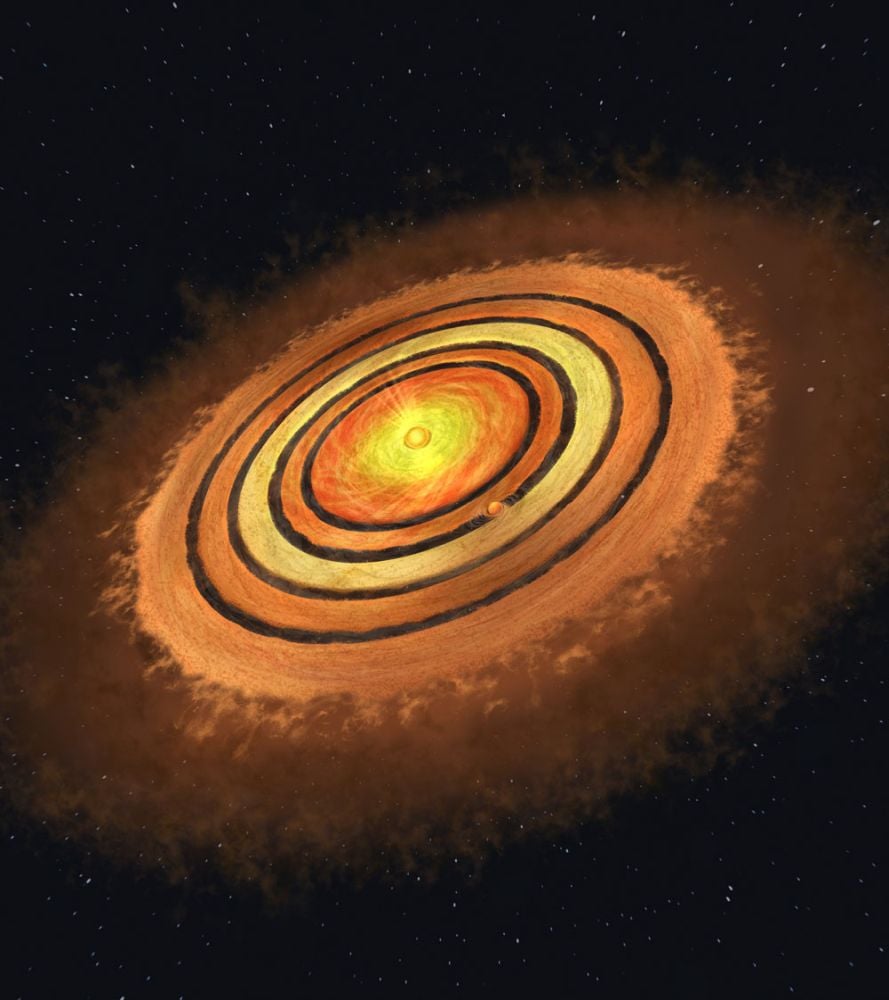
When astronomers look out into the Milky Way at very young stars, they find rings in their protoplanetary disks. It's pretty clear that these rings are where planets are forming. They're carving gaps and rings in the protoplanetary disks, the reservoirs of material around stars that planets form from.
ALMA, the Atacama Large Millimeter/submillimeter Array, has captured images of many of these disks and rings. Those images are part of the effort to understand how planets form, one of the primary questions in contemporary astronomy. But it's not clear if every ring is because of a planet. Protoplanetary disks are complex, and there are many forces at work in them. Some rings could be planets, and some could be caused by other phenomena.
“These new stars have bright rings and dark gaps patterned in concentric circles resembling the grooves of a vinyl record,” said Masayuki Yamaguchi, a post-Doctoral Fellow from Kyushu University’s Faculty of Science. “These patterns aren’t new; what was a mystery was how these grooves were carved. The most popular explanation is that young planets make these gaps as they orbit the star. However, when a disk has many rings, it becomes harder to explain since it’s hard to imagine that multiple planets have already formed.”
Yamaguchi is the lead author of new research in The Astrophysical Journal titled "A Hybrid Origin for the Multiple Ring-gap Structures in the Large Protoplanetary Disk V1094 Sco: A Low-mass Planet and Secular Gravitational Instability" Yamaguchi is a member of a team of Japanese astronomers who studied V1094 Scorpii, a young star about 500 light years away. V1094 Sco has a protoplanetary disk that extends out to 300 astronomical units, with multiple ring-gap pairs at great distances from the star.
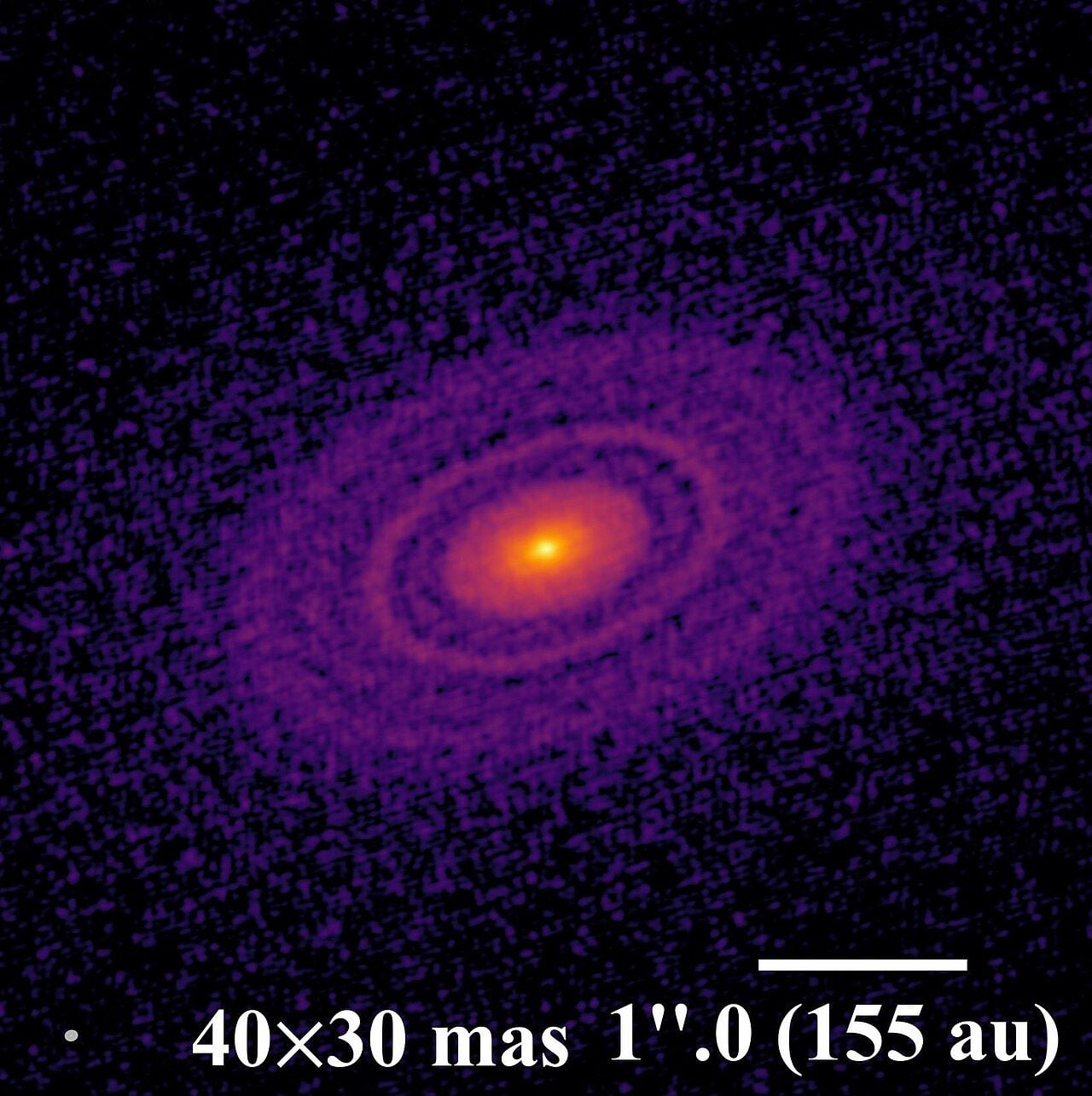 This is ALMA's image of V1094 Sco reconstructed with PRIISM. The researchers detected rings and gaps in the disk and were able to determine which were from still-forming planets. Image Credit: By YMasayuki - Own work, CC BY 4.0, https://commons.wikimedia.org/wiki/Special:Redirect/page/194635370
"High spatial resolution observations reveal that some protoplanetary disks host multiple ring–gap pairs at large stellocentric radii, yet their physical origin remains unsettled," the authors write. The researchers used ALMA images and observations with the Very Large Telescope's SPHERE (Spectro-Polarimetric High-contrast Exoplanet REsearch) instrument to analyze the V1094 Sco disk. "The continuum image shows four narrow dust ring–gap pairs extending to exceptionally large radii (r ∼ 380 au)," they write, and also "trace a spatially extended gas disk (r ∼ 760 au) in Keplerian rotation." Keplerian rotation means that objects further from the star orbit slower than those nearer the star.
Young stars with protoplanetary disks are T-Tauri stars, and among that group, V1094 Sco is known for having a giant disk with multiple rings, making it a rarity. It's the subject of a lot of research and observations. It was first recognized for its extended ring with multiple gaps and rings in a 2018 paper. That paper said, "In this work, the nature of V1094 Sco as a giant, multi-ringed protoplanetary disk is identified for the first time, based on data from the Lupus survey of protoplanetary disks." (The Lupus survey was an ALMA survey of disks in the Lupus star-forming complex.)
Ever since then, astronomers have been trying to understand V1094 and its unusual disk. There's not much doubt that still-forming planets are responsible for some of its features, but can they explain them all?
In an interesting twist, the researchers didn't use new ALMA observing time to study V1094 Sco. They relied on existing data and applied a new open-source super-resolution imaging technique called PRIISM (Python module for Radio Interferometry Imaging with Sparse Modeling.) It was built specifically to reconstruct sharper images with existing ALMA data, and replaces a previous technique called CLEAN. PRIISM proved its value in a 2025 study of 78 disks in the Ophiuchus star-forming region, where it found previously undetectable features in disks, only a few hundred thousand years after the stars formed.
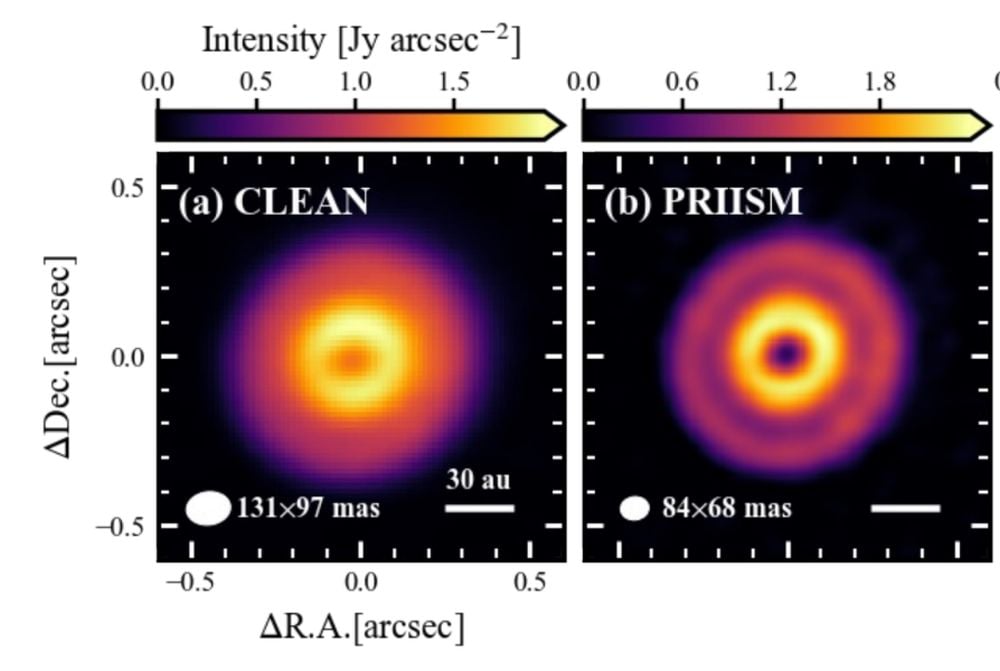 This figure doesn't show V1094 Sco; instead it shows CrA IRS 2, a protostar about 430 light years away. It illustrates how much better PRIISM is at detecting disk structures in existing ALMA data than its predecessor, CLEAN. Image Credit: Ayumu Shoshi et al 2026 ApJ 998 214
PRIISM paid similar dividends in this work.
“We observed that the disk extends approximately 380 astronomical units (AU)—about 13 times the distance between the Sun and Neptune—from the center. Within that, we found four narrow rings and gaps between 100–230 AU from the star’s center,” explained Yamaguchi. “When we compared the widths and depths of the gaps with the "one planet per gap" model, we could not explain the entire pattern. Instead, the origin appears to differ from place to place."
"The ensemble of gap widths and depths is inconsistent with a simple one-planet-per-gap interpretation," the authors write in their paper.
An exoplanet can explain the innermost gap, according to the results. "At r ≃ 100 au, a double gap and its scattered-light counterpart are consistent with multigap excitation by a single low-mass companion of (55 ± 35) M⊕," the authors explain.
But further from the disks, the rings were spaced more evenly. "At r ≃ 170–230 au, the outer ring system shows regular spacing and no clear scattered-light counterpart," the authors write. "These outer rings are quantitatively compatible with secular gravitational instability." That means the outer rings aren't associated with exoplanets. Instead, they're dust clumping together under its own gravity, which requires low turbulence.
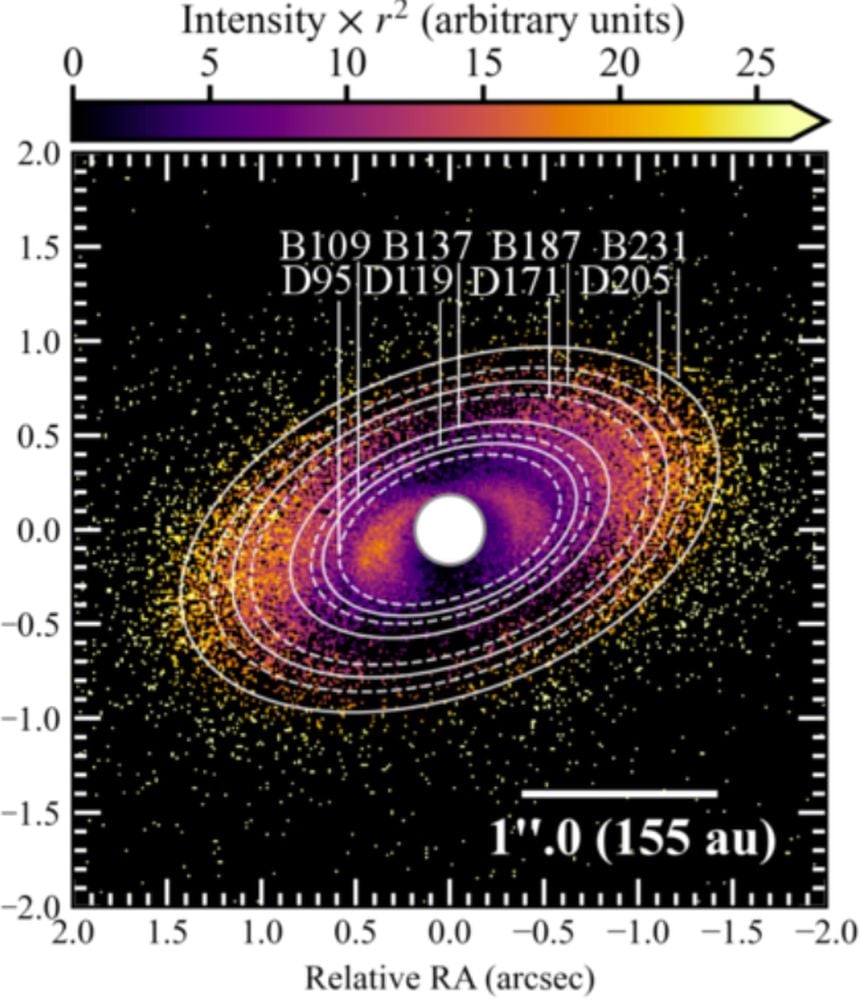 This is a near-infrared scattered-light image of the V1094 Sco disk obtained with VLT/SPHERE. It's overlain with the locations of dust continuum rings (solid lines) and gaps (dashed lines). The filled white circle indicates the SPHERE coronagraph. Image Credit: Masayuki Yamaguchi et al 2026 ApJ 1006 232
Secular gravitational instability intrinsically produces evenly spaced rings, while exoplanets don't.
"V1094 Sco therefore supports a hybrid pathway in which weak turbulence in an extended disk allows secular gravitational instability to assemble long-lived midplane dust concentrations that can cradle planet formation beyond ∼100 au, alongside planet-driven substructures at intermediate radii," the authors write.
These results don't mean that planets won't eventually form in these features that are at great distances from the star. It just means that there are no planets forming there right now. "In this framework, secular GI does not compete with planet formation; rather, it concentrates solids and establishes disk-wide conditions favorable for subsequent planet growth," the authors write in their conclusion.
ALMA doesn't image planets; that was never its job. But if exoplanets are in V1094 Sco's disk, other telescopes might find them.
“Because ALMA is a radio telescope, we have not yet directly detected the planet that generates the gap closest to the star. Using other telescopes such as the Subaru Telescope will help us get a clearer picture of this hidden planet,” said Yamaguchi. “As we analyze more disks, our understanding of the fundamental question of where and how planets form will deepen. Each new finding adds a thread to the tapestry of our knowledge of the universe.”