 Universe Today
Earth, the only life-hosting world we know of, contains signs of that life in its atmosphere. Oxygen/ozone is most convincing, because without being replenished by life, it would disappear quickly. Methane is another one, because it's produces by methanogens. Nitrous oxide is another, because it's produced by microbes and has no known significant source of abiotic production.
But finding these chemicals does not necessarily mean there's life there. Earth hosted life long before its atmosphere held oxygen and ozone. And as we've discovered, chemistry on other worlds can be significantly different than here on Earth. Also, exoplanets are at extreme distances, making unambiguous identification of these chemicals challenging.
Another approach to finding biosignatures involves using one of the human brain's most extraordinary evolutionary gifts: our pattern finding capability. From this angle, detecting life doesn't depend on any individual chemicals. Instead, it looks for patterns in statistics.
New research in Nature Astronomy shows how this would work. It's titled "Molecular diversity as a biosignature," and the lead author is Gideon Yoffe. Yoffe is from the Department of Earth and Planetary Sciences at the Weizmann Institute of Science in Israel.
“Astrobiology is fundamentally a forensic science,” said first author Yoffe in a press release. “We’re trying to infer processes from incomplete clues, often with very limited data collected by missions that are extraordinarily expensive and infrequent.”
According to the authors, there's an unfortunate reality we have to face when it comes to the search for life. Atmospheric spectrometry from a distance, as done by the JWST or other future observatories, won't be enough. Those observations can help us understand exoplanets, but by the authors' estimations, won't get us across the finish line.
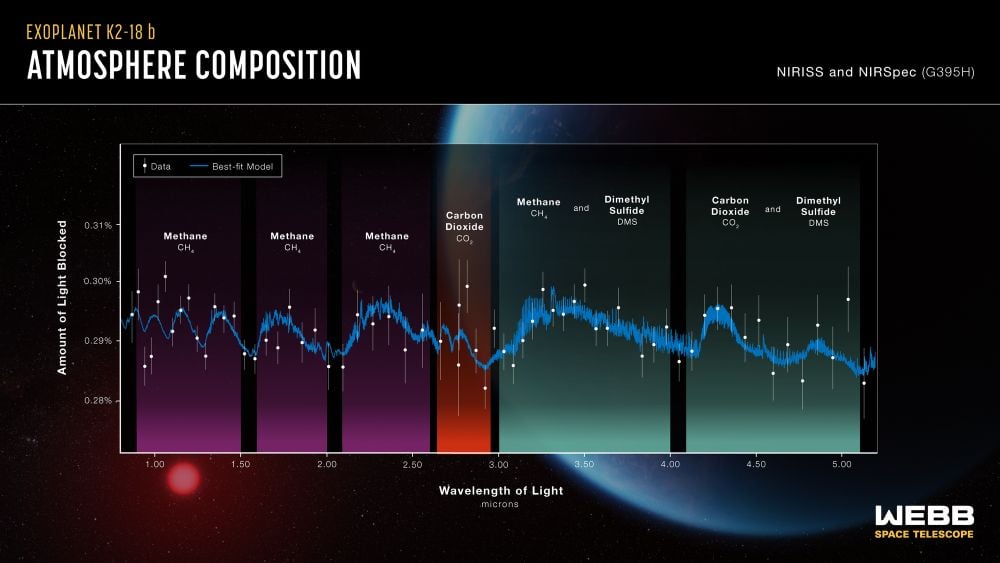 This graphic shows how the JWST detected methane, carbon dioxide, and dimethyl sulfide in the atmosphere of an exoplanet named K2-18 b. The presence of carbon dioxide and methane, and the absence of ammonia, suggest the presence of an ocean and a hydrogen-rich atmosphere. Together, the observations suggest habitability, but there are other abiotic explanations. Image Credit: NASA, ESA, CSA, Ralf Crawford (STScI), Joseph Olmsted (STScI); Science: Nikku Madhusudhan (IoA)
"The search for life in the Solar System hinges on data from planetary missions," they state. Only by visiting other worlds can we acquire the observations needed to show that life exists. And those observations have to focus on overall patterns in organic molecule populations, not on the presence of individual potential biosignatures.
"Life as we know it is built from a finite repertoire of organic molecules," the authors write. The composition and abundance of molecules like amino acids and lipids occupy a "priveleged position" according to the researchers. So do related amphiphiles, which are molecules with different parts that both attract and repel water. The water attracting parts of amphiphiles are the building blocks of proteins, and the water repelling parts form cell membranes and enable cellular functions.
The presence, composition, and abundance of these molecules are considered to be critical targets in the search for life. Unfortunately, they're also found where they can be created abiotically. "Yet, these compounds are not exclusive to biology: they have been detected in meteorites and asteroids, simulated prebiotic environments, and terrestrial settings where abiotic synthesis cannot be ruled out," the researchers explain.
This new research shows how we can bypass the search for individual molecules and look for statistical patterns.
“We’re showing that life does not only produce molecules,” said study co-author Fabian Klenner, a UC Riverside assistant professor of planetary sciences. “Life also produces an organizational principle that we can see by applying statistics.”
The researchers are introducing a new statistical framework based on ecodiversity. It goes beyond detecting individual molecules or isotopic ratios to search for life. "Ecodiversity statistics, originating in ecological theory, quantify the structure of biological communities and have hitherto not been applied to molecular inventories. These measures capture the number of unique species and the distribution of their abundances," the authors explain.
In this work, the researchers examined both biotic and abiotic assemblages of amino acids. "Biotic assemblages comprise environmental amino-acid distributions shaped by biological signatures in microbial cultures, marine and estuarine sediments, and fossilized biota," the authors write. "Abiotic assemblages include meteoritic and asteroidal materials, simulated icy-moon analog profiles, and laboratory-synthesized materials reflecting early Solar System and prebiotic chemistry."
The researchers found that amino acids produced biotically are different in their cumulative nature than those produced abiotically. They're more diverse and more evenly distributed.
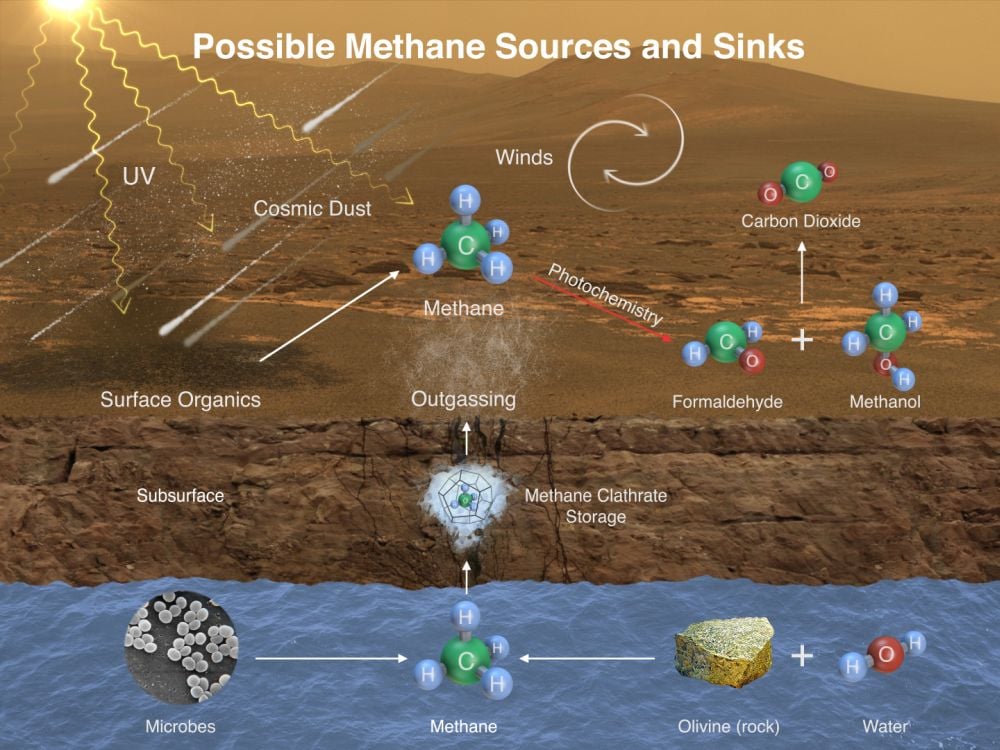 MSL Curiosity detected fluctuating levels of methane in Mars' atmosphere, which could be an indication of life. Since methane degrades rapidly, something needs to replenish it. But while microbes generate methane here on Earth, it can alse be generated by abiotic processes on Mars, showing that its detection doesn't necessarily indicate life. Image Credit: By Courtesy NASA/JPL-Caltech, Attribution, https://commons.wikimedia.org/w/index.php?curid=37351813
Then the researchers did the same for fatty acids. "We extend the diversity framework to a smaller dataset of biotic and abiotic fatty-acid assemblages," they write. They found that the opposite is true when compared to amino acids. Abiotically produced fatty acids are more evenly distributed than those produced biotically.
But biotic molecules don't last forever. They become degraded over time, and a big question is if the statistical patterns can survive degradation.
"However, planetary environments are often harsh, and organic molecules are often selectively degraded," they write. "To evaluate the durability of the diversity signal under such conditions, we simulated one degradation process, namely, radiolysis of biotic and abiotic amino-acid profiles in Europa’s near-surface ice, which was shown to be the main driver of degradation of organic compounds therein."
The researchers themselves were surprised by how robust their method is. Even though some of the biotic samples in their work were heavily degraded over time, the overall patterns remained robust. One of their samples was fossilized dinosaur eggs, and it still had detectable statistical signals indicating a biotic origin.
“That was genuinely surprising,” Klenner said. “The method captured not only the distinction between life and nonlife, but also degrees of preservation and alteration.”
The authors aren't suggesting that their method alone is enough to prove the existence of life elsewhere. No single method is likely to do that. “Any future claim of having found life would require multiple independent lines of evidence, interpreted within the geological and chemical context of a planetary environment,” Klenner said.
“Our approach is one more way to assess whether life may have been there,” Klenner said. “And if different techniques all point in the same direction, then that becomes very powerful.”

