 Universe Today
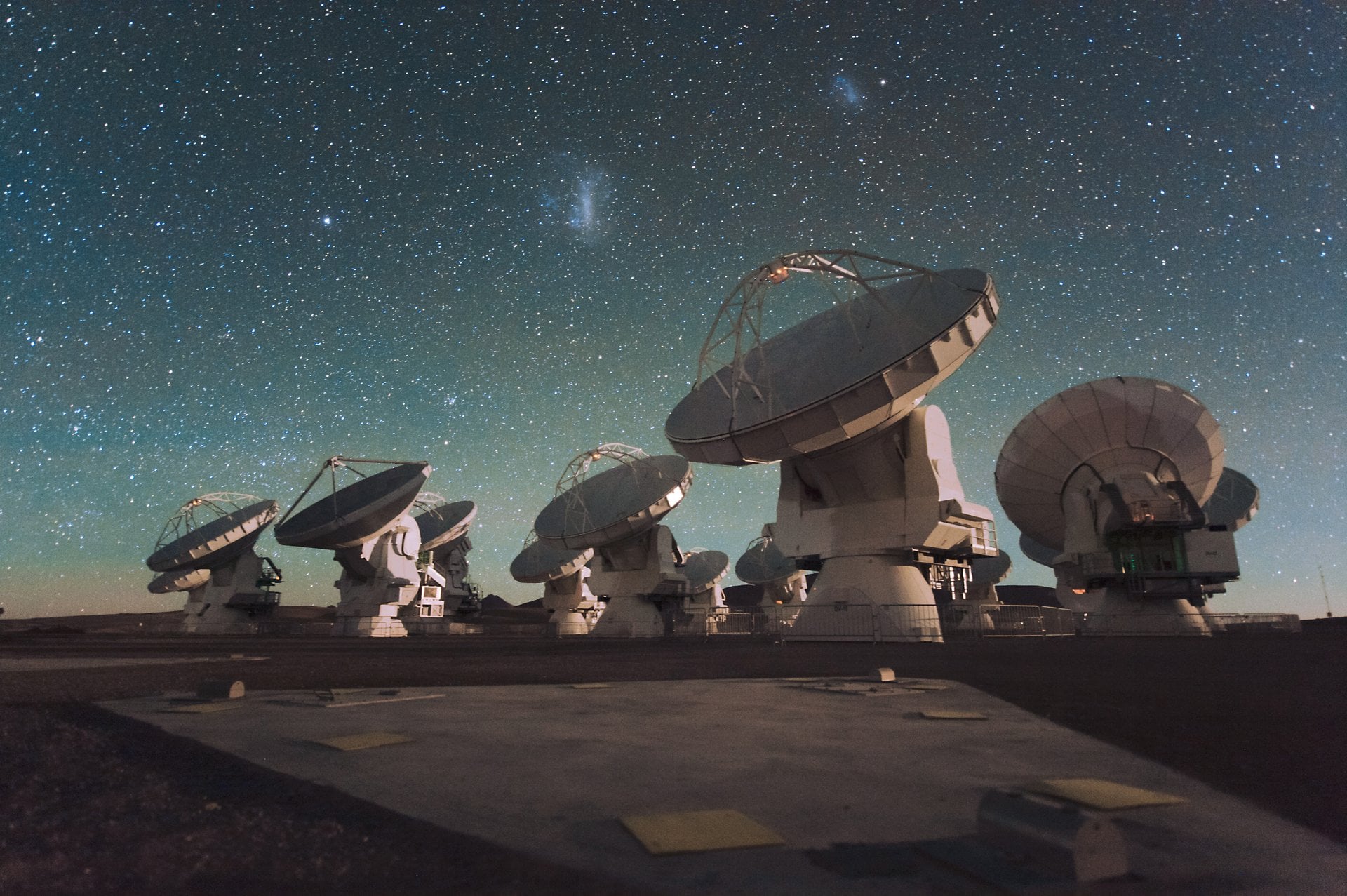
Long before modern astronomy, humans looked to the stars and were absolutely astounded by what they saw. Even by the most ancient reckoning, the night sky offered enough to inspire awe and wonder, make us feel insignificant, fire our imaginations, and foster hope and a sense of connection. Yet, for as long as humans have surveyed the heavens, they have seen no indication that life as we know it exists elsewhere - what has come to be known as the "Great Silence."
For many, the disparity between the assumed prevalence of life in the Universe and the lack of evidence for it raises a troubling incongruity often erroneously referred to as "Fermi's Paradox" (in truth, it was neither Fermi's nor a Paradox). It seems like a valid question when you consider the facts. Given the age, size, and density of the known Universe, shouldn't we have found unambiguous evidence of extraterrestrial life (and intelligence) by now?
Sixty years after the first Search for Extraterrestrial Intelligence (SETI) experiment (Project Ozma), scientists are still asking the question: "Are we alone in the Universe?" In addition to listening to the cosmos for radio signals and other signs of technological activity ("technosignatures"), efforts have been mounted to send messages to space for the purpose of making contact with an extraterrestrial intelligence (ETI).
This practice has come to be known as Messaging Extraterrestrial Intelligence (METI) to distinguish it from its more "passive" SETI cousin. Previously, we chronicled the history of SETI by examining some of its greatest milestones. Today, we will begin looking at the brief(-ish) history of METI and how it came to be.
Fermi's Question
As Universe Today's own Paul Patton addressed, Fermi's Paradox is named for famed Italian-American physicist Enrico Fermi. In 1950, during a lunchtime conversation at the Los Alamos National Laboratory, where he had worked a few years prior on the Manhattan Project, Fermi and his colleagues were discussing the recent spate of UFO sightings. It was here that Fermi posed his big challenge, saying out of the blue: "Where is everybody?"
After some quick calculations, Fermi and his colleagues concluded that, if interstellar travel were feasible and desirable, Earth should have been visited several times already. This led to the Hart-Tipler Conjecture, named after physicists Michael Hart and Frank Tipler. In a series of papers that appeared between 1975 and 1982, they argued that this "paradox" can be resolved only by asserting that extraterrestrial life does not exist.
Since then, many scientists (including Carl Sagan) have challenged this logic, arguing that there are innumerable reasons why humans have not heard from intelligent life yet (yet being the key word). Or as Sagan and William Newman famously put it: "the absence of evidence is not evidence of absence."
From this, the modern definition of the Fermi Paradox emerged. It states that the disparity between the assumed prevalence of life in the Universe and the lack of evidence for it can be resolved by one of two postulates: either extraterrestrials do not exist, or special circumstances exist that prevent us from detecting them. That certainly makes sense when you consider the observable facts:
- The Universe is Huge: While our observations are limited by Einstein's Theory of Relativity, scientists estimate that the "observable Universe" measures 96 billion light-years and might even stretch to infinity.
- The Universe is Packed: At last count, more than 2 trillion galaxies exist in the known Universe. These range from dwarf galaxies of 1,000 to several billion stars to massive elliptical galaxies, with as many as 100 trillion stars.
- The Universe is Old: Based on the most recent measurements of the Cosmic Microwave Background (CMB), scientists estimate the cosmos began with the Big Bang about 14 billion years ago.
- The Ingredients for Life are Everywhere: Finally, life, as we know it, comes down to several chemical elements. These include carbon, hydrogen, nitrogen, oxygen, phosphorus, and sulfur (or CHNOPS) and compounds like water, methane, and ammonia. Based on decades of observation, scientists have confirmed that the Universe is isotropic and homogeneous, and these elements exist in abundance everywhere.
An Evolving Name
Before we get into the history of this discipline, a little note on nomenclature is necessary. Traditionally, scientists made no distinction between SETI and METI, and pursued both projects concurrently. For instance, Cornell astrophysicist Dr. Frank Drake led the first SETI experiment (Project Ozma) in 1960, and was also vital to the first true METI project roughly fourteen years later (the Arecibo Message). Similarly, famed science communicator Carl Sagan, who became integral to early SETI efforts, later collaborated with Drake to create the Arecibo Message, the Pioneer Plaques, and the Voyager Golden Records.
The term "Active SETI" didn't emerge until 2005 to describe sending messages into space intended for extraterrestrial recipients. The following year, Russian scientist Alexander Zaitsev coined the term "Messaging Extraterrestrial Intelligence" to differentiate SETI and METI. As he wrote in the proposal paper, released in 2006:
Those who propose, or oppose, sending Messages to Extra-Terrestrial Intelligence (METI) must contemplate the Hamlet-like question: "To send or not to send?" The science known as SETI deals with searching for messages from aliens. METI science deals with the creation of messages to aliens. Thus, SETI and METI proponents have quite different perspectives.
SETI scientists are in a position to address only the local question "does Active SETI make sense?” In other words, would it be reasonable, for SETI success, to transmit with the object of attracting ETI's attention? In contrast to Active SETI, METI pursues not a local, but a more global purpose – to overcome the Great Silence in the Universe, bringing to our extraterrestrial neighbors the long-expected annunciation "You are not alone!"
Why Message?
In a follow-up paper released in 2011, "Rationale for METI," Zaitsev laid out METI's mission statement. In it, he quoted famed American radar astronomer Steven Ostro's unpublished paper, which proposed creating a powerful omnidirectional radio beacon on the far side of the Moon. As Oslo said in his paper, "We might conclude that it is better to give than to receive, and that the war on Great Silence must begin at home."
Among METI's benefits, Zaitsev highlighted what he coined the "SETI Paradox": advanced civilizations hear only silence from space because everyone is listening and no one is transmitting. He also noted that previous SETI programs spent hundreds of times longer listening to space than METI experiments did transmitting. But most important were the possible benefits interstellar communication could bring, something that was being avoided with passive SETI efforts. This, he wrote, could very well lead to civilizations living in isolation and eventually going extinct:
Isolationism as a possible cause of extinction of civilizations I do not know definitely, but it seems to me that Sebastian von Hoerner was the first, who in the 1960s indicated that "apathy" or "Loss of Interest" represents real cause of extinction of advanced Civilizations... I think that it is not interesting for inhabitants to live in such en- forced self-isolation, in such lurker-like Civilization! Civilizations, which are forced to hide and tremble because of farfetched fears, is doomed to extinction.
 Mars as conceived by astronomer Percival Lowell (1855-1916) in his books, Mars (1895), Mars and Its Canals (1906), and Mars As the Abode of Life (1908). Credit: H. Seppings Wright (1850-1937).
For fans of Liu Cixin's Remembrance of Earth's Past (or The Three-Body Problem) trilogy, these sentiments likely bring to mind the Dark Forest Hypothesis. And they would be correct! Whether it's safe to broadcast is at the heart of the debate over the ethics of METI (more on that later).
Early Experiments
The first example of an "active SETI" proposal came from the 19th-century German mathematician and astronomer Carl Friedrich Gauss, though debate continues over who first proposed the idea. In 1820, Gauss proposed drawing a petroglyph representing the Pythagorean theorem (a right triangle and three squares) on the surface of the Earth that would be large enough to be seen from the Moon or Mars. This would signal to extraterrestrial beings using the language of mathematics.
Several experiments were attempted in the late 19th and early 20th centuries, which were heavily inspired by astronomers like Giovanni Schiaparelli (1835-1910). While observing Mars, he noted several faint linear features, which he designed "canali" (Italian for "channels"). He further named these features after ancient seas and rivers derived from Classical Antiquity. The name "canali" was misinterpreted by scientists and the public to mean "canals," fueling belief in a Martian civilization.
Percival Lowell popularized the idea in the late-19th century, building an observatory in Flagstaff, Arizona, to map these supposed canals. Henceforth, people tried to message the civilization they believed was there. As Hugo Gernsback wrote in a 1909 opinion piece published in the journal Modern Electrics:
Every time our neighbor Mars comes in opposition to the Earth, a host of inventors and others begin to turn their attention to the great up-to-date problem, "signaling to Mars." It is safe to say that all the proposed, possible as well as impossible, projects would fill a good-sized volume, especially the ones invented in this country, which by far leads the world in number of projects and "inventions."
That same year, Harvard astronomer Professor William Pickering proposed building a massive $10 million system of motorized, synchronized mirrors in the desert to flash signals to Mars. Known as the Mirror Scheme, the goal was to see whether any sentient life and a Martian civilization existed by looking for return signals. In 1928, Dr. Hugh Mansfield Robinson, a British lawyer who believed he had been telepathically connected to a Martian woman (Oomaruru) since the early 1920s, launched what became known as the Martian Telegram.
The experiment consisted of a telegraph sent from London's Rugby Radio Station at a wavelength of 18,240 meters (ft). The message contained three words: "Opesti, Nipitia, Secomba," which Robinson believed were derived from the Martian language, followed by "Mar la loi de Earth" ("Love to Mars from Earth"). The station also kept a receiver antenna tuned to a wavelength of 30,000 m (ft), which Robinson insisted on, stating it was what the Martians preferred.
Like the earliest SETI efforts, the first METI experiments were humble and aimed at the nearest planets in the Solar System. They also reflected the then-accepted idea that Mars and Venus were inhabited and hosted civilizations. As our knowledge of the cosmos grew and technology improved, METI efforts would expand and direct their messages towards the stars. The transition from interplanetary to interstellar communications will be the subject of our next installment. Stay tuned!
Further Reading:
- "Messaging to Extra-Terrestrial Intelligence," Zaitsev, A. Searching for Extraterrestrial Intelligence. The Frontiers Collection (2006)
- "The SETI Paradox," Zaitsev, A. Bulletin of the Special Astrophysical Observatory, vol. 60 (2006)
- "METI: Messaging to ExtraTerrestrial Intelligence," Zaitsev, Alexander. Searching for Extraterrestrial Intelligence. The Frontiers Collection (2010).
- "Classification of interstellar radio messages," Zaitsev, A. Acta Astronautica. vol. 78 (2012)
- "The Fermi Paradox is Neither Fermi’s Nor a Paradox," Gray, R. H. Astrobiology, vol. 15, no. 3 (2014)
- "Signaling to Mars." Gernsback, H. Modern Electrics, vol. 2, no. 2 (1909)
- "An Explanation for the Absence of Extraterrestrials on Earth," Hart, M. Quarterly Journal of the Royal Astronomical Society. vol. 16, no. 128 (1975).
- "Extraterrestrial intelligent beings do not exist," Tipler, F. Physics Today. vol. 34 (1980)
- "The Solipsist Approach to Extraterrestrial Intelligence," Sagan, C., Newman, W. I. Quarterly Journal of the Royal Astronomical Society, Vol. 24. (1983)