Hubble

New IMAX Super Short: Galaxies Across Space and Time

May 23, 2013

Want to stay on top of all the space news? Follow @universetoday on Twitter “Hubble: Galaxies Across Space and Time” is an award-winning IMAX Super Short film. In less than 3 minutes you can explore 10 billion years of cosmic history as you fly through one of Hubble’s iconic images, the Hubble Deep Field. These [...]

Read the full article →

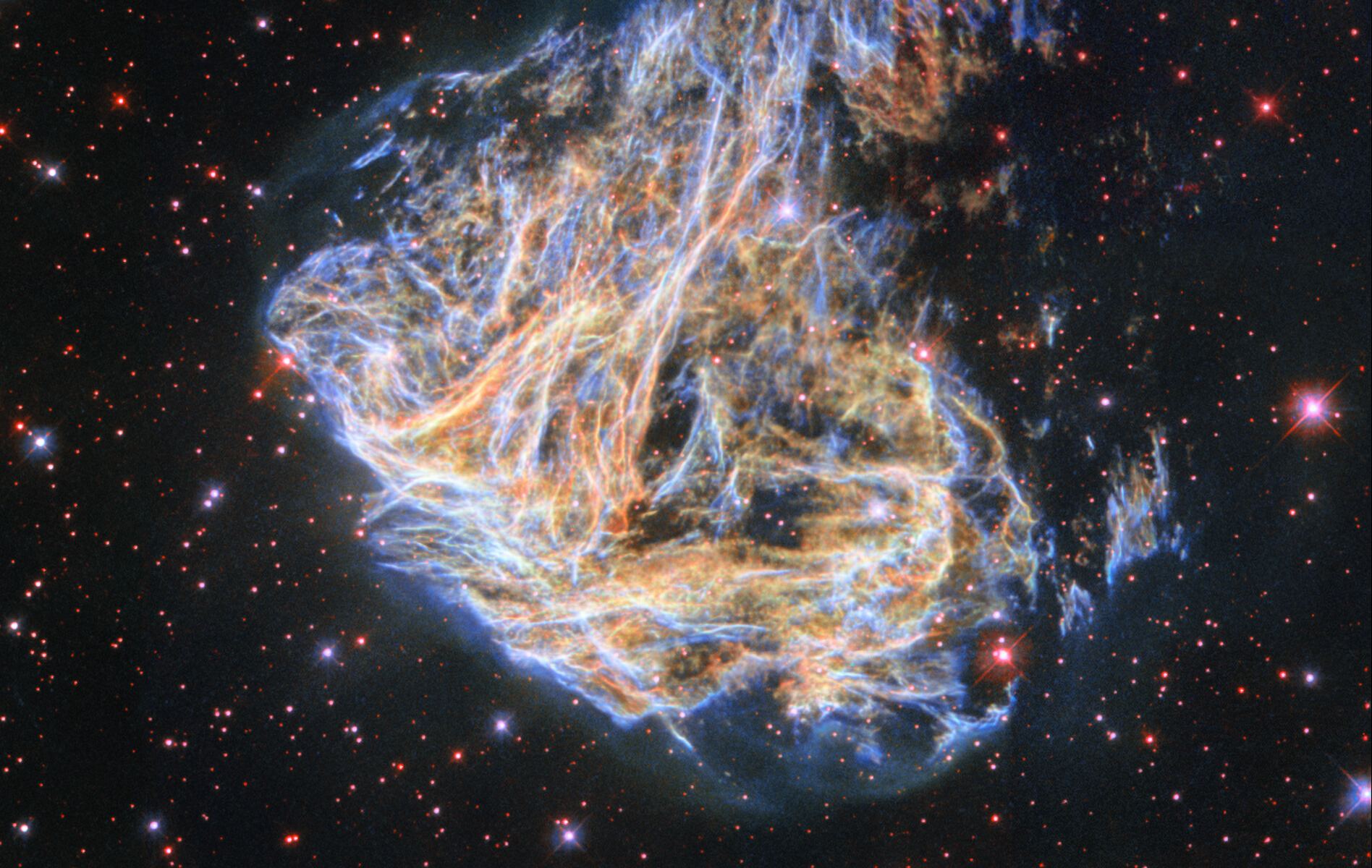
The Rosy Remains of a Star’s Final Days

May 3, 2013

Stars like our Sun can last for a very long time (in human terms, anyway!) somewhere in the neighborhood of 10-12 billion years. Already over 4.6 billion years old, the Sun is entering middle age and will keep on happily fusing hydrogen into helium for quite some time. But eventually even stars come to the [...]

Read the full article →

Are Our Textbooks Wrong? Astronomers Clash Over Hubble’s Legacy

April 4, 2013

“No scientific discovery is named after its discoverer,” - Stigler/Merton. Edwin Hubble’s contributions to astronomy earned him the honor of having his name bestowed upon arguably the most famous space telescope (the Hubble Space Telescope, HST).  Contributions that are often attributed to him include the discovery of the extragalactic scale (there exist countless other galaxies beyond [...]

Read the full article →

NASA’s Great Observatories Provide a Sparkly New View of the Small Magellanic Cloud

April 3, 2013

This is just pretty! NASA’s Great Observatories — the Hubble Space Telescope, the Chandra X-Ray Observatory and the Spitzer Infrared Telescope — have combined forces to create this new image of the Small Magellanic Cloud. The SMC is one of the Milky Way’s closest galactic neighbors. Even though it is a small, or so-called dwarf [...]

Read the full article →

Clouds of Sand and Iron Swirl in a Failed Star’s Extreme Atmosphere

January 9, 2013

Artist’s concept of brown dwarf  2MASSJ22282889-431026 (NASA/JPL-Caltech) The complex weather patterns within the atmosphere of a rapidly-rotating brown dwarf have been mapped in the highest detail ever by researchers using the infrared abilities of NASA’s Spitzer and Hubble space telescopes… talk about solar wind! Remove this ad

Read the full article →