
Sometimes, you just have to say “Wow!”
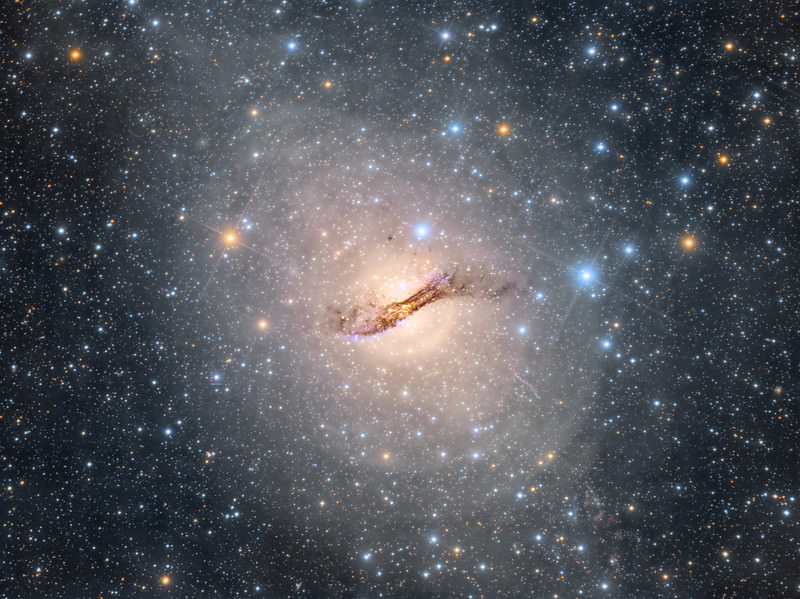
The view you’re looking at above is of Centaurus A (NGC 5128), a galaxy about 10-16 million light years distant in the southern hemisphere sky. It’s a favorite of astrophotographers and professional observatories alike.
But what makes this image so special is that it was taken by an amateur astrophotographer.
To construct this amazing image, New Zealand-based astrophotographer Rolf Wahl Olsen exposed the field of view for 120 hours over 43 nights spanning February to May of this year.
Rolf recently shared his motivation to construct this image;
“Over the past few months I have been on a mission to achieve a long time dream of mine: taking a deep sky image with more than 100 hours of exposure.”
Rolf also noted that the stars in the frame are visible down to magnitude +25.45, which “appears to go deeper than the recent ESO release” and believes that it may well be “the deepest view ever obtained of Centaurus A,” As well as “the deepest image ever taken with amateur equipment.”
Not only is the beauty and splendor of the galaxy revealed in this stunning mosaic, but you can see the variations in the populations of stars in the massive regions undergoing an outburst of star formation.
One can also see the numerous globular clusters flocking around the galaxy, as well as the optical counterparts to the radio lobes and the faint trace of the relativistic jets. The extended halo of the outer shell of stars is also visible, along with numerous foreground stars visible in the star rich region of Centaurus.
Finally, we see the dusty lane bisecting the core of this massive galaxy as seen from our Earthly vantage point.
To our knowledge, many of these features have never been captured visually by backyard observers before, much less imaged. Congrats to Rolf Wahl Olsen on a spectacular capture and sharing his view of the universe with us!
Read more on the Centaurus A deep field on Google+.
-Check out the comparison images of the Centaurus A deep field showing the relativistic jet (!) background galaxies and clusters.
-Explore more of Rolf’s outstanding work at his website.
Great image! Strictly speaking, though, the filamentary structure is not the jet itself, but rather star formation triggered by the passage of the jet through the galaxy. See http://mnras.oxfordjournals.org/content/421/2/1603.full and references therein.
Nice picture! Indeed, much deeper than other amateur ones I have seen before.
Now, if you want to continue exploring this nice object, you can go to this page to interactively compare the optical, infrared and X-ray images of this amazing galaxy, including the multi-wavelength detections of its powerful jets! Hope you enjoy it!
http://brunomerin.com/slider/centaurusa.html
This one is definitely a keeper.
LC
WOW! What a pic! That galaxy is about 11 million light years away. Trying to fathom and conceive that distance is nuts. And the universe is 13.8 billion light years? Again….WOW!
Wow.. until now the Carina Nebula was, to me, one of the most beautiful things I’d seen but this just took the cake.
Mark
ISPreview.co.uk
The filaments in the image above are composed of stars and ionized gas, both likely the result of interactions between the nuclear jet and the ISM of NGC 5128. This is one of the few known cases of jet-induced star formation. The paper you mention indeed has some fine Hubble images of these filaments (and is available here(for free): http://arxiv.org/abs/1201.3369 ). Definitely worth a look.
Also visible in the image is a tidal stellar stream composed of young blue stars probably formed by a gas-rich dwarf galaxy that fell into NGC 5128 300 Myr ago. A 2002 study had many deep images of this feature (see Fig 5, for example): http://arxiv.org/abs/astro-ph/0208422
It’s also interesting to compare this image to an extremely deep wide-field image by Michael Sidonio that was featured awhile back on UT : http://www.pbase.com/strongmanmike2002/centaurus_a
As someone who did a lot of astrophotography using hypered Tech Pan and 103a films in 70’s & 80’s I’m continually astounded by what modern amateur imagers are capable of capturing, especially using modest (in this case 6″[Mike] & 10″[Rolf]) telescopes.
WOW! ESA outdone by an amateur.