

Exoplanet Gliese 581g is back, and “officially” ranking #1 on a list of potentially habitable worlds outside of our solar system thanks to new research from the team that originally announced its discovery in 2010.
Orbiting a star 20 light-years away, the super-Earth is now listed alongside other exoplanets Gliese 667Cc, Kepler-22b, HD85512 and Gliese 581d in the University of Puerto Rico at Arecibo’s Habitable Exoplanets Catalog as good places to look for Earthlike environments… and thus the possibility of life.
First announced in September 2010 by a team led by Steven S. Vogt of UC Santa Cruz, the presence of Gliese 581g was immediately challenged by other astronomers whose data didn’t support its existence. Vogt’s team conducted further analysis of the Gliese system in which it appeared that the orbits of the planets were circular, rather than elliptical, and it was in this type of scenario that a strong signal for Gliese 581g once again appeared.
Read: Could Chance For Life on Gliese 581g Actually Be “100%”?
“This signal has a False Alarm Probability of < 4% and is consistent with a planet of minimum mass 2.2M [Earth masses], orbiting squarely in the star’s Habitable Zone at 0.13 AU, where liquid water on planetary surfaces is a distinct possibility” said Vogt.
And, located near the center of its star’s habitable “Goldilocks” zone and receiving about the same relative amount of light as Earth does, Gliese 581 g isn’t just on the list… it’s now considered the best candidate for being an Earthlike world — knocking previous favorite Gliese 667Cc into second place.
Read: Billions of Habitable Worlds Likely in the Milky Way
The announcement was made on the PHL’s press site earlier today by Professor Abel Méndez, Director of the PHL at UPR Arecibo.
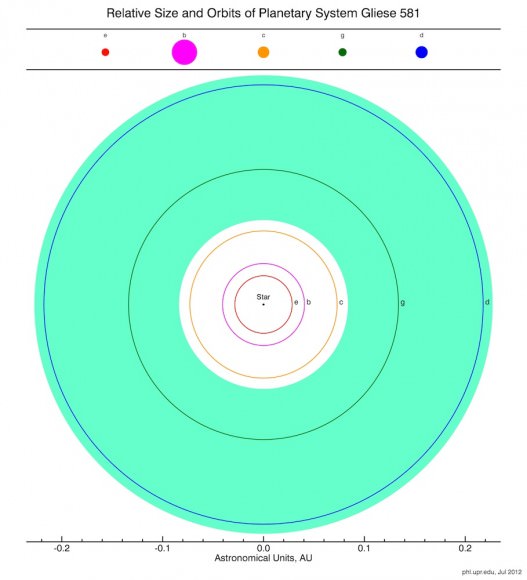
Diagram of the Gliese system. The green area is the habitable zone, where liquid water can exist on a planet’s surface. (PHL @ UPR Arecibo)
“The controversy around Gliese 581g will continue and we decided to include it to our main catalog based on the new significant evidence presented, and until more is known about the architecture of this interesting stellar system”
– Prof. Abel Méndez, UPR Arecibo
Packing my bags now. If we can get that warp drive going I’ll be 44 by the time we arrive.
The red sun will give you your superpowers back!
Sounds like a good Opportunity to think of a telescope binary on the Jupiter L4/L5 points.
Integrate LISA might be the double benifit.
So, New Earth (ideal for Glucosamine salesmen at 1.3g) is only 175,000 light hours away. Voyager 1 was launched 35 years ago and is now 16 light hours away, so at roughly half a light hour per day that’s around 1000 years. Zoutsteen’s proposal is a great starting point but to get a probe there we will need a small comet for reaction mass and a fusion or fission driven VASIMR plus we need some quantum entangled comms or we will have to wait another 20 years for the photos. Space is depressingly big.
That’s half a light hour per *year* for Voyager so ~350,000 years to get that distance. Interstellar spacecraft are well beyond us for the moment.
time to ponder whether space-wrinkles can in exist in our 3D space model, or if the wrinkle forces the existance of an additional dimension. At least a dimension that can speed up space travel.
The Voyagers were launched primarily for the Jupiter and Saturn flybys. Probing the edges of our solar system was added to the mission, for not very much added weight or cost. A probe with the primary purpose of getting to another star system would certainly have been designed to be much faster.
I find it endearing that as soon as a location is hard or impossible to reach, people want to go there. (Well, not into active volcanoes or the Sun – not often.)
Have we given up on the Alpha Centauri AB stars? Even so, there will be habitable planets closer than this. If we are really lucky, we will stumble on exoplanet nomads that wanders through the ‘hood, having subsurface oceans like Europa, and which we can actually visit with something like projected technology. We may want to assess these distribution first.
I have learned that the old VASIMR technology is surpassed by nested Hall thrusters:
“The success of the 1st-generation, <20 kW, nested channel thruster (the X2) has demonstrated that a 200 kW version (under development) could easily surpass the performance of VASIMR."
If VASIMR hits the market 2015ish, it may be too late to make an impact.
But more than that, wouldn't you want an MHD thruster for really large crafts?
It is explicit in the physics that entanglement doesn’t carry signals, it carries correlations, or it wouldn’t be compatible with relativity. Bell test experiments has shown that that is a fact to the lowest uncertainty among physics observations. (> 20 sigma in some cases.)
The outcome of decoherence of entangled systems travels with the lightcone as all other lightcone information.
Why wait for information? We can see if some of these planets are inhabited in a few years anyway, by looking at their atmospheres. That is much faster and cheaper, and the technology is mostly already developed.
It’s comforting for the opportunity to find life beyond Earth that now that we’re finding so many planets. In just 20 years we’ve gone from “If there are planets beyond our solar system” to “Holy cow, there’s too many to keep track of!”
It will be “Common Gliese” instead of “Rare Earth” from now on.
But it is a nice illustration of the importance of M stars for considering habitability.
Pros:
– A 2 habitable planet system out of 5 planets vs our 2 out of 8, both more closely Earth-like. Average habitability ~ 0.33 vs 0.21 per planet, 0.82 vs 0.83 per habitable.
– Gliese 581 g is even closer an Earth analog than the ESI suggests, since it is so sensitive to temperature. The temperature estimate is ~ 10 K lower than ours. All other parameters are freakishly [in statistical terminology] close.
Cons:
– The existence of this planet is controversial.
– Its implications for the fraction of stars having at least one habitable planet is huge.
– Vogt’s investment in it is extraordinary large.
– It is likely a tidally locked planet (M star), and the ESI is estimated based on an atmospheric model. It is thus far a longer shot than F & G star habitables.
I would cool your heels over going there. Warp drives are extremely unlikely, or at least warp drives that take a craft faster than light. A spacecraft that could carry a crew to another star, even within the 20-22 light year distance range (cosmically on our back door), would have to be utterly enormous. The costs are far beyond what our economy could afford.
It might be best to wait until we get some optical interferometric data on these planets to see if they are at all what we think they are. Even better we might be advised to send a probe to these star systems, which might drop a robotic probe on these planets. It might be best to get a close look at what we now observe. A photon driven solar sail, say with Fresnal lens concentrators which concentrate solar photons on a large sail craft, could reach low gamma, or for ? = 1.15 this is half light speed. The craft would take over 40 years to get there and over 20 years to send a signal back, A ? = 2 is about the upper limit with this technology, or v = .87c, which would take 25-28 years to get there and another 20+ years for a signal return.
I would be curious to know how the statistics for habitability are computed. Something tells me these are not at the 5-sigma level. Always remember Mark Twain, “There are lies, damned lies and statistics.”
LC
The measures are here, at a guess the statistics are depending on the planet. (Say atmosphere model.)
As these databases are to be used statistically for guiding further research, I don’t think one should read too much into each sample.
It looks pretty qualitative. To be honest I am not sure how anyone could refine this. Planets are pretty complicated things.
I suspect there are a fair number of planets with life on the same level seen on Earth up to around 700 million years ago. It could be that these Gliese planets have unicellular life, and maybe they have some multicellular type of life.
LC
Guessing the atmospheric composition of Gl 581 planets,
with their masses and the metallicity of the parent star as the only
data seems to be a very long shot. If Gl 581 d had an atmosphere of CO2
with 50 bars at the surface,
it would allow liquid water to exist, but how about 15 kbars of H2/He
instead? And the data about Kepler-11 system and
GJ 1214 b, strongly suggest that 2-10 M(earths) planets rather prefer
to
be sub-neptunes, or at least oceanworlds with much higher water content
than that of our terrestrial planets, and not super-earths. Any CO2 in
the composition of an oceanworld would
dissolve in it’s ocean, so the assumed conditions for Gl 581 planets could in fact be highly unlikely…
Besides, If Neptune had just a little less hydrogen in it’s bulk
composition, we would have a second liquid water surface in our Solar
system, although under several hundred bars of H2/He, illuminated no
better than deep twilight on Earth, and with 1,5 g gravity. But that
could be, in case of not-too-great pressure, much more human-friendly
environment than Martian surface. So why Neptune-like planet ranks
0,3-0,4 points lower than Jupiter on ESI?
More, Gliese 581 e could very well have been formed with substantial
water content. The water then likely would have been photodissociated by stellar
activity, and hydrogen would escape, but not oxygen due to the mass of
1,9 M(Earths). Since the planet likely is tidally-locked and has no axial
tilt, it could have some temperate zone close to it’s terminator. This sounds
like super-Arrrakis, but could be more human- and life-friendly than a deep oceanworld due to all the heavy elements being more available, and still more
likely than 8-earth mass Gliese 581d with continents and 50 bars of
CO2…
There is likely some boundary region between a super-Earth and a dwarf Neptunian planet. Is suspect some of these larger super-Earth planets might have huge atmospheres. Also M-class stars flare up considerably. Gliese 581 exhibits little flaring, as I recall, but this could be a transient phase or state. A million years from now the star could be flaring violently, or it flared up a lot a million years ago.
These estimates are based on a rather small number of parameters, which is the best we can do at this time. I would imagine that a sample of planets with the same parameters for mass, materials, atmosphere, distance from star and so forth could vary considerably in their properties.
LC
I suspect we can agree on that the ranking-system used for these planets are a mere indicator and basically educated guesswork from the get-go. It is far from useless, but also not a true indicator of chances of life, just a starting point for the search.
Me myself I find water-worlds a more likely starting point for abiogenesis, but also more restrictive on the development of said life into high intelligence ones. Restrictive, not a block.
20 years ago huh? So aliens on that planet could have seen the moon landing, as well as… Ooh, Knight Rider came out in ’81. 🙂
That is what we humans want. When we find a good planet we want to go there,but even if it is so close it is stil so far away. First we need to find out if there is life there.
Red dwarfs are not the best stars for life. And even if there is life. I do not think it will be a place were we can live.
So, this scale doesn’t rate a planet’s size, but habitability factor, am I correct?