
[/caption]
The International Space Station is big. About the size of American football field, it has an acre of solar panels, includes 358 cubic meters (12,626 cubic ft) of habitable volume, and there is enough reflective outer surface that in the right conditions, it can be seen from Earth during the day. But with the ISS, we’re just getting warmed up with building structures in space. There are some ideas out there for even larger structures — so called megastructures in space. Here are a few proposals for future space stations and structures that one day could be built in Earth orbit.
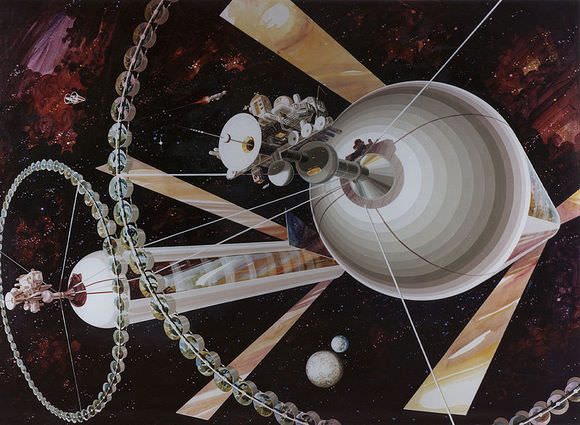
The top image is called an O’Neill cylinder, and is a space habitat proposed by physicist Gerard K. O’Neill. What started out as a design challenge for his students became structures O’Neill used in his book that promoted the idea of humans living in space, The High Frontier: Human Colonies in Space. An O’Neill cylinder consists of two very large, counter-rotating cylinders, each 5 miles (8 km) in diameter and 20 miles (32 km) long, that are connected at each end by a rod via a bearing system. The rotation provides artificial gravity on the inner surfaces while the central axis of the habitat would be a zero gravity region, where recreational facilities could be located.
To save the huge cost of rocketing the materials from Earth, this habitat could be built with materials launched from the moon with a mass driver.

After O’Neill proposed his structure, a later NASA/Ames study at Stanford University developed an alternate version, the Stanford torus. This is torus, or donut-shaped ring, 1.8 km in diameter. This structure would be capable of housing 10,000 to 140,000 permanent residents, similar to a suburb here on Earth.
The structure would rotate once per minute to provide between 0.9g and 1.0g of artificial gravity on the inside of the outer ring from centripetal acceleration. The interior of the torus would be used as living space, and is large enough that a “natural” environment can be simulated, including trees and other plants. Sunlight would be provided inside the structure with a system of mirrors.
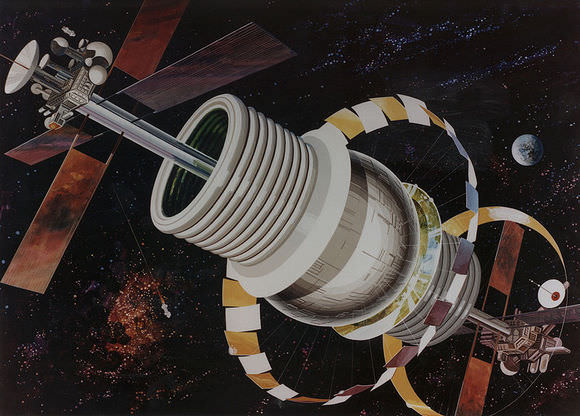
A Bernal sphere is a another type of orbital space habitat intended as a long-term home for permanent residents. It was first proposed in 1929 by John Desmond Bernal, and is said to be one of the inspirations for Gerard O’Neill and his students. Bernal’s original proposal included a hollow spherical shell 1.6 km (1 mile) in diameter, filled with air for a target population of 20,000 to 30,000 people.
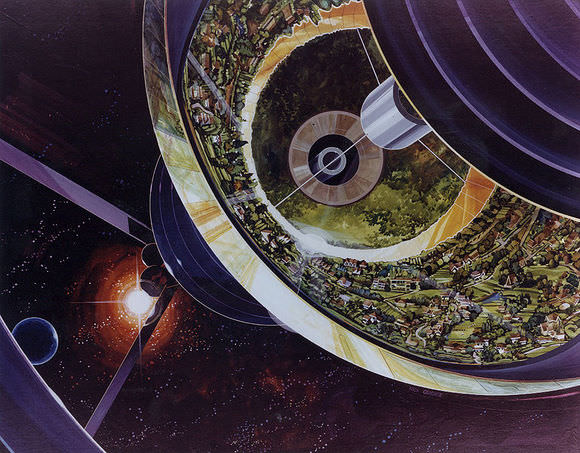
Bernal predicted that as the human race grew, their material and energy needs would outpace what planet Earth could provide. Orbiting colonies could harness the Sun’s energy and provide extra living space for a burgeoning population.
Rotating the sphere twice a minute would generate an artificial gravity aproximate to Earth’s. An advantage of the sphere is that it has the smallest surface area for a given internal volume, so minimizing the amount of radiation shielding required.
Our next Future Friday will take a look at megastructures at the planetary scale.
Source: Wiki
I’m not that pessimistic, LC. I think we’ll get there eventually, just not in our lifetimes, sadly. Before we can start making strides towards megastructures in space two things must happen. Development a low cost launching system (e.g. multiple space elevators or the equivalent) and a compelling need, which could be anything from the need for mass exploitation of resources not found on Earth to the need to develop some type of lifeboat if things start getting dicey on Earth. (Of course, tourism and a playground for the super-rich could be just as likely a reason!)
In the end I think the human race will get there, simply because we will have the drive and curiosity to do it. Unless you are pessimistic about our chances of avoiding a civilization ending catastrophe, then I believe we will, at some point begin solving some of the more intractable problems facing us — global warming, over population, energy crises, etc. And when we’re all living comfortable lives to the age of 250 (yeah, not any time soon, I know) then the call of the frontier will always be there, beckoning. And I just don’t see how we will be able to refuse the call.
As a reminder, just think how far we’ve come in just in the last 150 years. Life expectancy (in the West anyway) has doubled. We travel routinely to the other side of the world in less than a day (it took at least 6 weeks in 1850, usually more). We’ve been to the Moon, sent space probes out of the solar system, on and on and on.
When we look at how the manned US space program has stagnated in the last 40 years (in terms of missions beyond LEO) we tend to overlook the tremendous amount of technological progress we have made in the last century or two, and it’s not slowing down. Add another 500 years to that and who knows what will be routine in 2509?
Yeah, as I mention in my first comment, I think we’ll have to solve most of the difficult problems we’re facing before we really push hard into space in large numbers.
There could be some unforeseen circumstance that pushes us there before that happens. My favorite would be first-hand ETI contact, not because it’s at all likely, but it’s the only way, in my lifetime, that I can see how we’re going to be able to do it 🙂
It must be pointed out that the toridial structure, or Standford Torus, is the only which makes sense physically. The rest of these have the rotation along a small moment of inertial. This will result in the axis of the rotation to eventually precess.
These ideas seem to be receeding further into the realm of fiction. I think the energy and cost of developing these things are far beyond what we can muster, or maybe beyond what we can ever accomplish.
LC
I really really hate this notion of creating more space to relieve overpopulation. It’s nuts. The only way to go about solving that particular problem is right here on Earth.
And rather ironically, if we keep wasting ressources on breeding like rabbits down here, we’ll never be able to afford going up there.
That is not to say that finding a way to live a thrive in Space is not a worthwhile goal, but it must be the target in it’s own right, not a means to an end.
For one thing: if we can’t first stop popping out babies on Earth, what are the odds that we will once we’re stuck in an ever more confined space?
Nah. Good idea, but not yet. Not by a far cry.
I tend to agree with Sili. However, space colonization, including space habitats, while it can never be used as a relief for Earth problems, will one day be needed if we want to survive as a species. It’s simple as go spatial or become extinct.
It ain’t for now, of course, it isn’t for many, many years, and we really can’t think space colonization will relief anything on Earth (apart from the very real byproducts of all space research, which we’re already enjoying, and the possibility that one day we may find some really great material that can only be produced in microgravity). But the need is there, so we better start finding the technology as soon as we can. Which is right now.
For that, the ISS is invaluable. Every glitch, every flaw, every thing that works brings us closer to that goal.
And we don’t have to go all Bernal or O’Neill anytime soon to continue developping our presence in space. After the ISS, there are lots of intermediary steps to be taken before even the smallest of these megastructures can be contemplated in earnest.
Jorge is right, we must expand as a species or the human race will stagnate (or worse). It may be difficult to imagine cities in space, but thats normal; in the 19th century do you think anyone expected planes or the internet or even skyscrapers? Many of the more narrow minded people (LC) believed that technology was as far as it would ever progress (look up Lord Kelvin).
Hell, even without radically new technology this is possible, it just needs money, time and the human spirit (determination and ambition). The money is by far the hardest part, but given the hundreds of billions in economic stimulus packages and the trillions in our GDP, this can be overcome.
Thank you, Mr. Man.
As fun as these mega structures seem, I do not believe they are of any practical use. As a space hotel – fine, but let’s not kid ourselves that they could act as a relief to an over populated Earth.
Mining resources from our moon or neighbouring planets might become a viable financial proposition, but other than a folly mega structures have no place on the scientific hit-list. Interstellar travel is a journey of such distance that rotationally generated gravity would become redundant due to the force provided by the need to accelerate to a sensible proportion of light speed if we are to make it to another possibly habitable solar system inside anyone’s lifetime.
Maxwell, it’s not a matter of needing to work out our foibles — it’s whether we have enough money and resources to exploit space to the extent we would have thousands of people living there (or on the Moon, Mars, whatever) while there are so many expensive problems to solve down here.
If the USA or Europe had hundreds of billions of dollars going spare *and* there was enough of a reason to spend the surplus in space, we likely would, even if Africa was still struggling to overcome plague and famine,
Alternatively, if some clever chap comes along and builds a viable space elevator within the next 20 years and reduces the cost of getting into orbit 100-fold, then there will be all kinds of private as well as public money being sent up into space, and as soon as human travel on that elevator was safe enough, you can bet your bottom dollar that there will quickly a place visit on the top end of it, followed by a place to live.
I don’t think space colonies will buy us that much living space. Also everything which one depends upon must be technically managed, including the air one breathes. Life on a space colony would likely be completely managed — and expensive. Life on a space colony would not be about wide open spaces, but life confined in a can.
For a space colony to really exist it would have to justify itself economically. For a return on investment one might ponder the economic throughput required, and what sort of industry it would be devoted to. Even the smallest of these cans in space would cost in the hundreds of trillions of dollars, and would require a lot of monetary flow to maintain as well.
When I was in high school and some into college I was pretty big on these ideas. I read the O’Neill books with great interest. Later I learned a thing or two, and working on space systems for a time I realized how improbable these things are.
I found it interestin that O’Neill, a particle physicist, drew up his original colony as rotating along an axis with a smaller moment of inertia. It is a long can rotating about the cylindrical axis. The problem, as learned with some early satellites such as the first Explorer, is they end up wobbling and eventually rotating end over end. Any internal motion in the thing causes the energy of rotation to be attenuated and it begins to rotate with a lower energy configuration around the largest moment of inertia. I should think that he or someone would have spotted that basic problem.
If these things are to come about, the only prospect is to engage in applications in the cis-lunar environment, such as maybe solar power satellites. If astronauts are to land on the moon the program needs to focus on science applications, such as deploying working facilities for astronomy or cosmic ray particle physics. Then maybe, and I think it is a distant maybe, we will baby step off Earth.
Lawrence B. Crowell
Perhaps it would actually make sense to have small mining colonies on the moon, before orbital ones because they could send resources there (including the construction material) without all the hassle of trying to escape earth.
Best. Mr. Man
Oh look, LC has depression again. 😀
@Lawrence B. Crowell:
“The problems which face human survival have a time frame of a century or so into the future. Billions of years from now are beyond consideration. Our problems stem from the fact we are some sort of terminator species which is doing an extraordinary job of tearing down the planetary biosphere.
The average mammalian species exists for a couple of millions of years. Our hominid relatives and ancestors faired no better, and in many ways worse. Neanderthals existed only 350k-years. We have only been around 100-150k-years. Species longevity is the province of the simpler life forms, particularly bacteria. Insects are by comparison very complex life forms, but simple enough to have lasted 350 million years.
Our power, if we want to call it that, is that for some time in the universe there came sufficient organizational complexity so that subunits of the universe observed and thought about itself.”
A couple of billions people might die but a lot will survive.
If we won’t top Neanderthals……..:D
We might evolve. Then, our successors will colonize earth-like planets thanks to us. We already figured out a lot.
I have no fuckin’ idea what are you talking about in the 3rd paragraph.
Anyway, I really don’t understand your pessimism. Are you old or something? How is it possible to live with so much pessimism?
Obviously we would have already built and colonized the moon by the time we would begin building such structures, but images like these are what inspired my childhood mind to look at the stars and wonder.
The problem with space structures is there is nothing actually in space to use. You’re either sending stuff up from earth, the moon, or looking for a nearby asteroid… which begs the question, why not build there instead?
I’m not going to haul rocks to a Lagrange point if I can live on or near the rock.
Personally I don’t think space has to wait for mankind to work out its foibles any more than America had to wait for Spain to become a utopia. Its a matter of using our existing abilities.
The only thing we need to build up is our space travel capability, the rest solves itself.
Tacitus, We don’t put a whole lot of money into the space program as it is and its given us some of the biggest returns.
I think its been proven you can invest ten fold in military or social programs and get far less of a pay back. People will still get sick and the brown men will still shoot at us.
Maybe its time to hustle the space elevator thing along so at least a few of us can get off this rock. A little expansion might just give us the resources and breathing room so we don’t take to wiping ourselves out on the ground.
Btw, I’m really, really tired of seeing impossible ideas of space habitation as a means of stemming overpopulation discussed as if they made any sense whatsoever. The current population increase at a net rate of ~ 1 %, or 10^8 out of a population of 10^10.
To launch that many or more would mean launching 10^6 people every day, or ~ 10^8 kg. Current launch cost is ~ 10^8 USD/Ariane, or 50 kUSD/kg. Total marginal cost, not counting building infrastructure, is then ~ 5*10^4*10*8 or ~ 10^13 USD.
The world GDP was ~ 65*10^12 USD 2007 or ~ 10^13 USD. That means that if we abandon all else for the purpose of launching people in LEO, we would not get rid of overpopulation the intended way. Instead we would starve to death.
I’m tired of these types of observation as well. We are doing what every other species are doing, utilizing ecological resources found in our niche. The planetary biosphere has been “torn down”, or rather transformed, many times before. The baddest guys where the forerunners of the plants, who destroyed most earlier niches in “the oxygen catastrophe” when Earth atmosphere got oxygenated.
(But we have also analogues in what you may call “the motility catastrophe”, when early thriving microbial mats were shadowed and/or consumed by motile plants and predators, or putatively “the shit catastrophe” when animals with digestive systems killed of two whole clades of competing animals without them by concentrating nutrients away from wholesale dissolution in sea water, as reported a few weeks back.)
Anyhow, humans are neither better nor worse than other species in this respect. So why mention it at all?
Perhaps, but the average species exists AFAIU around a hundred thousand year or so, as most species goes extinct. This is, as you note, standard fare for homo species. The longest lasting species, Homo erectus, seems to have been around ~ 1 million year.
The reason for this may be that the average hominid weren’t as successful as H. erectus. In fact, genetics says that we ourselves went through a bottleneck with an effective (breeding) population of ~ 2000 individuals. Such small populations evolve rapidly by bottleneck drift.
Today we evolve rapidly for the reverse reason. Or at least, that is what Hawks et al measure. The selection rate has gone up two orders of magnitude the last 10^5 years as the population increased several orders of magnitude. Selection is ever more efficient in “resolving” small fitness benefits where instead earlier near neutral drift or bottleneck effects fixed genes.
In any case, besides the non-sequitur of population size effects on evolution and speciation rates as a longevity measure of success, there is no telling where our behavior, contingent evolutionary or contingent socially, will lead us. Either in numbers (biomass) or longevity, whichever your preferred measure of success. But FWIW, pessimism is an emotional state with little survival value.
Unless you compare individual species, you are comparing apples with pears. Mammals or synapsids have existed as long as the sister clade sauropsids. Well, actually synapsid fossils are older, 320 million years as opposed to 310.
And amniotes are 340 million years old. Are you putting a mere 10 % difference between insects and synapsids, or insects and amniotes, against us? Or better, against tetrapods in general, ~ 380 million years old. And what would this difference mean exactly?
Um, OK. I think it is a great idea to point out that the ISS is a prime demonstrator in a time were seemingly everyone want to find something wrong with its existence.
Yes, there were pretty large and complicated structures built before. (One can argue, from the Gemini/Agena and Apollo CM/LEM structures and on.) But it’s a matter of scale and complexity, where ISS is an important achievement.
However, for the long future I agree with Maxwell. For an IMHO great example, harnessing NEOs are better use of available resources.
[NEOs can be mined in synergism with them being made geo-habitable by more or less known techniques. (Indubitably nevertheless needing massive development.) The same synergism adhere to removing them as risks and them being made transportable. (But the technology for that is non-existent.) Finally, AFAIU they won’t suffer from introduced spin instabilities if one is careful.]
In the near future, the later article on using an ESA tin can (MPLM) to extend the ISS means there may be a potential large window for increasing the space tourism business. I think Bigelow wants to place space hotels close to the ISS which can be used as a way and rescue station. But seeing the above perhaps also on it. Such flexibility and synergism is what one could hope would drive space habitation for now, not megastructuring for its own sake.
My position is not based on pessimism. That is unless I am being pessimistic by saying I will die — which of course is true, as it is with all of us. We just opt to keep that prospect as postponed as possible.
The same is true of the human species in general: We are doomed! The only type of universe where we could stand any chance of surviving indefinately is the Hoyle-Narlikar steady state continual creation universe. If we have learned anything about cosmology we have ruled that model out. So even if we manage to escape the sun’s future firey bloat as a red giant, even if we survive the end of the stellar phase of the universe, confront the thermal die-off of local structures, and on and on, we simply can’t survive indefinately.
When it comes to things which imperil human existence there are problems of grave concern that have time frames of decades into the future. Matters of survival on astronomical, geological and cosmological time scales are hardly of any real concern IMO.
Maxwell above has a good point: There is nothing in space for us. Space is a fascinating area for study, but there is nothing out there for us aqueous bags of peptides, lipids and saccharides. Even if we set up shop on the moon there is very little water beyond some putative spectral signatures for ice in craters, there are no organic compounds to speak of, and the environment is a most lethal desert. Mars is only a little better, and the rest of the planets are almost inaccessible gravitational pits of death.
I have some experience with scientific programs in space. Getting a spacecraft into an appropriate orbit to test general relativity (eg LAGEOS) is a considerable task. Even tougher are getting a craft into the Lissajous L2 orbit, or send a craft to Mars, or the complex orbitial dynamics of Messenger and …, these are tough problems. Now putting humans in the mix makes the program 10-100 times the complexity and cost. Then heap onto that the idea of setting up permanent stations or colonies with thousands of people.
Does this mean we may be limited forever to living on Earth? That is a very serious prospect, and if that is the case we need to prepare for it.
Lawrence B. Crowell
I’ve already made two long comments, but this tickles me to make yet another:
Another non-sequitur. Species, as part of the evolution process are not persistent states. Populations comes and goes, as they must, or the process stop.
[Life however, as the process of evolution, is potentially eternal. And it is more competitive than static life forms. Why else do we observe a lack of those?]
I’m sure that was what the earliest biochemicals “thought” of Earth before they were replicators, or the sea creatures “thought” of land before they tried it out.
There are potentially infinite resources out there. Why not try to make it in a potentially good niche?
Finally, out of curiosity: Why aren’t there organics on the Moon and how do we know that? Most other bodies, or even space itself even if dispersed, have plenty of them, so why would the Moon differ?
D’oh! Seems I forgot to convert launch cost on a daily basis back to years. We wouldn’t only be starving to death, we can’t possibly do it.
Unless launch costs come down 2-3 orders of magnitude, which seems ridiculous even in the long run, but more so in the short overpopulation perspective of a few decades here or there.
Because unlike other species, we have the capacity to know what we’re doing. Due to our big brains and handy hands, we’re not like other species. We’re something special and unique in evolutionary terms. Very soon, we’ll be able, if we so wish, to extricate ourselves totally from evolutionary mechanisms. And we also can, if we so wish, avoid doing irreparable damage to the biosphere as a whole. We’s not mindless microbes acting according to the rules set in their nucleic acids: we can learn and we can act upon what we learn.
No, it isn’t. Life cannot possibly outlive the Universe it’s part of. That’s the point Lawrence was trying to make.
This said, I mostly agree with you. To think we can avoid overpopulation by fleeing to space is totally nuts. Earth problems have to be solved on Earth, perhaps with a little help from our space friends. Colonists, perhaps, but more likely workers spending part of their professional lifes in space environments, much the same way some people spend part of their professional lifes in some of the most unhealthy environments we can find right here on our mild planet of ours. I’m convinced that, unless some major implosion overcomes our civilization (wich IS a scary but very real possibility), it will happen.
We’re nothing but toddlers in what space is concerned, and we’ll remain toddlers for decades, perhaps centuries. But yes, there are almost endless resources to be harnessed out there. The exploration of some minerals on Earth will some day be so difficult and expensive that space mining will become an economically viable endeavour. And I’m hopeful that some day some experiment in microgravity materials pays off, leading to orbital factories and everything that follows the factories. That’s when our real expansion into space may start. What we’re doing now, and what we’ll be doing for the next decades, is simply probing the waters before taking a dive.
Shoot! Whay is it that I only spot errors after posting? 🙁
“We’s not mindless microbes” should read “We’re not mindless microbes”
“right here on our mild planet of ours” should have been “right here on this mild planet of ours
Sigh…
Larsson,
I like your idea about using NEO’s as the first available step-off into space. I imagine the early steps as automated probes used to “prospect” the various bodies to determine their composition and orbital path. Use probes to discover which ones have materials we want and which of those have acceptable orbital paths (I’d think highly elliptical orbits would be more problematic). Then set up automated mining facilities that extract, package and launch the material into parking orbits for us to pick up and use for orbital construction or repackage for reentry into our atmosphere. We could mine the sky, so to speak. If we use correctly positioned mass drivers we could, over time, optimize the orbits of our mining asteroids. I think our early manned space structures will be research and industrial in nature. Only if we develop radically different launch technology will we ever look to space for more living space.
Now THAT what I’m talking about. This will happen. It is a matter of time, when we wake from our stupidity and realize that homes in space need to be a priority.
Sadly, it is too late for homes in space to defuse the population bomb. If the entire industrial output of the world was dedicated to this project starting tomorrow, it still could not keep up. So, we will have gigadeath in the next century or so.
But the survivors will learn how to colonize space and living at the top a gravity well instead of the bottom. And then there will be a day when there will be more people in space than on Earth…or any other world.
This is the is the future of humankind.
“which begs the question, why not build there instead?” It is a lot more efficent to mine material from asteriods than to bring it up from the earth. The moon had one sixth the gravity and lots of solar power available to start off, but later asteriods…and comets (for volitles) can provide.
And no, space migration will not solve the problem of unchecked reproduction – we must learn to control that first. But it will provide a place to grow and have diversity of cultures spread out….and increase the species change of long term survival (like in millions of years) in case of a disaster on the Earth.
And if C is the limit, it will prepare us for multigenerational, oneway star travel.
If you buy into the Law of Accelerating Returns, then we should have the molecular manufacturing technology to accomplish this within two or three decades, tops. We should have the materials, energy, manufacturing techniques and engineering to accomplish any and all of these proposals.
However, that same level of technology should also let us essentially upload our minds onto computer architectures, then download to a variety of robot forms suitable for a much wider range of environments than biological humans can handle. Thus there would be no need to build such structures.
That’s the funny thing about prognostication: people usually look at one advance in technology without considering the parallel advances in other areas that will likely alter the equation drastically. That can lead to predictions like “computers in the future may have only 1,000 vacuum tubes and weigh only 1.5 tons.” — Popular Mechanics, 1949. (Then again, there’s the flying cars prediction that’s still not in sight.)
I don’t doubt if we have the funds and the will, such hugh space stations can be built. Outer space remains and really, may stay a very dangerous place dispite the best technology not now known. The further we are away from any thin part of our protective atmosphere, the more danger is involved. Very powerful Gamma-Ray bursts-,
UltraHighEnergyCosmicRays,the likes of which has not been recorded in density before and other nasty rays from the Sun and the Universe will endanger all onboard the space stations. Such a large surface area for the space station will be a bigger target for wayward meteoroids. It is possible technology not now available can lessen the dangers of meteoroids,however, UHECR and other nasty radiation from the Sun and Universe may not be defeated unless there’s a way to shield the space station with about
20,meters of lead, but that may not be feasible.It would probably be in the 24th or 25century before space stations can even attempt to approch the size pictured in this thread.
LC is very intelligent and has good points. I may sound pessimistic, however, I believe there are other advanced lifeforms far away in our galaxy at various periods of time who went through a 1000 year experiment to travel to other stars, but it was futility at best because of the enormous distance involved. These advanced cultures went back into being ‘homebodies’ and merely sent out probes to explore the galaxy., These probes travels far faster than what we have, still, the Galaxy is HUGH!!!. I would not be surprized if a extraterrtrial probe traveled at it’s closest 20LY away 100M years ago or sooner, Perhaps there are thousands or tens of thousands or even more probing our galaxy but the distance is so enormous, any whizzing by our Sun will still be at best a few light years away.Perhaps the creators of many of the probes are now extinct.!!!!!. Humans may use probes to check out other close stars, I am hoping humans can send manned vehicles to other stars, however, we still lack suitable proplosion systems but perhaps far in the futre, something feasible can be found. Still, traveling to the nearest stars will be of a danger many,many magnitudes greater than circling the Earth or going to the Moon or even the other Planets.
Some people are touching on topics which might indicates something of how some influence of our species will continue onwards into the distant future. I think that if any life form, or quasi-life form takes root in the solar system it will be due to self-replicating cellular automata or von Neumann probes we establish in space. It strikes me as plausible the solar system hundreds of millions of years from now will be filled by a sort of eco-system of self-repllicating AI systems. These will over many millions of years have evolved into a myriad number of forms. These might then migrate over time to other star systems and so forth. I find this to be a far more plausible scenario for how we might influence the distant astro-future than with more conventional or old fashioned sci-fi ideas of large starships and planetary or star colonies and so forth.
My skepticism about moving into space colonies is not motivated particularly by any depression of sorts. As pointed out above we are not going to reduce Earth population by moving people into space. That is very clear. Other future-scape ideas involving space travel from last century just simply appear to be fading away.
Our immediate problems are two fold. The most immediate is some sort of mass-social phenomenon. Societies seem to have a 3-4 generation cycle of chaos, which over the last 400 years has mode locked the world increasingly into one cycle originating in Europe. I think there might be pheremonal and endocrine elements to this which set our neuro-transmitter levels in strange ways. This occurs with some animals when they collectively enter into gregarious behaviors. We seem to do something like this as well, and about every 100 years we go collectively crazy. The last such episode lasted from 1914-1945, and we appear to be on track for the next disaster. Last time Germany was the crux of the problem, this time it will be the US of A. The rhetoric and intrusion of religious and semi-fascistic fanaticism into the political fray is less than comforting.
The second and longer term problem is of course our situatiuon on this planet, where we are tearing up natural systems. We are akin to the classic demonstration of a mold or bacteria on the petrie dish which exponentially multiples and grows to fill up the dish, consumes the agar and eventually dies out and leaves a black crisp behind.
Lawrence B. Crowell
If we don’t expand out of the Earth, humanity will be dead in 1000 years (from war, pollution, terrorism or whatever) and I don’t know about you guys but I’m not ok with that happening!
I DON’T want us to be a dying piece of mold, and niether should you (how can you be so content with that thought if your not depressed?!)
-Mr. Man
I agree those structures will not solve overpopulation, but at the very least they will increase the limit on how many humans can be alive at one time, before overpopulation becomes severe. This is especially true, if we extract resources and create industry on the moon and astriods.
@ ILOVETHESTAR: I wrote a book on the physics required to send probes to other stars. “Can We Explore Star Systems, The physics of star probes” by World Scientific. I outline some of the basic mechanics and relativity involved with relativistic rocketry and photon sails. I discuss some exotic space propulsion theories and the problem of humans travelling to the stars.
Cheers LC
LC-=Thank you for pointing out the book you wrote. I’ve checked the sample pages and looks interesting. I always wanted to read a book on what is actually involved in traveling to the stars with the associated problems described instead of ‘theorist beliefs’ without describing the real problems and other issues involved. it will take a few days for UPS or whatever to deliver it to me.
I look forward to reading the book.
Take care
I vote, caveman at least one more time, then maybe with enough mutational genetic processing thrown in, a civilization will evolve that finally reaches for the stars. Til then? Dream up!
Thanks for buying it. The book is a way of illustrating some aspects of physics in an alternative format. Sending probes to other stars is possible, maybe within the next 50 years.
LC
LC-Yes,it will be about a week before I get it and I look forward to reading a realistic alternative book about outer space travel. The barrier to travel at a high % of speed-of-light and through White Holes will, IMHO, not be defeated.!! If a manned spaceship can travel 50% speed-of-light, the journey will be fatal for all onboard in less than a second!!!. ‘Empty’ outer space has many hydrogen and other particles per sq. meter, and the kinetic energy hitting ONE of those particles would be about the energy of a 5 kiloton explosion and/or radiation-perhaps 22 meters of lead ‘shield’ may lessen the impact, but the ‘shield’ will not last long, Manned travel to the nearest stars may forever be out of the question, but there is much to explore in our own Solar System
@ ILOVETHESTAR
Hydrogen atoms at 0,5c have about 24 orders of magnitude lower kinetic energy than you suggested. If there were such cosmic rays (kilotons of TNT equivalent), they would probably prohibit planet formation. Space travel is really hard, but not THAT hard.
inuk-Thank you for info.
The particles out there in outer space is still going to make travel even at 50% Speed-Of-Light an awfully serious issue for the spaceship and the occupants.
So far, humans hit nearly 10miles per second (16kps) propulsion powered and 28miles per second (45kps) gravity assisted.
This is FAR from even 50% the speed of light
There was many co-workers who complaint to me if we could hit the speed of sound, why is it so difficult to hit the speed of light!?!?
Unfortunately, there are too many people out there who complaint why the space programs did not reach this goal. I told these SI-FI freaks the speed of sound is about 700MilesPerHour (1125kph),
I told them there are animals that can already run 10% speed-of-sound and fly/dive +20% !!!’
I told them to check their math, to even reach about 50$ speed of light is to have a propulsion that can make the space vessel move nearly 10,000 times faster!!!. Nuclear power is not going to be fast enough, although humans attempting travel
to the nearest stars, the mass of nuclear material required will be 5-10 times the mass of the vessel, besides, there are anti-nuclear peeps who don’t want any nuclear material close to Earth. Anti-matter, dream on!!!!!
LC If there will indeed be a probe to the stars launched 50 years from now, it will be far,far more capable than the Pioneer and Voyager projects as both projects used computer tech
that was most likely of the IBM360 series (1960s) or ‘top secret’ 1st generation IBM370 series as the chips and materials involved
had to be’ super-hardened’ to withstand Jupiters fierce radiation field. I think NASA is surprized these probes are still functiioning although the transmitters are very weak and they been traveling about 35 years each, none has yet to completely clear the Suns’ heliosphere, or be in ‘true’ outer space.
The probe to be launched 50 years from now will be a few generations in the making by the time very informative data can be transmitted and understood by the layperson..
@ILOVETHESTAR
The solution to nuclear power is to build the ship in space, away from Earth’s magnetic field. Or maybe on the moon. Such a ship could go 10% the speed of light, sure its not .5c, but it’s not one ten thousenth either! And don’t tell those “SI FI Freaks” to get their Maths strait when YOUR the one that said 1H atom would do 5KTs of damage at .5c…you would need a mass of 4grams to cause such damage…small, indeed, but hardly close the mass of a Hydrogen atom!
Also, whether somebody would die in a second or not at .5c is based on the acceleration to get to that speed, not the speed itself, which is obviously what you were thinking! At a constant acceleration of 1g, you would still reach .5c in a reasonable timeframe given the context of travelling to another star system, which will take years already.
why are you trying to crush everyones dreams, especially since you haven’t a clue what your talking about.
Mr. Man
Mr. Man-I would think going at 50% SOL will cause +4grams of particles to hit the vessel every second.!!!!!!!!!!!.
‘True’ outer space is not really empty!!!!!!!!!!!!
Mr. Man- Although it will be generations before they have an idea how many particles there is in a cubic meter of space in ‘true outer space’ , the vessel will travel 93K miles
150k Kilo per second at 50%SOL-since you say your math is excellent while my math is poor, tell me how many particles will hit the vessel in 1 second with a direct frontal bow of
20 sq meters.!!!!!!!!!!!!!!!!!!!!!
Since we have no idea how many particles are in each cubic meter
how am I supposed to even attempt that question….mr. math genius.
Mr. Man =you appear to be a SI-FI freak. Our best telescopes,other devices knows there’s particles in each cubic meter of true outer space due to dimming that must be accounted for. However, before you talk crap with me, you better get your head out of your as_ and read what I did say to begin with.!!!!! I bet you believe in 2012, read the thread on ‘ onion’ what I do with chumps errr customers who believes that crap!!!!!! I multi-task on these ‘puters’ so I don’t have time to waste with fools like you.!!!!!!!
Mr. Man-apparently, you did not read the 1st post fully where I said it was a 5kt blast and/OR RADIATION, Instead of me pointing this out when you was having diarrea of the mouth and you had me wasting time, just remember RADIATION, humans are NOT RADIATION proof unless you have a thick shield of lead.
LC- I’ve created a post earlier about the probe being launched about 50years from now. That probe is going to be far,far more capable than the Pioneer and Voyager projects. The probe will be most likely nuclear power and will travel 500MPS (800kiloPS) and be require .about 2 years to completely past the Suns’ Heliosphere. The probe can note the type of charged particles,
UHFCR and other nasty rays etc in true outer space. IMHO, the Suns’ helioshere or the Suns’ charged particles stops far over 99% of deadly radiation creators , still, much gamma rays, UHFCR and many other nasty cosmic rays gets through due to the numbers wizzing about in true outer space, the source is many,
but to make it short, many exotic objects creates these deadly rays and the helioshere stops a stupendous amount but still the numbers getting through is still enormous.
Perhaps in 200 years, a larged human vessel with much lead shelding traveling about 500MPS (800kiloPS) can journey into the ‘unknown’ true outer space and check what effect this will have on humans. IMHO, the overall scheme of things is, the number of particles per sq meter of space in true outer space is of secondary importance; it is the frequency of deadly charged particles in true outer space that worries me most
BTW, I’m retiring in 4 days at 55yo from the State of California and will actually bring home more money because of my savings.
401 and state retirement lol. . I will turn more into being a far more serious amateur astronomer. I also took a week vacation and brought whatever was mind at the office home as I will not go to the office again so I don’t have to hear that fake ‘ sorry to hear you go’ or ‘we will miss you’ or ‘we now have to find another Network Administrator,hardware security unit. I’m sorry to Mr. Man I blew up but I have 3 powerful home ‘puters and I do multiask and my writing will be mixed up but I’m in to Astronomy, graphics, multimedia, earth sciences etc so I will later travel much real soon before I get too old lol-I will go to Australia in Dec2009-Jan2010 then go to Western
Europe late spring to early summer for about 3 months.
Small particle impacts are of course a problem. Since velocity scales as v^2 for nonrelativistic mechanics a small milligram particle can have the same kinetic energy as a high velocity round. At higher velocities you have to devise ways of deflecting small particles. Also designing a spaceprobe in a needle shaped configuration is advised.
For more Earth or cis-lunar regions you still have to contend with micrometeoroids which can have impacting velocities up to 74km/sec and will average about 30km/sec.
LC
Hello again, ILOVETHESTAR
ok, maybe I do enjoy SI-FI, but doesnt make me a freak, also I think the 2012 prediction is dumb and retarded (the movie looks fun though) just like you. Personally I believe that you said that because you want to imagine me as a dumb zealot freak. I’m not though, and you are in fact argueing with one just as rational as yourself, just because someone disagrees with you doesn’t, after all, make them irrational and kooko.
Furthermore since you seem so inclined to point out your earlier “facts” radiation, as problematic as it is, is not an unsolveble problem and it would not be what you would expect from a 5KT explosion, in fact, given how wrong you were about that, this would likely be proportionally smaller. Still it does add up, and can cause problems, and this is one of the reasons why we still have a ways to go (you problably know as well as I do, we can’t go anywhere near .5c…yet). But if you think that scientists in the future will be dimwits, your are mistaken, problems like these will be overcome in time.
Mr. Man
Oh and FYI about the radiation, most radioactive particles can be blocked with a sheet of paper…alpha particules….you were probrably thinking of the more potent gamma particules, caused by gamma ray bursts, which, contrary to your theory, do not instantly get more dangerous as one leaves Earth. They are isolated events that happen when a massive star dies (something that is rare, happening only a few times over millions of years in our galaxy).
Also, the closest potiential canidates for this, are so far away that even if they were to explode tommarow our spacecrafts would be unscathed. Think about it, these stars are 7500LY away so what difference would the 4-20Ly’s to the nearest stars make. As you said: the galaxy is a big place.
The bottom line is it will be many years in the future before manned spacecraft will even approach .5C. At our current speeds, it will take 300K years to reach the nearest star. I’m hopeful, but manned spacetravel to distant (and near stars) stills seems to be nothing more than a dream. @STARS, congrats on your impending retirement, you’re getting out of the State at the right time, I live in N. CA.
Onward and Upward
I know, I know
I’m getting a little carried away.
The only method avaiable for sendting something an appreciable fraction the speed of light is the photon sail. columated light from a Fresnel lens that focuses solar radiation could send a sail driven spacecraft to low gammas (gamma = 1/sqrt(1 – (v/c)^2). .5c is gamma = 1.15 and a photon sail could reach gamma = 1.5, or v = .75c. The photons reflect of the sail an impart momentum, similar to the Nichols radiometer.
Cheers LC