
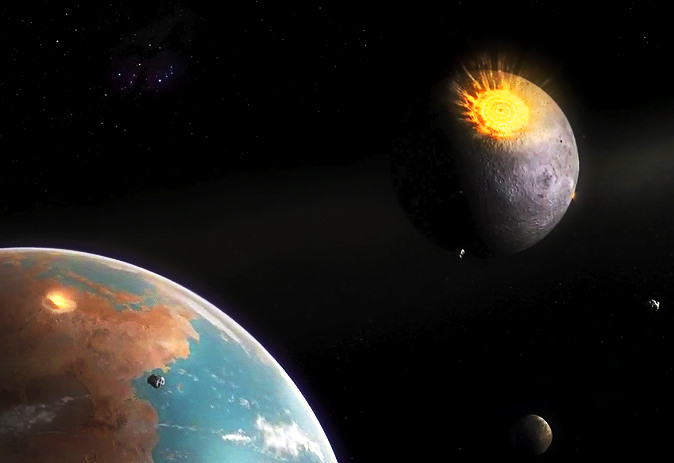
When the Moon was receiving its highest number of impacts, so was Earth. Credit: Dan Durda
Some questions about our own planet are best answered by looking someplace else entirely… in the case of impact craters and when, how and how often they were formed, that someplace can be found shining down on us nearly every night: our own companion in space, the Moon.
By studying lunar impact craters both young and old scientists can piece together the physical processes that took place during the violent moments of their creation, as well as determine how often Earth — a considerably bigger target — was experiencing similar events (and likely in much larger numbers as well.)
With no substantial atmosphere, no weather and no tectonic activity, the surface of the Moon is a veritable time capsule for events taking place in our region of the Solar System. While our constantly-evolving Earth tends to hide its past, the Moon gives up its secrets much more readily… which is why present and future lunar missions are so important to science.
 Take the crater Linné, for example. A young, pristine lunar crater, the 2.2-km-wide Linné was formed less than 10 million years ago… much longer than humans have walked the Earth, yes, but very recently on lunar geologic terms.
It was once thought that the circular Linné (as well as other craters) is bowl-shaped, thus setting a precedent for the morphology of craters on the Moon and on Earth. But laser-mapping observations by NASA’s Lunar Reconnaissance Orbiter (at right) determined in early 2012 that that’s not the case; Linné is actually more of a truncated inverted cone, with a flattened interior floor surrounded by sloping walls that rise up over half a kilometer to its rim.
On our planet the erosive processes of wind, water, and earth soon distort the shapes of craters like Linné, wearing them down, filling them in and eventually hiding them from plain sight completely. But in the Moon’s airless environment where the only weathering comes from more impacts they retain their shape for much longer lengths of time, looking brand-new for many millions of years. By studying young craters in greater detail scientists are now able to better figure out just what happens when large objects strike the surface of worlds — events that can and do occur quite regularly in the Solar System, and which may have even allowed life to gain a foothold on Earth.
Most of the craters visible on the Moon today — Linné excluded, of course — are thought to have formed within a narrow period of time between 3.8 and 3.9 billion years ago. This period, called the Late Heavy Bombardment, saw a high rate of impact events throughout the inner Solar System, not only on the Moon but also on Mars, Mercury, presumably Venus and Earth as well. In fact, since at 4 times its diameter the Earth is a much larger target than the Moon, it stands to reason that Earth was impacted many more times than the Moon as well. Such large amounts of impacts introduced material from the outer Solar System to the early Earth as well as melted areas of the surface, releasing compounds like water that had been locked up in the crust… and even creating the sorts of environments where life could have begun to develop and thrive.
(It’s been suggested that there was even a longer period of heavy impact rates nicknamed the “late late heavy bombardment” that lingered up until about 2.5 billion years ago. Read more here.)
In the video below lunar geologist David Kring discusses the importance of impacts on the evolution of the Moon, Earth and eventually life as we know it today:
“Impact cratering in Earth’s past has affected not only the geologic but the biologic evolution of our planet, and we were able to deduce that in part by the lessons we learned by studying the Moon… and you just have to wonder what other things we can learn by going back to the Moon and studying that planetary body further.”
– David Kring
David is a senior staff scientist at the Lunar and Planetary Institute in Houston, TX.
It’s these sorts of connections that make lunar exploration so valuable. Keys to our planet’s past are literally sitting on the surface of the Moon, a mere 385,000 km away, waiting for us to just scoop them up and bring them back. While the hunt for a biological history on Mars or resource-mining an asteroid are definitely important goals in their own right, only the Moon holds such direct references to Earth. It’s like an orbiting index to the ongoing story of our planet — all we have to do is make the connections.
Learn more about lunar research at the LPI site here, and see the latest news and images from LRO here.
I was surprised to discover that the impact angle has to be extremely oblique to create a crater that isn’t circular.
It is mainly because a hypervelocity impactor travels faster than the sound velocity of rocks, so mechanical energy is inefficiently transferred away. (Or at least that is my understanding from secondary astrobiology descriptions.)
Then all the impact energy goes to vaporizing or liquefying the impactor and the surrounding material. Typically such an impactor makes an impact feature with ~ 20 times the diameter of the impact body.
Eg the Linné crater is ~ 2.5 km diameter, so impactor was ~ 100 m large.
During the formation of such a large feature any initial obliqueness tends to be smoothed away.
Very cool research and video!
The LHB must be seen in the context of the Nice model predictions, which predicts so much else of the system.
However, we should also keep in mind that the Moon evidence hinges critically on the Apollo datings, and that it has two problems:
“While the cataclysm hypothesis has recently gained in popularity, particularly among dynamicists who have identified possible causes for such a phenomenon, the cataclysm hypothesis is still controversial and based on debatable assumptions. Two criticisms are that (1) the “cluster” of impact ages could be an artifact of sampling a single basin’s ejecta, and (2) that the lack of impact melt rocks older than about 4.1 Ga is related to all such samples having been pulverized, or their ages being reset.
The first criticism concerns the origin of the impact melt rocks that were sampled at the Apollo landing sites. While these impact melts have been commonly attributed to having been derived from the closest basin, it has been argued that a large portion of these might instead be derived from the Imbrium basin.[7] The Imbrium impact basin is the youngest and largest of the multi-ring basins found on the central nearside of the Moon, and quantitative modeling shows that significant amounts of ejecta from this event should be present at all of the Apollo landing sites. According to this alternative hypothesis, the cluster of impact melt ages near 3.9 Ga simply reflects material being collected from a single impact event, Imbrium, and not several.
A second criticism concerns the significance of the lack of impact melt rocks older than about 4.1 Ga. One hypothesis for this observation that does not involve a cataclysm is that old melt rocks did exist, but that their ages have all been reset by the continuous effects of impact cratering over the past 4 billion years. Furthermore, it is possible that these putative samples could all have been pulverized to such small sizes that it is impossible to obtain age determinations using standard radiometric methods.[citation needed]
[ http://en.wikipedia.org/wiki/Late_Heavy_Bombardment ]
When we last touched the first criticism a year ago, it had been further substantiated:
“Dr. Spudis’s research focuses on the Montes Taurus area, between the Serenitatis and Crisium basins, not far from the Apollo 17 landing site. This is a region dominated by sculpted hills that have been interpreted to be ejected material from the adjacent Serenitatis basin impact. But, Dr. Spudis and his team have found that, instead, this sculpted material comes from the Imbrium basin some 600 kilometers away.
Previous data of this area, from the Lunar Orbiter IV camera, hadn’t shown this because a fog on the camera lens made the details difficult to see (this fog problem was eventually resolved, and Lunar Orbiter IV provided a lot of useful data on other parts of the Moon). The new LROC data, however, shows that the sculpted terrain seen at Apollo 17 is very widespread, extending far beyond the Montes Taurus region.
Furthermore, the grooves and lineated features of this terrain point to the Imbrium basin, not the Serenitatis basin, and line up with similar features in the Alpes and Fra Mauro Formations, which are known to be ejecta from the Imbrium impact. In the north of Serenitatis, these Imbrium formations even seem to transform into the Montes Taurus, confirming that the sculpted hills do, in fact, originate from the Imbrium impact.”
[ http://www.universetoday.com/92375/new-research-casts-doubt-on-the-late-heavy-bombardment/ ]
And just recently the second criticism has been deeply [sic!] amplified, I believe, if not verified, by the GRAIL findings that the whole lunar crust is pulverized and porous from the amassed impacts.
[ http://www.universetoday.com/98836/grail-first-results-provide-most-precise-lunar-gravity-map/ ; http://www.universetoday.com/98835/moons-inner-crust-almost-completely-pulverized/ ]
Maybe the Nice model can be constrained also by a more stretched bombardment than merits a LHB peak observation. My hope is that the analyzed GRAIL results will help tip the balance either way within a few years.