Robots Could Prepare Moon Outpost Site

by Nancy Atkinson on February 25, 2009

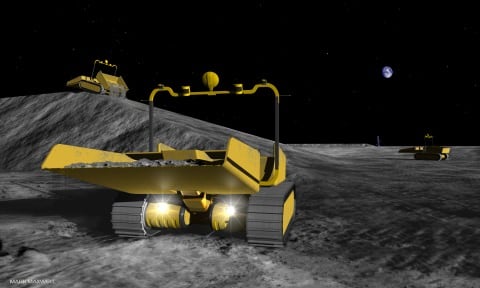
Small digger/loader on the Moon.  Creidt:  Astrobotic Technology

Small digger/loader on the Moon. Creidt: Astrobotic Technology


A new type of lunar robots is being designed which could help prepare locations on the Moon for human outposts and landing pads. With supervised autonomy, small robots the size of riding mowers and weighing 300 kg or less could prepare a site in about 6 months, says a new study by Astrobotic Technology Inc. in cooperation with Carnegie Mellon University’s Robotics Institute.

Anyone else having visions of Wall-E on the Moon?

Using small robots would offer an alternative to bringing large loaders to the Moon, as Caterpillar, Inc. has proposed, and is working on details with NASA of using a big skid steer loader on the Moon (see previous UT article, “Heavy Construction on the Moon.”)

“NASA faces a challenge in planning the layout for its outpost, which is expected to begin operations in 2020,” said William “Red” Whittaker, chairman and chief technical officer of Astrobotic and a Carnegie Mellon professor of robotics. “For efficient cargo transfer, the landing site needs to be close to the outpost’s crew quarters and laboratories. Each rocket landing and takeoff, however, will accelerate lunar grit outwards from the pad. With no atmosphere to slow it down, the dry soil would sandblast the outpost.”

The research examined two potential solutions: 1) construction of a berm around the landing site, and 2) creation of a hard-surface landing pad using indigenous materials.

In the first solution, researchers found that two rovers weighing 330 pounds each would take less than six months to build a berm around a landing site to block the sandblasting effect. A berm 8.5 feet tall in a 160-foot semi-circle would require moving 2.6 million pounds of lunar dirt. Robots this size can be sent to NASA’s planned polar outpost site in advance of human expeditions. Astrobotic Technology Inc. has proposed that landing site preparation be provided by commercial ventures.

In the second solution, researchers showed how small robots could comb the lunar soil for rocks, gathering them to pave a durable grit-free landing pad, said John Kohut, Astrobotic’s chief executive officer. “This might reduce the need to build protective berms. To discern the best approach, early robotic scouting missions need to gather on-site information about the soil’s cohesion levels and whether rocks and gravel of the right size can be found at the site.”

Astrobotic's plan for lunar rover for Google Lunar X-PRIZE. Credit: Astrobotic Tech

Astrobotic's plan for lunar rover for Google Lunar X-PRIZE. Credit: Astrobotic Tech


Whittaker is directing the development of Astrobotic’s first lunar robot, which is vying to win the $20 million Google Lunar X-PRIZE by visiting the Apollo 11 landing site and transmitting high-definition video to Earth. They are looking to launch in December 2010. The robot has been undergoing field trials for several months.

Details of the study are available at www.astrobotictech.com.


  • Max

    Why bring stuff back?

    A lunar brick on earth is worth bumpkiss compared to all the cheap bricks we have lying around.
    But a lunar brick on the moon replaces one flown from earth at extrodanary cost. Making lunar brick making a viable industry when you get someone out there to buy the things.
    Government Astronauts will likely be the first customers for private operations in space.

    Just with this article as an example, a private landscaper using remote controlled bulldozers could’ve scored themselves a contract doing basic prep work for a lunar base.
    That kind of job would be worth many millions, and its not nearly that complicated compared to space mining.

  • dollhopf

    Mr. Jefferson,

    to colonize the moon would be heavy labor.

    And I guess that “the rich” have better ways to enjoy their lives on this earthly paradise than to spend them under adverse circumstances. Also, living in a society with a broad offer of welfare benefits, I estimate that also most of “the poor” might not really exchange their backed lifestyles with the restrictions, threats, and strains of colonists. The rich or the poor: do those categories really have any interest to be on the moon? But of course, there are romantic idealists in every social class.

    What sort of people would colonize the moon? It would be men and women with the highest qualifications. Because who would pay for 80 kilogram of dumbass? Not the no-good – rich or poor – would go there! Instead, the moon would be conquered for mankind by most qualified and most skilled people. Well trained. Perfectly prepared.

    Also, Evolution (the Origin of Species by Means of Natural Selection) never sleeps!

  • robbi

    Simon Poet-That article about the abrasive Moon dust is interesting-in June1980 after the great blast and collapse of Mt St.Helens, I was living in the Portland Metro area, and St Helens erupted and the wind blew southward toward our area and it was raining, I was out for a few minutes that early morning then said I better get ready for work, I lite up the light on my watch to see the time, and when I did ‘scratched the glass’ from the abrasive ash-I did not realize how abrasive is that ash!!! When I said the area of the Moon that was vaccumed and walked over by humans or that ‘robot’ ,a few microns depth of the surface ‘cleaned’ will break off and cause more dust -that ‘robot’ looks quite heavy and will creat quite a lot of dust. The tiny bb sized meteors I’ve described are too small to creat any crater and will just go through the surface and be covered by dust it stirred up but enough hits will cause the surface to not be that ‘solid and hard’ to be dust production proof when trampled over by humans or the ‘robots’ (Ive never said on all the posts I’ve made the surface will be like walking over a ‘swiss cheese’ surface and humans may fall into a ‘swiss cheese’ weakened surface 3 meters or so-that is something for class B movies, like 2 thugs in black leather jackets jumping off their spaceships without any ‘protective suits’ looking for someone to beat up and one of the goons falls into a collapsed surface! LMAO) The Moons’ surface is far stronger than that!!!! lol-I’m just saying there will be a constant dust issue that will have to eventually be addressed!!

  • U.S. Citizen

    Mr. dollhopf

    Have you noticed how the wealthy are throwing millions into a ride to the I.S.S. already? Onboard a soviet space craft even? like The millionares don’t care about the adverse conditions. They want the fun and prestege of it all. They wont care about the adverse conditions on the moon eather. At lest I don’t think they will anyways. The wealthy are already lined up and have pre-paid or placed a down payment on a ride on Virgin Galactic already, even before the company has begun to start flight service yet.

    A lunar colony may be started with people like scientists, backed by government funding through N.A.S.A and other space programs, But there will also be other people that are not, that will want to go to the moon for just the same reasons as the ones that went to the I.S.S. One fact we must all understand and bare in mind also here, Is just what a colony is. So we don’t comfuse a colony with a short term vacation resort. A colony would be people that move to the moon to live and stay there without any intentions of returning to Earth. A vacation resort is just a place people go, to visit and then return back from. As far as being a place of employment, The Moon would be too expencive of a place to go to on a daliy bases so any employment would be only through government and corporation funding for short junts of time, like a 6 month job where you would remain there for 6 months to do a job and then return to Earth. But that would only be for the ones you pointed out, the most educated and experienced, well trained people to do. I doubt that the Moon will actually be colonized, not for at lest a long, long time from now.

  • dollhopf

    Dear U.S. Citizen,

    I can make a distinction between Anousheh Ansari or Richard Garriott and a Colombian drug lord, but never mind!

    A touristic visit of the landing site of the Eagle on the Moon would cost a lot. It is not unfair that rich people can have the experience of space while many can not. It just would be iniquitous if they would not have to pay a fair market value for this experience. Socialistic egalitarianism and enviousness are not helpfull to develop space tourism. The wealthy can help to pave the way to the stars much more than popular front revolutionaries. Therefore, don’t hinder them on their pursuit of happiness! I would rather advise you to encourage the rich to spend money on space tourism. Makes more sense! ;)

  • Salacious B. Crumb

    “I can make a distinction between Anousheh Ansari or Richard Garriott and a Colombian drug lord, but never mind!”

    I read this. Still LMAO.

  • Jefferson

    What would be a strange turn of events is if all the isolation from being on the moon months to years at a time would drive people crazy. have some astronaught related accidents, maybe not fom them killing each other ( would make a cool movie….oh wait, event hozrizon….) but maybe due to prolonged exposure to a lower to nil state of gravity, I have no idea what that could do to the human brain.I’ve heard that if your in space too long you slowly loose bone mass,but would that be the only thing to happen? What if a person was on the moon for 40 or 50 years and add some closterphobia from being stuck in dome, not being able to just be “ouside” so to say, In a sence it would kinda be like being in a cage I guess, or not, maybe someone would get use to it, maybe if they had been born on the moon orignally. And if that happend It would be interesting to see how they they would adapt to being on Earth for the first time.

  • Jefferson

    “Horizon” my bad

  • Aqua

    Robotics seem to be the obvious ‘no brainer’ when it comes to exploring and developing the moon. I think swarms of cheap solar powered mini-rovers are the answer for the exploration phase. Lets take a look at what’s there before we even begin to think of anything as expensive as manned bases! If and when we do, I like the idea of using volcanic tubes for possible habitat locations. Underground facilities would provide raditaion and micro meteor impact protection. How about focusing solar energy to create air tight fused walls in volcanic tunnels?

  • Keith Atkin

    As the astrobotictech report on lunar robots is entirely in metric (as it should be!), why has Nancy Atkinson dumbed down her account by translating into old fashioned imperial units?
    I find this insulting and wholely inappropriate for the 21 st century.
    95% of the people of this planet are metric and America has already decided to be entirely metric on future moon missions. So come on – get up to date!

  • dollhopf

    Dear Aqua,

    it is contradicting to explore places with no sunlight and difficult to access – like volcanic tubes are – with solar powered mini-rovers. You will agree that neither can pitch-dark places be explored with solar powered probes, nor can vertical tubes be explored on wheels.

    At least, probes for exploring volcanic tubes – if there are those features on the moon – should have the ability to advance in a controled motion in vertical direction. In other words, they need the ability to fly!

    Therefore, engineers should consider whether any material at the lunar environment could easily be used to extract any gas. Gas would be a perfect fuel for vehicles to fly in the void of air environment of the moon. Simply by repulsion! Even small probes could descent into volcanic tubes with such a drive. So this might be one of many solution for powering vehicles on the moon. Thanks for being without prejudice!

  • Aqua

    Dear dollhopf,
    Ahem… of course there would’nt be sunlight in a volcanic tube on the moon. That’s not what I am suggesting. Volcanic tubes can be found using ground penetrating radar from lunar orbit. The rovers would be used to explore mineral compostitions and possible entrances to a volcanic tube. Once a suitable location is identified, other robots would used to assemble an array of mirrors used to focus solar energy into a beam which then is directed into the cavern to ‘vitrify’ the walls into a glassy airtight enclosed space. As for exploring deeply into said caves and processing that space into a useful chamber, another source of power would indeed be required. Perhaps the vitrification mirrors would then be used to provide that power?

  • Aqua

    Location, location, location! The key to my suggestion is that molten lunar magma will have formed caves similar to what is found on the Hawaiian Islands. These long tunnels are where lava flowed downhill underground folowing the terrain’s sloping elevations. And yes, volcanic tubes have been found on the Moon. Whether or not they might be suitable for excavation and vitrification is another matter.

  • dollhopf

    Aqua, forgive me! Any doubts are now clearly swept off. lol

  • dollhopf

    Jefferson,

    when I saw the NASA design for lunar habitats for the first time I was reminded on TOI TOI & DIXI toilets.

  • Salacious B. Crumb

    @ Aqua (my favourite colour, incidentally)
    Give that man a big gold star!
    Lateral thinking like that might even get you a job a NASA as an advisor (Seriously)
    Do hope someone is reading in at NASA (or even in China)!
    Cheers!

  • Jefferson

    lol A zero G space out-house? Now there’s were the big bucks are!

  • Aqua

    Tay, if you liked that one, try this one on for size. In my previous comment I mentioned that solar energy could be collected and used to fuse volcanic tube walls.. The same type of set up could be used to fuse the surface around landing sites.. eliminating dust hazards by sealing the surface with a vitrified layer.

  • Aqua

    Lunar dust is a nasty actor fur shore! I like the idea of incorporating a conductive mesh in lunar spacesuits which, when charged would electrostatically repell unwanted dust particles. Get it?

  • Aqua

    Of course, the conductive mesh I mentioned might also cause you to get fried by a passing CME or other charge if you weren’t properly grounded? Protection against?

Previous post:

Next post: