Triple Whammy: Milky Way More Massive, Spinning Faster and More Likely to Collide

by Nancy Atkinson on January 5, 2009

Want to stay on top of all the space news? Follow @universetoday on Twitter

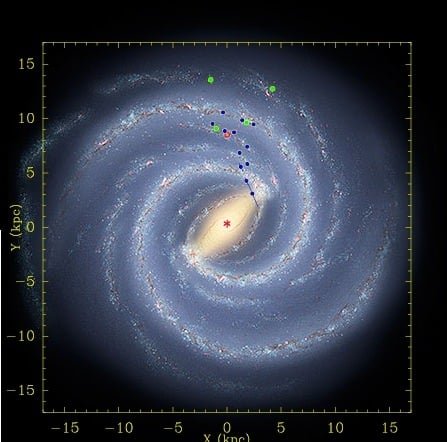
Artist's Conception of our Milky Way Galaxy: Blue, green dots indicate distance measurements. CREDIT: Robert Hurt, IPAC; Mark Reid, CfA, NRAO/AUI/NSF

Artist's Conception of our Milky Way Galaxy: Blue, green dots indicate distance measurements. CREDIT: Robert Hurt, IPAC; Mark Reid, CfA, NRAO/AUI/NSF

For many of us, looking closely in the mirror and stepping on the bathroom scale just after the holidays can reveal a substantial surprise. Likewise, astronomers looking closely at the Milky Way have found our galaxy is more massive than previously thought. High-precision measurements of the Milky Way disclose our galaxy is rotating about 100,000 miles per hour faster than previously understood. That increase in speed, said Mark Reid of the Harvard-Smithsonian Center for Astrophysics, increases the Milky Way’s mass by 50 percent. The larger mass, in turn, means a greater gravitational pull that increases the likelihood of collisions with the Andromeda galaxy or smaller nearby galaxies. So even though we’re faster, we’re also heavier and more likely to be annihilated. Bummer!

The scientists are using the National Science Foundation’s Very Long Baseline Array (VLBA) radio telescope to remake the map of the Milky Way. Taking advantage of the VLBA’s unparalleled ability to make extremely detailed images, the team is conducting a long-term program to measure distances and motions in our Galaxy. At the American Astronomical Society’s meeting in Long Beach, California, Reid said they are using trigonometric parallax to make the measurements. “This is exactly what surveyors use on Earth to measure distances,” he said. “And this is gold standard of measurement in astronomy.”

Trigonometric parallax was first used in 1838 to measure the first stellar distance. However, with better technology, the accuracy is now about 10,000 times greater.

Our solar system is about 28,000 light-years from the Milky Way’s center. At that distance, the new observations indicate, we’re moving at about 600,000 miles per hour in our Galactic orbit, up from the previous estimate of 500,000 miles per hour.

The scientists observed 19 regions of prolific star formation across the Galaxy. In areas within these regions, gas molecules are strengthening naturally-occurring radio emission in the same way that lasers strengthen light beams. These areas, called cosmic masers, serve as bright landmarks for the sharp radio vision of the VLBA. By observing these regions repeatedly at times when the Earth is at opposite sides of its orbit around the Sun, the astronomers can measure the slight apparent shift of the object’s position against the background of more distant objects.

The astronomers found that their direct distance measurements differed from earlier, indirect measurements, sometimes by as much as a factor of two. The star-forming regions harboring the cosmic masers “define the spiral arms of the Galaxy,” Reid explained. Measuring the distances to these regions thus provides a yardstick for mapping the Galaxy’s spiral structure.

The star forming regions are shown in the green and blue dots on the image above. Our sun (and us!) are where the red circle is located.

The VLBA can fix positions in the sky so accurately that the actual motion of the objects can be detected as they orbit the Milky Way’s center. Adding in measurements of motion along the line of sight, determined from shifts in the frequency of the masers’ radio emission, the astronomers are able to determine the full 3-dimensional motions of the star-forming regions. Using this information, Reid reported that “most star-forming regions do not follow a circular path as they orbit the Galaxy; instead we find them moving more slowly than other regions and on elliptical, not circular, orbits.”

The researchers attribute this to what they call spiral density-wave shocks, which can take gas in a circular orbit, compress it to form stars, and cause it to go into a new, elliptical orbit. This, they explained, helps to reinforce the spiral structure.

Reid and his colleagues found other surprises, too. Measuring the distances to multiple regions in a single spiral arm allowed them to calculate the angle of the arm. “These measurements,” Reid said, “indicate that our Galaxy probably has four, not two, spiral arms of gas and dust that are forming stars.” Recent surveys by NASA’s Spitzer Space Telescope suggest that older stars reside mostly in two spiral arms, raising a question of why the older stars don’t appear in all the arms. Answering that question, the astronomers say, will require more measurements and a deeper understanding of how the Galaxy works.

So, now that we know we’re more massive, how do we compare with other galaxies in our neighborhood? “In our local group of galaxies, Andromeda was thought to be the dominant big sister,” said Reid at the conference, “but we’re basically equal in size and mass. We’re not identical twins, but more like fraternal twins. And its likely the two galaxies will collide sooner than we thought, but it depends on a measurement of the sideways motion, which hasn’t been done yet.”

The VLBA is a system of 10 radio-telescope antennas stretching from Hawaii to New England and the Caribbean. It has the best resolving power, of any astronomical tool in the world. The VLBA can routinely produce images hundreds of times more detailed than those produced by the Hubble Space Telescope. The VLBA’s tremendous resolving power, equal to being able to read a newspaper in Los Angeles from the distance of New York, is what permits the astronomers to make precise distance determinations.

Source: AAS, Harvard-Smithsonian Center for Astrophysics

About

Nancy Atkinson is Universe Today's Senior Editor. She also is the host of the NASA Lunar Science Institute podcast and works with the Astronomy Cast and 365 Days of Astronomy podcasts. Nancy is also a NASA/JPL Solar System Ambassador.

  • Mr. Obvious

    Salacious’ brain, enlarged “roughly” 4,000,000,000 times —–>.

    First of all… there is no “international” measuring standard for things. Nor is there a standard on what power you use when you do define a variables value. Don’t blurt out crap you don’t have any idea about. The IAU doesn’t insist on the use or endorse any system.
    If you were a real scientist/scholar you would realize this, since you would have read many papers, reports, thesis, outlines, blah blah, and noticed …. THERE IS NO STANDARD when it comes to UNITS OF MEASURE.

    Second… Salacious in your attempt to appear more intelligent than everyone, you actually appear more foolish. An intelligent person wouldn’t complain about what standard is used, because they are intelligent enough to convert it, and would even relish the challenge! If they didn’t know… they would welcome learning it. This should be obvious to anyone with “common sense”.

    Third… Only a bigot would keep belting out how any one country is the dominant feature here. Since you can’t open your mind beyond your own beliefs. I don’t think most people really care whether its the international year of astronomy, or the year of the blister. Just because an announcement was made in America doesn’t mean there wasn’t world wide cooperation; as is the case here. In fact, very few astronomical devices are used solely by one country. All most all are shared with scientist througout the world.
    Like anything else, if you have the money, you can use it. Your Aussie dollars also go to paying for an Aussie scientist to use the Keck scope in America. I could go into more detail here, but you have your own predjudiced belief which isn’t’ going to change.

    Fourth… this is an open blog. Full of experts and laymen alike. If you want something more precise and professional, then fork out 14,000 euros a year to join a professional organization and blurt your rediculous ramblings on its web site.

    Fifth… I’m sure you heard this a lot…. but everyone is aware what you are. You aren’t brilliant in any sense of the word. You are simply an idiot who has to bring up controversy in order to bring sunshine on your face and get noticed; just like a 4 year old attempting to get attention.

    You rant and rave about everyone else, yet for someone who bats down others unprofessionalism, you bring up everything in rants without using any objective reasoning or objective language. You simply site narrow views which are unfounded and unscientific in nature. Instead of being the all knowing jerk; if you really are knowledgeable you would spend your time helping others… instead of failing in your attempt to be superior.

    You can deny this all you want, but you can’t change our scientific, unbiased, and totally objective reasons for ‘knowing’ this. I’m sure you’ll now attempt to deflect all this by rambling back some more BS… but we have science; you only have bad methods!

  • Salacious B. Crumb

    Mr. Obvious,
    Thanks for you very much for your carefree appraisal, it is very much appreciated.
    .

  • http://www.bbc.com Dan

    Salacious,

    Why don’t you take a bath and get all that Sand out of your vagina.

    Let us read through the well thought out and enjoyable comments/criticisms, not your usual negative and quite franky boring tirades.

  • marcellus

    I can convert miles into kilometers and vice versa, and I am just a humble forestry worker who’s winning the battle against global warming.

    This is a very cool story about our Milky Way Galaxy!

    Mr. Salacious should crack a Foster’s and just chill.

  • Bosco

    Salacious

    Ya, it would be a better point if after subtracting personal hallucinations the article had mentioned an “American Year of Astronomy.”

    Another point for you and others is this site is geared for laymen. Americans in particular. Why? Because it’s their largest audience. My guess, this is why miles are used. OR … it’s what the source material uses.

    Along those lines of being for laymen. They source the article to a CfA press release. You source it beyond that to a source not listed in their source. Assuming you correctly sourced it closer to, or to it’s original published source, we can

    Having followed up, as far as my interest allows, on your sourcing may it be asked, did you read the material and by doing so happen to notice all the contributers or where you chiefly interested in the contributers? How did you gain access to the original paper? Personal account, academic / institutional account or ? 25$’s a pop in offensive American dollars, why can’t they price this in Australian dollars or Euro’s, Yen, Pound, Peso, Dinar, Sand Dollars and Glass Beads? It’s soooo unfair. But I digress. It must be a bit expensive whatever currency.

    So you read the original paper, meant your approval? Good, Good, so uh … why are you here?

  • Marco

    600,000 mph…NASCAR eat your heart out.

  • joe

    When should we expect the first gravitational stresses from Andromeda that will begin to distort our galaxy? Do I have time for a last drink or two?

  • Average Dad

    All seriousness aside – does this mean that the Universe Song (Monty Python’s: Meaning of Life) will have to be re-written?
    Once again, I believe, the cosmos we live in surprises and educates (?) us.

  • RUF

    To the point at hand….

    Am I right in understanding we are now back to four galactic arms, instead of two? I know recently it was suggested we had 2 instead of 4.

    PS: I like m.p.h. (being American) but it is ok to put them in parenthesis after units. I would rather debate 4 arms or 2 arms rather than debate Imperial or Metric units!

  • kts

    I believe the reason why some stars follow an elliptical orbit around the galaxy is because our galaxy is a mixture of two galaxies that combined billions of years ago, would also explain why the two pairs of “arms” are not the same age too.

Previous post:

Next post: