
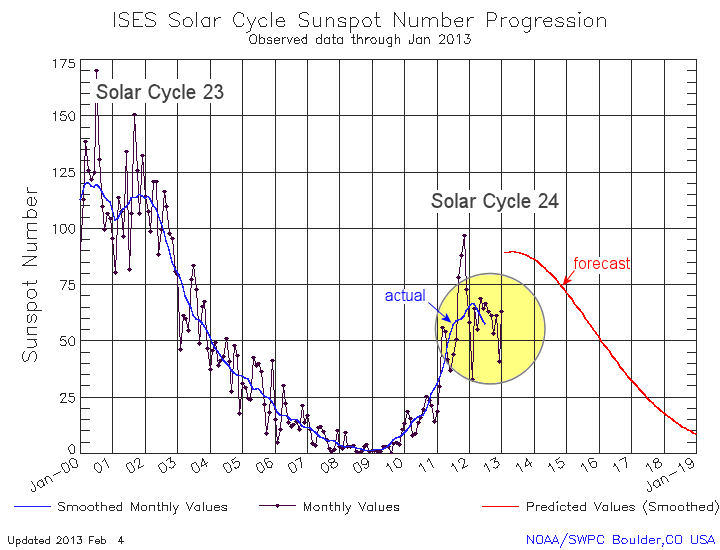
2013 was supposed to be the year of Solar Max, the peak of the 11-year sunspot cycle. But so far, solar activity has been fairly low, with sunspot numbers well below expectations as well as infrequent solar flares.
Back in 2008, the NOAA/NASA Solar Cycle Prediction Panel, said that due to the extrememly deep and quite solar minimum going on at that time, they anticipated Solar Cycle 24 – our current cycle – to be below average in intensity. They’ve certainly been right about that.
In this video, solar physicist Dean Pesnell of the Goddard Space Flight Center says that this solar max looks different from what we expected because it may end up being “double peaked.”
This video shows the low amount of sunspots so far in 2013:
Read more at Science@NASA
.
Quiet before the storm….. .A bulb burns brightest….. . Ever get the notion something is going to happen? Some thing just feels off keel this with Solar Max’m.
if it has energy, it will release it. If it doesn’t, it will be mighty quiet.
Kinda like Nancy managing to put out story after story. You don’t see her for a week … UT will experience its Solar minimum.
Yep, I know & agree. I just have this feeling. I hope our solar fireball just goes to sleep & has a peaceful max’m. PEACE!
True 🙂 I can believe what a dynamo Nancy is.. Thanks for all the great articles. Nancy probably doesn’t get enough gratitude for the amount of great content being gifted to the world here. I just saw a storm of new articles appear today.. Can’t believe how much great science there is to read every day here..
ps. reminder to myself.. Pay to have the ads removed.. Lets keep UT up and running… How meta of me to reply to myself..
Damn, I good at that too!
Me, myself, I, us & we, …have been there & done that here before in here. You’ll prob see it in here. Playful ways are strong for the heart, soul & spirit to make one’s mind open to things. Take care…
Something happening? Yeah sure, the most embarrassing end of the world predicting ever recorded in the history of this world.
Its just a gut feeling, that all. And no, not the end of the world as we know it. I am no doomsday people either. Although its always good to prepare. But a solar storms could happen like it did back in the mid 1800’s. Its too quiet. Communication sats, including internet, banking could be hurt. Just a thought. PEACE!
You have been watching too many crappy Youtube clips.
Nope. Just know the facts. Work for a sat-com co.. It has already fried out some sat-com-components over the last 30 yrs.. What does YT got to do past factual happenings? Although small, one never knows for sure. Peace.
Of course satellite components gets a hard time in outer space. Huge heat swings, getting bombarded with radiation all the time. Engineers that creates modern satellites that do not compensate for space related disasters like solar flares are not worthy their job.
You do not need a satellite to have big communications disruptions. A storm like Sandy or Katrina can do the same damage if it hits critical sections.
When you watch too many crappy end of the world YT clips, you become paranoid. You program yourself subconsciously that something is about to happen, and prepare for it, ignoring the big elephant in the room that you might die in a car crash first.
If something is going to happen, it will never be what you expected and surely not what the lunatic YT’ers are predicting.
I have been guilty of this myself – going for hours from crappy youtube paranoid conspiracy to nutty ufo video.. for hours on end.. But NASA, NOAA and others have put out some pretty concerning videos of their own.. And I don’t think it would hurt to strenghten the electric grids.. Quebec and South Africa are two examples in the last 30 years of major unexpected grid disruption…
Exactly, ..agree w/Quebec assessment. The US Interior needs to be very vigilant in this regard. Take care.
It is not only a CME that causes power outages.
How much power outage happened during Sandy and Katrina?
WOW..you have issues. Look pal, I’ve been working w/these components & systems for almost 40-yrs. through NASA & MIT. The men & woman, young & older I work with have fears also. Its not a panic either. Call it human intuition or whatever. “I assure you, I do NOT need you explaining what these components/sats can or cannot do nor especially life’s happenings either”. I stated I feel somethings “might be up” w/ole man . Deal w/it. You act is if it cannot happen. So please, at my age I’ve been there, done that. Take care.
Yea – I am sure no amount of design and redundancy could protect against a directed earth-facing blow from a CME generated by an X20+ Flare, like X23+ (carrington / earth-facing) or in particular the Halloween storm of 2003 (X28 luckily earth-glancing). There is a bit of ‘luck-of-the-draw’ invoved as a lot depends on variables such as the intensity of the plasma discharge from CME, orientation of CME Magnetic field/intensity, and of course earths magnetic fields at the time… All tolled, it would make sense to spend a few hundred million installing earthing capacitors in large power station transistors than suffer the trillions of dollars damage a carrington like event could cause (NOAA projection). Olaf’s responses remind me of some people’s responses when I would carry-on (20 yrs ago) about asteriod threats to earth. It’s easier to be blissfully ignorant in the short term.. But the longer term an lack of planning is the issue
Again, …I agree. And yes, luck is a huge part of it. Well said by the way Take care.
If you cannot protect a satellite against a carrington effect then why even bother to lay awake all night? The thing is that when you keep on promoting the “world economy is going to collapse because of a CME that *might* be directed to Earth” every single day that the sun then it directly makes young people give up hope of a future.
Google “Carrington effect” and I guarantee you that you get a kazillion of links to “We are all going to die soon sites” with links to survival gear to just prepare.
If the satellites are not up to the task to face a CME, then it is up to the engineers to design a better satellite system that takes this into account. Satellites could be built with a radiation shield that could be pointed towards the sun when needed. Induced currents can be easily discarded by creating short circuits when a a CME is detected.
And I want to add on it the world does not only rely on satellites for communication. We also have communication wires that runs between continents.
In addition not all satellites are vulnerable. Some of them are located in the shadow of Earth when a CME comes in.
ps. When did I promote the world economy collapsing? I linked an article which quotes a projection contained in a report by NOAA. If you want you can google the report by William Murtagh which contains this projection. Or email some of the helfpul staff at: http://www.swpc.noaa.gov/AboutUs/staff.html Also I think you are not giving our children enough credit. Most of them are smart enough to not believe bs and spinsters trying to sell survival gear. But I do think it would be helpful to start a discussion about protecting our electric grid from solar flares since we are all increasingly reliant on it…
So you have been working in the satellite business.
Maybe you like to share your expertise. There is an incoming CME, what effects are expected in the satellite, what components would be affected? How are those components designed to compensate for the effects of space hazard? What is the procedure when a CME is detected. Are systems shut down? Are circuits activated to prevent over surge? …
Now why would I want to prove my “expertise” to you for? No one in here should have to prove nothing to no one. Wezley did well explaining various suggestions & final adaptations. Oh, ..your last 2 sentences depends on the components speeds to shut down. That is so mighty hard to do. Your keyword should be what I am so interested in & do research daily in,===>”R & D”! Take care “O”.
“Expertise” right? Sure….
The solar panels are actually the most vulnerable part of a satellite. Big in surface, outside and you cannot put Faraday cage or radiation shield around it to protect it.
However you could implement 3 radiation detectors in the satellite body do determine the direction of the incoming radiation in 3 dimensions and orient solar panels in such a way that they only get exposed sideways. You could even put a radiation shield around the edge of the solar panels.
Internal components could also be shielded wit a one side shield.
Second EM fields, a Farraday cage would do the trick. But short circuiting the circuits to one single ground could protect electro static build up and could be activated when the satellite detects increased EM impulse. Normally you do not even need to go that far. Over-surge protectors would be just fine.
And you are not going to tell me that in modern satellites built in the last 10 years, they forgot about CME protection.
lol…damn your fun, but a complete pain in the ass. f you were in my R&D department in the test lab, you’d be in the childish corner cleaning and preparing diodes all damn day in my Faraday “cage”. I’m going to call you “semiconductor-pain-in-the-ass””A DIRECT HIT”! Not a glancing blow, but a 100% direct hit! There is “NO” 100% guarantee protecting that my favorite SPITA! Now get back to your lil’area and back into your “CAGE” & get cleaning those diodes, and I’ll see you in the ‘clean room’ in the PM. Wait till you hear and see what you next assignment is! So sorry to be you! Take care lil’SPITA.
If you care to spend the time here is an article from a financial journal quoting NOAA sources: http://www.ibtimes.com/severe-solar-storms-could-disrupt-earth-decade-noaa-826351 – There’s also this from NASA: http://science.nasa.gov/science-news/science-at-nasa/2008/06may_carringtonflare/ These people dont’ seem to be the alarmist Youtube consipiracy types?
Olaf2I am going to send you a website my colleagues & I have ‘our personal lab’. in the Palo Alto area. We all come together quarterly to go over certain things things. We are in the process of rebuilding the site adding/updating facts, findings & formula’s. Also, I am a firm believer in a playful sense of humor. Being too serious in our line of work is not good for the inner heart, mind & soul. When you didn’t reply, back at me, I was disappointed. Hands on scientists & associates are far too stone faced & non compliant to humorous harmless play. Will be in contact asap. Take care
Currently I have other important priorities to take care of. I am in a critical release cycle with a deadline end of this month.
But I am very interested space related engineering. One thing I do know about (software) engineering is that designs that do not get challenged will fail. I do expect that people break down what I design, it makes my designs even stronger. And I always will challenge the design of others.
I do realize that satellites are not always designed for perfection. People in charge do not always choose the best design, sometimes they will force engineers to take short cuts to cut costs and get a dead line. Sadly enough when that badly behaving manager goes away the people left have to clean up the sh*t.
I do know that orienting a satellite to shield itself from an incoming CME has limitations. It needs power to operate and facing away the solar arrays means that the batteries gets drained. You basically have to power it down too. But you can pretty easily add cosmic ray detectors that detects in 3D and have software that acts on an incoming CME automatically when it exceeds a certain threshold value. Shielding from radiation basically means reducing the exposed surfaces, and the surfaces that are exposed are provided with additional shielding.
I am actually wondering if you can shield radiation better by using a layer approach instead of one single lock of lead. When radiation hits the first layer of some kind of thin shield then the particle is leaving that material under an angle making it miss the satellite in the first place. There is no need to completely absorb the incoming particles, just bend them that they miss the satellite.
Protecting from cosmic rays is harder since they have no incoming vector. With the exception that they will not come from Earth’s direction because Earth shields those.
Very well said Olaf2 :-)… .
As I was typing this to you. I(my dept)are analyzing the thickness & the angle of said shields, & the types of course. ESP, ..you?…lol.
As you are well aware of,.Stealth bombers like the B-52’s, the fighter jets like the F-18’s etc.., all have angles to deflect the beam of radar. I(we here)have been preparing, testing such ways w/Ole=-Man-Sols particles. A colleague is working on the ‘absorption’ factor. .
I sure wish I could deflect & or absorb this headache that is coming on now….lol. Besides the constant interruptions we all experience. It is the delay of materials ordered that is so time consuming. I agree, time is so crucial. When they finish w/rebuilding the website, I will send it to you asap. Take care.
Don’t forget that a shield thickness can be made 70% bigger from the incoming radiation point of view when it is angled at 45 degree. A wedge shaped shield is more efficient than a flat one.
The intention is to shield the satellite from a CME, and that does not require a complete surrounding shield. The hardest part is to point it to the correct direction which can only be done by actually measuring the incoming radiation peak levels in 3D.
It also does not require a 100% stop of the radiation. Just stop it enough so that amount is maximal below the maximum average cosmic radiation levels. The satellite is designed for those levels.
Again, well said. Yes I agree. You elaborate well. I don’t care for typing much. So I skip along like a child playing on the side walk. And yes, …the objective(shield)does not have to be 100% protected. Although that is best. The level of radiation is the whole key. I just have this gut feeling Ole Man Sol will be shooting out a big CME this year. I hope not. But in case he does. I hope he is gentle about it….lol. Take care Olaf2.
I found this article because I’d subscribed to updates about ‘solar maximum’
The reason WHY I’d subscribed is because I’d been reading predictions that we will be entering a new ‘little ice-age,’ or ‘Maunder minimum,’ as last experienced in the 17th century. A weak solar maximum was indicated as a predictor for this.
http://www.sott.net/article/229988-New-Maunder-Minimum-Scientists-Predict-Rare-Hibernation-of-Sunspots
A new little ice age could mask the signs of climate change.