Universe Today
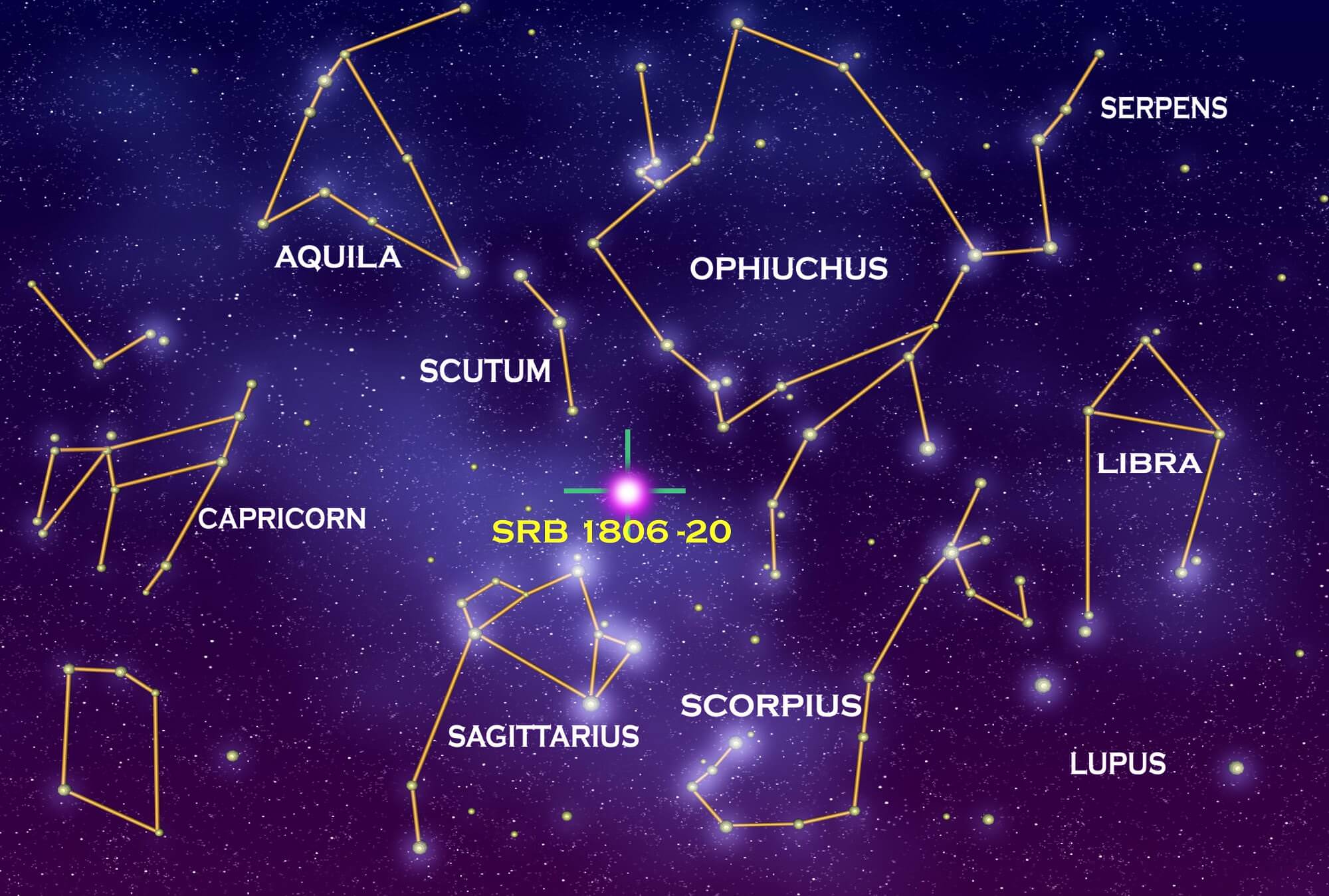
Since ancient times, astronomers have organized the stars into various constellations. We have the Big Dipper (Ursa Major), Orion the Hunter, and his "Greater Dog" and "Lesser Dog"(Canis Major and Canis Minor). And those are just some of the better-known ones. But have you ever wondered if the Sun belongs to one of these collections of stars?
The simple answer is that - in accordance with both ancient astrological tradition and modern astronomy - the Sun technically has no constellation. But if you were to change locations and travel to a new star system, you would then be able to view the Sun as we do other distant collection of stars. Unfortunately, depending on where you are, the answer would change.
The Zodiac:
First, let us consider the astrological answer to this question. Unless you were born prior to the Scientific Revolution - during which time Nicolaus Copernicus proposed the heliocentric model of the Solar System - you know that the Earth revolves around the Sun. Over the course of a year, the position of the stars changes as the Earth's position relative to the Sun changes.
During the year, the Sun passes through each of the constellations of the Zodiac. For example, in August, the Sun is in Leo, and then in September, the Sun is in Virgo. Your astrological sign is based on this. What this means is that the Sun is part of each constellation of the Zodiac over the course of a single year, so it can't be said to be in any single constellation.
However, astrology is an obsolete and entirely unscientific practice. And if someone were to ask which constellation the Sun is in, surely they are seeking an answer that was astronomical (and not astrological) in nature. For that, we must consider what the constellations are in scientific terms.
The 88 Constellations:
Since ancient times, astronomers and scholars have been keeping track of "asterisms" (aka. constellations) in the night sky. By definition, these are collections of stars that, when viewed from Earth, appear in the same general area as each other night after night. In reality, they are actually located in very different locations, and can sometimes be up to thousands of light-years away from each other.
During the 2nd century CE, Hellenistic astronomer Claudius Ptolemaeus (Ptolemy) organized the constellations into a single treatise. This treatise, known as the Almagest, was the definitive source on Greek astronomy, and contained the names and meanings of the then-known 48 constellations. For over a thousand years, this work would remain canon for European and Islamic Astronomers.
Thanks to the Scientific Revolution and "Age of Exploration" - ca. 15th to 18th centuries CE - astronomers became aware of many more constellations. This was due to extensive overseas exploration, which brought European traders, explorers and waves of colonization to the Southern Hemisphere, East Asia and the Americas.
By 1922, the International Astronomical Union (IAU) officially divided the celestial sphere into 88 constellations. Of these, 36 lie predominantly in the northern sky while the other 52 lie predominantly in the southern. While it would take years to work out the exact delineation between these constellations, and many corresponded to their Greco-Roman predecessors, these 88 modern constellations would remain in use until this day.
However, these constellations divide up the night sky based on how it is viewed from Earth. Once again, our Sun cannot be considered to lie in any one of them because - relative to the Earth-bound observer - it passes through them. Alas, the only way to answer this question is to change our perspective.
From Other Star Systems:
If you could move away to another star, then our Sun would indeed appear to be part of the background stars. For example, if you were to travel to a planet orbiting the nearest star to the Solar System - Alpha Centauri (aka. Rigil Kentaurus) - then the Sun would indeed appear to be part of a constellation.
To be scientifically accurate, let us consider a planet that we actually know of. This would be the rocky extrasolar planet recently discovered around Proxima Centauri, which is known as Proxima b. Viewed from the surface of this planet, the Sun would appear to be part of the Cassiopeia constellation. However, rather than forming a W shape, our Sun would form a sixth point on its "western" end, making it look like a mountain chain (or a scribbled line).
But if you went to a different star system, the Sun's position would change, depending on the direction. As such, the Sun really isn't in any constellation per se. But then again, none of the other stars that make up the Milky Way are either. Much like what Einstein's Theory of Relativity teaches us about space and time, the constellations themselves are relative to the observer.
We have written many interesting articles about the Sun and the constellations here at Universe Today. Here's What are the Constellations?, Zodiac Signs and their Dates?, Where is the Sun?, and Earth's Orbit Around the Sun.
For more information on how our Sun looks from Alpha Centauri, be sure to check out this page from Learn Astronomy. SAnd here's an article about all 88 recognized constellations.
Astronomy Cast also has episodes on the subject. Here's Episode 30: The Sun, Spots and All and Episode 157: Constellations.
Sources:
-
NASA/Starchild - 88 Officially Recognized Constellations
-
Learn Astronomy - How Would Our Sun Look From Our Nearest Star System?