
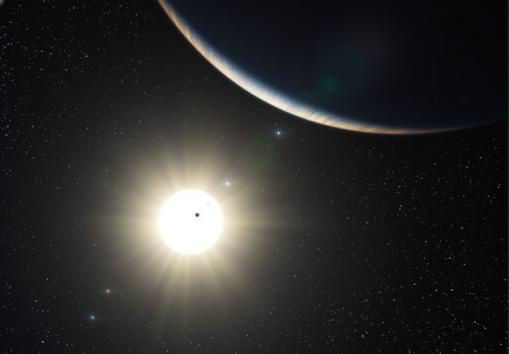
This artist’s impression shows the planetary system around the sun-like star HD 10180. Credit: ESO/L. Calçada
Our Earth feels like a warm and welcoming place for us life forms, but beyond our little planet, the majority of the solar system is too cold for us to live comfortably. A new study suggests that planets in other solar systems might be more habitable than our own because, on the whole, they would be warmer — up to 25 % warmer. This would make them more geologically active and more likely to retain enough liquid water to support life, at least in its microbial form. In turn, the “Goldilocks Zone” around other stars — the habitable region — would be bigger than the Zone in our own Solar System.
This new study comes from geologists and astronomers at Ohio State University who have teamed up to search for alien life in a new way.
They studied eight “solar twins” of our Sun—stars that very closely match the Sun in size, age, and overall composition—in order to measure the amounts of radioactive elements they contain. Those stars came from a dataset recorded by the High Accuracy Radial Velocity Planet Searcher spectrometer at the European Southern Observatory in Chile.
They searched the solar twins for elements such as thorium and uranium, which are essential to Earth’s plate tectonics because they warm our planet’s interior. Plate tectonics helps maintain water on the surface of the Earth, so the existence of plate tectonics is sometimes taken as an indicator of a planet’s hospitality to life.
Of the eight solar twins the team has studied so far, seven appear to contain much more thorium than our Sun—which suggests that any planets orbiting those stars probably contain more thorium, too. That means that the interior of the planets are probably warmer than ours.
For example, one star in the survey contains 2.5 times more thorium than our Sun, according to team member and Ohio State doctoral student Cayman Unterborn. He says that terrestrial planets that formed around that star probably generate 25 percent more internal heat than Earth does, allowing for plate tectonics to persist longer through a planet’s history, giving more time for live to arise.
“If it turns out that these planets are warmer than we previously thought, then we can effectively increase the size of the habitable zone around these stars by pushing the habitable zone farther from the host star, and consider more of those planets hospitable to microbial life,” said Unterborn, who presented the results at the American Geophysical Union meeting in San Francisco this week.
“If it turns out that these planets are warmer than we previously thought, then we can effectively increase the size of the habitable zone around these stars.”
“At this point, all we can say for sure is that there is some natural variation in the amount of radioactive elements inside stars like ours,” he added. “With only nine samples including the sun, we can’t say much about the full extent of that variation throughout the galaxy. But from what we know about planet formation, we do know that the planets around those stars probably exhibit the same variation, which has implications for the possibility of life.”
His advisor, Wendy Panero, associate professor in the School of Earth Sciences at Ohio State, explained that radioactive elements such as thorium, uranium, and potassium are present within Earth’s mantle. These elements heat the planet from the inside, in a way that is completely separate from the heat emanating from Earth’s core.
“The core is hot because it started out hot,” Panero said. “But the core isn’t our only heat source. A comparable contributor is the slow radioactive decay of elements that were here when the Earth formed. Without radioactivity, there wouldn’t be enough heat to drive the plate tectonics that maintains surface oceans on Earth.”
The relationship between plate tectonics and surface water is complex and not completely understood. Panero called it “one of the great mysteries in the geosciences.” But researchers are beginning to suspect that the same forces of heat convection in the mantle that move Earth’s crust somehow regulate the amount of water in the oceans, too.
“It seems that if a planet is to retain an ocean over geologic timescales, it needs some kind of crust ‘recycling system,’ and for us that’s mantle convection,” Unterborn said.
In particular, microbial life on Earth benefits from subsurface heat. Scores of microbes known as archaea do not rely on the sun for energy, but instead live directly off of heat arising from deep inside the Earth.
On Earth, most of the heat from radioactive decay comes from uranium. Planets rich in thorium, which is more energetic than uranium and has a longer half-life, would “run” hotter and remain hot longer, he said, which gives them more time to develop life.
As to why our solar system has less thorium, Unterborn said it’s likely the luck of the draw.
“It all starts with supernovae. The elements created in a supernova determine the materials that are available for new stars and planets to form. The solar twins we studied are scattered around the galaxy, so they all formed from different supernovae. It just so happens that they had more thorium available when they formed than we did.”
Jennifer Johnson, associate professor of astronomy at Ohio State and co-author of the study, cautioned that the results are preliminary. “All signs are pointing to yes—that there is a difference in the abundance of radioactive elements in these stars, but we need to see how robust the result is,” she said.
To continue this research, the team wants to do a detailed statistical analysis of noise in the HARPS data to improve the accuracy of his computer models. Then he will seek telescope time to look for more solar twins.
Source: The Ohio State University
There has to be other life out there. I keep doing SETI and hope I find something one day.
Why does there? We know nothing scientifically about how life began here. For all we know until falsified (that’s what science does, falsify contentions) life is so improbable that nowhere in 10 exponent 26 stars in the visible universe is there any other life. Just because the # of stars is a big # does not mean by itself that the probability of life isn’t a even smaller #.
You wrote: “We know nothing scientifically about how life began here.”
It’s time for Philip to crack open some books!
the verb is KNOW. We don’t know how life began. Sample of one. Insufficient data until we discover life elsewhere or create life in the lab. So far, results = 0. You’re faith based, not science based.
I have to disagree.
– As I have described numerous times here, the short time with which life was established here on Earth as observed by trace fossils allows for a test. We can use the simplest possible Poisson model for attempts of chemical evolution to pass to biological evolution.
As luck will have it due to the exponential distribution stacking up probability mass it is 3 sigma testable. This means the process from chemical to biological evolution is a simple one. You may assume different processes on different planets, but the problem for that alternative model is that it isn’t testable.
From this you can predict that ~ 100 % of surface habitable planets will be inhabited @ 7 billion years of age. Provided sufficient likeness with Earth that is, which probably includes plate tectonic for reasons of fosfor availability and rapid cold-hot cycling. See more below.
– There are numerous more or less testable pathways from chemical to biological evolution in the scientific literature. Wäschterhäuser proposed a complete and testable one already ~ 1980. And yes, they a) can stall and b) they are so many that we need to start cutting down by actual testing.
Until recently I didn’t believe that thermodynamics could on its lonesome predict the process, but it turned out I was wrong. 2010-2012 may well be the years that the process from chemical to biological evolution got its generic theory. Because a thermodynamically driven pathway won’t stall unless suitable conditions changes to unsuitable.
Here is how:
1. A cooling planet would have a thermodynamic selection for enthalpic enzymes. RNA ribozymes are such. [“Impact of temperature on the time required for the establishment of primordial biochemistry, and for the evolution of enzymes”, Stockbridge et al, PNAS 2010.]
2. A stratified mechanism building increasingly larger chemical networks on an enzymatic basis would appear, driven by thermodynamics. [“The structure of autocatalytic sets: evolvability, enablement, and emergence”, Hordijk, W., M. Steel, et al, Acta Biotheoretica 2012.]
3. A pool of random ribozymes (see #1) would have a thermodynamic force that would take it from a replication “melted” to a “crystalline” state with replicators based on measured RNA properties. [“Thermodynamic Basis for the Emergence of Genomes during Prebiotic Evolution”, Woo et al, PLOS Comp Biol 2012.]
4. So far the only known replicator sufficiently stable to make reasonably robust cells without being too stable to pass the thermodynamic bound to make replicators is RNA (with ~ 4 years half life against hydrolyzation). Variants like the later evolved DNA are too stable to make initial cells. [“Statistical Physics of Self-Replication”, Englund, to be published in Science (IIRC).]
And we know that spontaneously assembled, growing and dividing lipid membranes would allow a pool of ribozymes to grow enclosed, ensuring best replication. Diffusion of phosphate activated RNA nucleotides through the membranes would make it so. (Shoztak cells).
This is of course tested by all the phylogenetic tests of RNA/protein at the root of all life.
And, finally, now I believe we may understand the time scale! This should add to testing:
#3 shows that RNA replication crystallizes on the order of ~3*10^4 year.
Shoztak cells need hydrothermal vents for the cold-hot cycles that cycles RNA strands through acting as templates and then release of reproduced strands. Those vents have a maximum lifetime of ~ 10^5 years today.
At the same time the free ocean water cycle through such a vent’s sterilizing core in ~ 10^4 years. This IMO ties cells as at least part time found in the porous walls of vents, precisely as Shoztak cells would prefer to cycle, or they would perish too fast.
Now we know we have plenty of time for crystallized reproducing cells to appear. And they would randomly seed the waters for tens of thousands of years as some are lost to drift away. Some of them would in turn easily manage passive drift to nearby vents under the RNA half life time to continue evolving.
But by now we have left chemical evolution which is thermodynamic driven and entered classical biological evolution which is driven towards increasing fitness.
The fitness increasing pathways from a replicating to a translating (gene) genome are legion in the literature. [Cf “Hypothesis: Emergence of translation as a Result of RNA Helicase evolution”, Zenkin, J Mol Evol 2012.]
The gene sets increase and diversify by the usual mechanisms and recorded in fold phylogenies. Cells ought to tie themselves to control the underlying metabolism simply because such control increases fitness, consistent with the record. Such capable cells would over time evolve to become independent of the vents for reproduction, and eventually other chemoautotroph sources for energy and nutrients would be utilized.
I don’t see any obvious large gaps in there, reaction rates and concentrations should be there. (Except perhaps for #2 which I haven’t read yet, and for phosphate activation as of yet, and for modeling if we have sufficient survival as early cells migrate between hydrothermal vents.) So yay.
BOO-yah! FASCINATING, TL! I’m going to point others to this comment and quote it often when I get into these discussions with people. Thanks for sharing your lovely info!
“1. A cooling planet would have a thermodynamic selection for enthalpic enzymes.”
I’m not sure I understand this conclusion, and I do not have access to the journal in question. Could you summarize the evidence for this?
“the short time with which life was established here on Earth as observed by trace fossils allows for a test. We can use the simplest possible Poisson model for attempts of chemical evolution to pass to biological evolution. This _is_ a stochastic process model.”
IF the Earth is typical within several sigma as you describe, all you state follows. But this reasoning overlooks the possible fact that life’s origin is a 10 exp – 100 to the 100th power or worse improbability even given a huge # of potential occurance scenarios per planet. I for one doubt such but it’s “faith” not science. Data from more than one planet is needed. Or a nice lab experiment mixing amino acids and Viola! Life!
Life may well be common in the universe, It started very early in our planet’s history. Intelligent life is a whole ‘nother can of worms. It started very lately in our planet’s history. And may well be self-extinguishing.
This article’s language was peppered with caveats about microbial level life, so that point per the discussion of this article is moot.
I agree but honestly SETI is a long shot to put it mildly. It’s definitely worth doing for the time being seeing as how the alternative is to sit & wait for better instruments.
I know there has to be a better way to search for other life forms than aiming a radio dish at the sky & hoping they beam a signal right at us. But I be dammed if I could tell you what that better way might be?
I once read about light and the effect of one handedness, I can’t remember all the details but simply put, if vegatation for example favors left handed light this is absorbed and right handed light is reflected, so it could be possible to detect a world that is covered in vegetation with the right equipement, surely easier to detect life on a large scale than on a small scale, if I’m not mistaken I’m sure this theory was put to the test in orbit around our planet, but I’ve not heard about it much since, it seems whenever interest spikes in life elsewhere in the universe, the image in most peoples minds are of little green men instead of very large green veg, perhaps Universe Today could do an article about it . 🙂
I believe the JWST (James Webb Space Telescope) will be able to make observations on that scale.
I might have to review some of this geophysics. I took a course in geophysics in graduate school. The theory as I recall at the time was that weak interaction decay of various isotopes in the core generated the heat. There is some controversy about whether there is a nuclear reactor of sorts in the core. Uranium and thorium might fission some in the core, thus generating heat that way. I am not sure what the status of this theory and debate over it are today.
LC
As I remember it they managed to measure the neutrino flux component of the core & mantle heat flux. It is ~ 50 % of the current heat flux.
Neutrinos are a signature of weak interactions. The remaining 46% appears to be a mystery. Maybe strong nuclear interactions, such as a slow fission reaction accounts for that.
LC
Maybe these will help…
Nature article: Are there nuclear reactors at Earth’s core?
PNAS (PDF): Deep-Earth reactor: Nuclear fission, helium, and the geomagnetic field.
Thanks for the references. I find in the first one these statement that uranium decays into plutonium curious. Plutonium is a breeding product that comes from neutron absorption by U238. Also helium is a product of the strong nuclear interaction, but is a decay product, not due to fission.
LC
I think the author of that article might have interpreted things the wrong way; I think he should have stated that U238 transmutes, via neptunium, into P239 through two stages of β‾ decay.
Ironically the Sun has been labeled “metal rich”. (It is slightly so, but just at the edge of the top of distribution in exoplanet catalogs.)
I like how the unlikely “Rare Earth” idea, I don’t think it can be called a hypothesis as it is fully unconstrained, takes hit after hit. As it should, it is a type of conspiracy theory.
Great article/Fascinating information, Nancy! I LOVE this stuff. Planetary geology is one of my top favorite topics! Now we have the tech to glean it from other systems. Wow…
How do they determine the availability of radioactive elements in the planets by knowing the same of their host stars?