Researchers have used the Chandra X-Ray Observatory to understand just how large supermassive black holes can get by performing a very detailed census of the mysterious objects. These are the gigantic black holes, with millions of times the mass of our Sun, that sit at the centre of almost every galaxy. The largest of them reach 100 million solar masses and gained this weight early - then they ran out of material to consume. The smaller holes, between 10 and 100 million solar masses, have been more frugal with the gas and dust they consume, and continue to grow to this day.
Continue reading
From the big to the small, physicists want to know it all. But what good is this knowledge unless you can bring it together and make something of it? Michael Mallary in his book
Our Improbable Universe connects quarks to the likelihood of a deity and makes a lot of it. Sometimes rambling but always pertinent, his musings on subjects as diverse as multi-universes and the good fortune of having fissile material in the Earth's mantle makes for a very interesting and thought provoking read.
Scientists working with the Mars Exploration Rover Spirit believe it's discovered another rock that was affected by liquid water in the past. Dubbed "Peace", the rock contains more sulfate salt than any other rock Spirit has examined so far. Normally this sulfur is at the surface of the rock, but Peace has this material deep inside too. The scientists have two theories for how these sulfates formed, but both involve large amounts of liquid water.
Continue reading
The European Space Agency's Mars Express spacecraft took this image of the central region of the Valles Marineris. This 4,000 km (2,500 mile) long gash in the surface of Mars was probably created when the relatively nearby Tharsis bulge rose up from volcanic activity to a height of more than 10 km (6 miles). A similar situation exists here on Earth (on a smaller scale), at the Kenya rift in east Africa.
Continue reading
Now who put that "Valentine" up there in the stars? Although the splendid IC 1805 will be lost to this week's Moon, there will be no shortage of things to view as we explore selenography with dorsa, mountains, impact craters and "hidden" surprises! With plenty of history as well as lunar features to tantalize all observers, we'll begin the week with a day of "love", and learn to love the Moon and all its amazing details by week's end. So get out your telescopes...
Because here's what's up!
Continue reading
There should be relatively safe orbits within the swirling gas and dust of a newly forming solar system that could allow planets to gain mass without being destroyed. This is according to a new simulation developed by astronomers from the University of Indiana. They built a simulation that showed how gravitational instabilities form which can bring planets together quickly. New theories of planetary formation predict that large gaseous planets, like Jupiter and Saturn, need to hurry up and form before their material is blown away by the growing star.
Continue reading
Astronomers from Carnegie and Caltech have pinpointed the exact location of the first gamma-ray burst detected by NASA's Swift observatory on December 23, 2004. The team used the telescopes at Las Campanas Observatory in Chile to watch the fading afterglow of the explosion in the constellation of Puppis. Three more bursts were detected in January, and they have also been studied by various telescopes around the world. Researchers are hoping they can use these intense explosions as a kind of flashlight, to illuminate distant objects which are normally too dark to study.
Continue reading
The massive Ariane 5-ECA finally lifted off on Saturday, carrying two satellites into orbit, and demonstrating that the launcher is ready for business. The rocket blasted off from Europe's spaceport in French Guiana at 2103 GMT (4:03 pm EST), and deployed its payloads about 90 minutes later. The primary payload was the Spanish XTAR-EUR military communications satellite, but it was also carrying Sloshsat, a satellite designed to measure how liquids behave in microgravity. The Ariane 5-ECA can carry up to 10 tonnes to geostationary transfer orbit.
Continue reading
Amateur photographer
John Chumack took this picture of Spiral Galaxy NGC-253, which is located in the constellation of Sculptor. The telescope was a Takahashi Epsilon 250mm and ST8XE CCD camera, on a Software Bisque Paramount ME, taken on Mount Joy, New Mexico, New Mexico Skies Resort. John operated the telescope remotely from Dayton, Ohio using Arnie Rosner's
Rent-A-Scope setup. John has been imaging the sky for 2 decades, and has an amazing collection of pictures at his website:
Galactic Images. If you're an amateur astrophotographer, visit the
Universe Today forum and post your pictures, we might feature it in the newsletter.
By tracing back the family tree of cyanobacteria, a researcher from Washington University in St. Louis believes these tiny organisms began life in fresh water, not salt water as most biologists theorized. Cyanobacteria use light, water and carbon dioxide to produce oxygen and biomass, and they probably got their start 2 billion years ago in fresh water, and then evolved to survive in saltier environments.
Continue reading
The massive Ariane 5-ECA rocket is ready for its second flight this weekend, after its first attempt ended in destruction back in 2002. The 50m (160 ft) tall rocket is capable of carrying more than 10-tonnes into geostationary orbit. On this second test flight, the ECA is equipped with two satellites: the Spanish XTAR-EUR military communications satellite and SloshSat, which will see how fluids work in orbit. If everything goes well, the ECA should lift off from the Kourou spaceport in French Guiana on Saturday.
Continue reading
Researchers from the Georgia Institute of Technology have uncovered a surprising link between air pollution levels over land, and the growth of phytoplankton in the ocean. These tiny, but hardworking, aquatic plants carry out half the Earth's photosynthesis, and are responsible for removing tremendous quantities of carbon dioxide from the atmosphere. Normal dust storms produce iron which the phytoplankton can't use, but when it's modified by sulfur dioxide pollution, the iron becomes soluble and can trigger phytoplankton growth.
Continue reading
The inner planets in our solar system are largely made of rock, which are formed from silicon. But in a different solar system, with a different distribution of minerals, planets could be mostly formed from carbon instead. Inside these planets, where the heat and pressure are intense, this carbon would form layers of diamonds. Small versions of these planets fall to Earth all the time, in the form of carbonaceous chondrite meteorites, which contain different carbon compounds, such as carbides, organics and occasionally even diamonds.
Continue reading
Astronomers have known for a few years now that there's a direct connection between the size of a galaxy and the supermassive black hole that lurks at its centre. Until recently, they haven't been sure why this relationship exists. A new computer simulation from the Max Planck Institute has shown that growing black holes release a blast of powerful energy that actually regulates the amount of star formation in the galaxy. The bigger the galaxy, the longer this takes to happen, so the black hole can become larger.
Continue reading
This photograph of Mimas, one of Saturn's moons, shows a head-on view of its largest crater Herschel - making it look like the Death Star from the Star Wars series of movies. Mimas is only 398 kilometers (247 miles), so the impact that formed this crater probably nearly destroyed the moon. Herschel is 130 kilometers wide (80 miles), and has a tall central peak similar to many craters on our own Moon. Cassini took this image on January 16, 2005 at a distance of only 213,000 kilometers (132,000 miles).
Continue reading
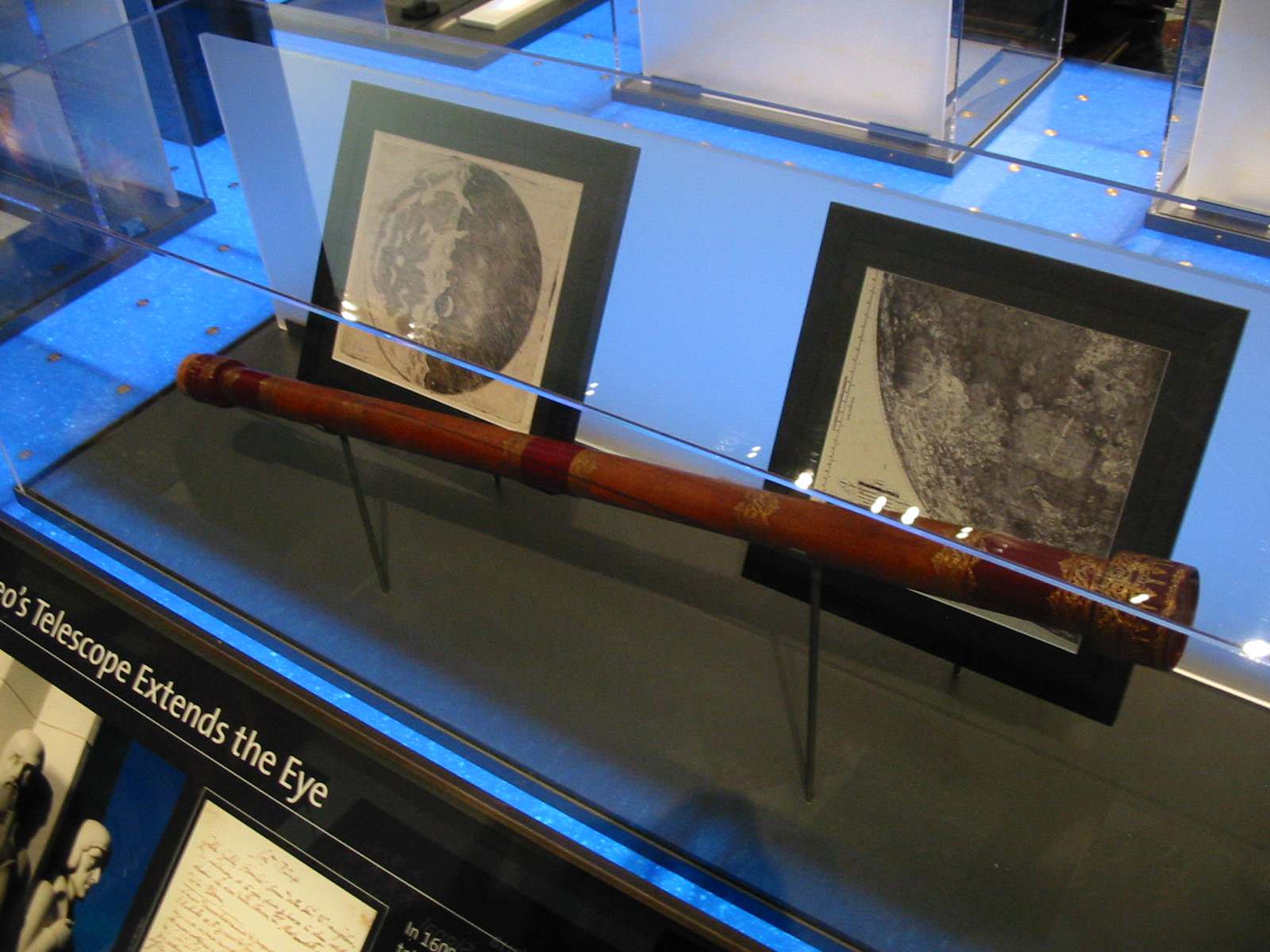
Born February 15, 1564, Galileo Galilee was a scientist, philosopher, mathematician, professor, optician, musician, painter, and father of three. Despite all these accomplishments, it is easy to conceive that - like many amateur astronomers of today - one of his greatest loves was to turn eye and telescope upon the wonders of the night sky. In this article by Astro.Geekjoy's Jeff Barbour we retrace a few of his steps and come to a deeper insight into the kinds of questions driving his personal quest for understanding.
Continue reading
Radio telescopes around the world listened for signals from Huygens to measure wind speeds on Titan as the probe descended through its atmosphere last month. The telescopes discovered that winds on Titan are very weak near the surface, and then increase in intensity with altitude. Huygens passed through winds going nearly 435 kph (270 mph) at an altitude of 120 km (75 miles). Cassini was originally supposed to make these measurements, but there was a configuration problem with one of its receivers.
Continue reading
NASA has released new colour images of Saturn's northern hemispheres taken by Cassini - and the Ringed Planet is looking a little blue. This blue colour of Saturn's atmosphere is probably linked to the cloud-free nature of the upper atmosphere, but imaging scientists still aren't really sure. Icy moon Mimas is set against the image, and a few large craters are visible on its surface. This image was taken on January 18, 2005, when the spacecraft was approximately 1.4 million kilometers (870,000 miles) from Saturn.
Continue reading
NASA's Spitzer Space Telescope has found the dusty disc of planetary material surrounding an extremely low-mass brown dwarf. The failed star, called OTS 44, is only 15 times the mass of Jupiter, and is located 500 light-years away in the Chamaeleon constellation. Previously, the smallest brown dwarf known to have such a disc was twice as massive. Astronomers are now wondering if a habitable world could form around such a small, dim dwarf.
Continue reading
Astronomers from Penn State and Caltech have found the smallest extrasolar planet yet, orbiting a pulsar 1,500 light-years away. The small planet - the fourth discovered around this pulsar - has 1/5th the mass of Pluto, and orbits approximately the same distance as the asteroid belt orbits the Sun. The pulsar is spinning quickly, and gives off pulses of radiation at a very regular rate. Fluctuations in the pulses can then be used to calculate the orbits of planets going around them down to the size of large asteroids.
Continue reading
Engineers at the European Space Agency will go ahead and give Mars Express the command to deploy its MARSIS radar booms during the first week of May. The agency was holding off on this decision because the manufacturer revealed a risk that the spacecraft could be damaged by a whiplash effect when the booms are deployed. Mission controllers have performed computer simulations, and they can't rule out that the spacecraft will be hit by the booms, but they're pretty sure that any damage will be minimal. The MARSIS radar will study the Martian ionosphere and search for subsurface water.
Continue reading
Astronomers from the Harvard-Smithsonian Center for Astrophysics have discovered a star speeding out of our galaxy at over 2.4 million kph (1.5 million mph). It's probably moving this quickly because of a close encounter with the supermassive black hole that lurks at the heart of our Milky Way. The star came too close, was captured by the black hole's gravity, and then hurled onto an exit trajectory. The star contains many heavier elements than hydrogen and helium, so astronomers believe it began life in one of the stellar nurseries near the galactic centre.
Continue reading
Greetings, fellow SkyWatchers! This will be a wonderful week as we begin by viewing the spectacular "Kemble's Cascade". Looking for some challenging studies? Then while New Moon is on our side, let's go for some serious hunting in the constellations of Pisces, Lepus, Canis Major, Cetus and Puppis. You can do them in one night if you try! Comet Machholz rounds off the week as the Moon returns. So start with binoculars and break out the "heavy artillery" for the faint stuff. Enjoy a leisurely comet hunt or lunar viewing week end...
Because here's what's up!
Continue reading
Continue reading
Engineers have outfitted the National Science Foundation's (NSF) Arecibo Observatory telescope with a new instrument that could help it discover galaxies that have no stars - so called "dark galaxies". The instrument is called ALFA (for Arecibo L-Band Feed Array), which is essentially a seven-pixel digital camera, which allows the radio telescope to receive data seven times as fast. Researchers will explore groups of galaxies, and determine how fast they're converting gas into stars. It should be able to discover if there are gas-rich regions, invisible to optical telescopes, which can be detected by their hydrogen signature.
Continue reading
After the fun and excitement of any wild party comes the clean-up. Broken things need fixing, steps get taken to prevent the repeat of problems and plans are made for the next one. The same goes for space missions. After the euphoria of a successful landing ebbs away, the whole operation has to be assessed, anomalies identified and remedies initiated. Robert Godwin dived through the NASA archives and in his book, '
Apollo 12 The NASA Mission Reports Volume Two', he presents an edited collection of the assessment of this lunar landing. Perhaps a bit dryer than most parties, this text gives the skinny on what was shaking when Apollo 12 did its thing.
Continue reading
New research from the University of Michigan has determined that there's definitely an upper limit to the mass that stars can reach - between 120 and 200 times the mass of our own Sun. The team examined a wide range of stellar clusters, and determined the distribution of the mass of stars in those clusters. They couldn't find any stars above this 120-200 stellar mass limit. But this brings up a new mystery. Is this as big as stars get because they run out of material, or is there a fundamental limit in physics that stops them from getting any bigger?
Continue reading
The ringed planet Saturn has some of the most turbulent weather in the Solar System, including a powerful polar vortex at its southern pole. But new observations by the giant Keck 1 telescope in Hawaii have turned up a mystery. Unlike the other planets with polar vortexes, which are generally much colder than the surrounding atmosphere, Saturn's is warmer - in fact, it's the warmest place on the planet. One theory is that particles in Saturn's atmosphere, which could warm the planet through a greenhouse effect, have been concentrated by winds down to the south pole.
Continue reading
NASA's Cassini spacecraft took this natural colour image of Saturn's moon Rhea. It seems to display bright, wispy terrain, which looks like it's just been painted onto its surface - this is similar to another of Saturn's moons, Dione. Images were taken using Cassini's red, blue and green spectral filters, and then combined to create the natural colour version. They were taken on January 16, 2005, when Cassini was 496,500 kilometers (308,600 miles) from Rhea.
Continue reading
Beagle 2 should never have been approved to go to Mars according to an official report from the ESA/UK Commission of Inquiry. The under funded mission was developed on a shoestring, and lacked adequate time for testing. Mission managers treated it like another scientific instrument on board Mars Express, and this fundamental error led to many subsequent problems. Beagle 2 disappeared after entering the Martian atmosphere in December 2003, and controllers still have no definitive answer for what actually caused its failure.
Continue reading
International Launch Services (ILS) oversaw the launch of two rockets today, in different parts of the world. A Russian-built Proton/Breeze M rocket lifted off from the Baikonur Cosmodrome in Kazakhstan, carrying the AMC-12 satellite for SES AMERICOM, which will provide broadcast service to the Americas, Europe, the Middle East and Africa. At Florida's Cape Canaveral, an Atlas III lifted off with a classified payload for the US National Reconnaissance Office. The two launches occurred less than 10 hours apart.
Continue reading
Here's a 1280x1024 desktop wallpaper of V838 Monocerotis taken by the Hubble Space Telescope. Hubble has been watching this star off and on since it brightened unexpectedly for several weeks in 2002. This light pulse has been moving through a cloud of dust that was probably sloughed off in a previous explosion. V838 Mon is located 20,000 light-years away in the constellation of Monoceros, which puts it at the outer edge of the Milky Way galaxy.
Continue reading
Now on the surface of Mars for longer than a year, the twin Mars Exploration Rovers, Spirit and Opportunity, are getting pretty dusty. Both rovers have a fine coating of dust 1-10 micrometers thick which is starting to obscure their solar panels. Spirit has gotten more dusty, with about 70% more dust, so it's getting less power. This could be because it's windier around Opportunity's landing site, which is constantly blowing away the dust. It's also cold enough at night that frost forms on the rovers. This could be clumping the dust together, and causing unexplained boosts in electricity coming from their panels.
Continue reading
NASA's Chandra X-Ray Observatory has located two huge clouds of interstellar hot gas that could partially explain where all the matter is in the Universe (we're not talking about Dark Matter here, just regular matter that hasn't been seen yet). Computer simulations predicted that this missing matter could form into a weblike structure of gas clouds, from within which clusters of galaxies formed. These clouds have defied detection until now because of their low density. Astronomers used Chandra to watch a distant galaxy which has been brightening for about 2 years. Their data showed that two separate clouds of gas containing ions of carbon, nitrogen, oxygen, and neon were absorbing X-rays from this galaxy.
Continue reading
In this article Jeff Barbour explores the origins and development of that "Instrument of Long Seeing" known as the telescope. We trace its roots back to simple hemispheres of crystal and to the first correcting lenses - associated with both near and far-sightedness. We discuss the fundamental image quality problems shown by the earliest telescopes and the steps taken to overcome these limitations over centuries. Despite having explored all this, we still end up with what may ultimately be an unanwerable question: "But where did the telescope really come from?"
Continue reading
Mission controllers used NASA's Swift satellite to capture this image of the Pinwheel Galaxy (M101) using its Ultraviolet/Optical Telescope (UVOT). This is Swift's third and final telescope to come online, joining the Burst Alert Telescope (BAT) and the X-ray Telescope (XRT) which are already capturing scientific data. Swift is now fully operational, and ready to spot gamma-ray bursts wherever they happen in the night sky. The BAT detects bursts when they first happen, and the entire observatory swings around quickly to focus its two additional instruments and study the gamma-ray burst as it happens.
Continue reading
Because of the tremendous distance to Mars, human explorers will probably process local materials to get their air, fuel, and even building supplies. But extracting resources from the Red Planet is going to be hard, especially when the environment is so hostile. Scientists are studying how the dry Martian soil will likely behave in the low gravity and air pressure, to help engineers build equipment that can dig and move dirt. NASA's upcoming Phoenix lander will help put some of this research to the test when it arrives on Mars in 2008; it will be digging trenches about a half-metre deep (20 inches).
Continue reading
Continue reading
Greetings, fellow SkyWatchers! As the month ends and a new week begins, it's time chase down the "Magnificent Machholz" again as it heads to the far north. Our European friends are in for a treat as the Moon occults Antares on February 4! Feeling "trapped" by winter weather? Then enjoy your captivity as we utilize early dark skies to delve deeper into all the secrets of the Great Orion Nebula complex -- including the holy of holies -- the "Trapezium"! There are plenty of fun astronomy facts as well as some unique things to observe for all skill levels, so turn your eyes to the skies...
Because here's what's up!
Continue reading
The European Space Agency's Mars Express spacecraft has discovered that Mars' atmosphere glows during the night. The discovery was made using the spacecraft's SPICAM instrument, which is designed to study the chemicals in Mars' atmosphere and ionosphere. This nightglow occurs because atoms combining to form molecules in the Martian atmosphere release energy in the form of photons. A similar nightglow had been discovered on Venus, and give scientists an insight into the kinds of chemical reactions that are going on, and refining atmospheric circulation models.
Continue reading
The Hubble Space Telescope has unquestionably shown the benefits of a space-based observatory, but having a telescope far from Earth offers the current conundrum of how to maintain such a facility. Since NASA?s Vision for Space Exploration is seemingly leading humans back to the moon, why not construct an observatory there? A group of scientists from the U.S. and Canada are exploring the option of building a Deep-Field Infrared Observatory in one of the moon?s polar craters. Although not quite a garden spot, this location would provide an excellent site for a very large and very unique spinning liquid mirror telescope.
Continue reading
Many scientists feel that there's compelling evidence that the Moon formed when a Mars-sized planet smashed into the Earth, throwing out a hail of debris that eventually collected into our satellite. Now researchers from the Southwest Research Institute have developed a simulation that shows how Pluto and its moon Charon could have formed in a similar way. Two objects about 2,000 km across might have collided billions of years ago, producing Pluto, and smaller Charon orbiting it. Astronomers now believe that the early Solar System was a dynamic place, with collision after collision violently building up the planets.
Continue reading
If you're going to head into space, make sure you check the weather forecast - the space weather forecast. Just a week ago, a large sunspot blasted out an X-class solar flare, and sent a highly energetic cloud of protons our way. The Earth's atmosphere and magnetic field protect us on the planet, but it could be an emergency for people on the Moon. The Moon is totally exposed to solar flares, and an astronaut outside would have gotten very ill from radiation sickness. Future Moon explorers will watch the Sun's behaviour carefully, probably staying indoors and behind shielding while big sunspots are pointed our way.
Continue reading
Astronomers from the Harvard-Smithsonian Center for Astrophysics have found evidence that the big stars become extremely powerful magnets when they die. They used the Australia Telescope Compact Array and Parkes radio telescope in eastern Australia to watch a powerful magnetar - an exotic neutron star with a magnetic field one quadrillion times more powerful than the Earth's field, which releases X-rays and gamma radiation. They found clues in the surrounding nebula that indicate that the magnetar used to be a star with 30-40 times the mass of the Sun. Larger stars spin faster when they become neutron stars (500-1000 times a second), and this generates a powerful dynamo that boosts the magnetic field.
Continue reading
You're really interested in the search for extraterrestrial intelligence. We put out the call, and received dozens of questions for SETI researcher Seth Shostak. The forum team picked out their favorites, and passed them along to Dr. Shostak. Here are his answers. Thanks to everyone who participated: both the questioners and Dr. Shostak for taking the time to put together his answers. And a special thanks to Ola D. in the forum Community Support team for organizing this. See if your question was answered.
Continue reading
An experiment recovered from the wreckage of the space shuttle Columbia has given researchers valuable insights into how plants behave when they're growing in space. Experimenters were expecting common roof moss to grow in random, confused directions, but instead it grew in an ordered spiral pattern. On Earth, gravity controls the growth of moss so that it grows directly away from the centre of the planet. It's possible that this spiral direction is a backup growth response that existed before the moss evolved the ability to detect gravity. Unfortunately, only 11 out of 87 cultures were salvageable from the Columbia's wreckage.
Continue reading
NASA has chosen to fund a new spacecraft, called the Interstellar Boundary Explorer (IBEX), to study the edge of the Solar System, where the solar wind from the Sun interacts with interstellar particles. IBEX will launch in 2008, and take a highly elliptical orbit that keeps it away from the influence of the Earth's magnetosphere. It's equipped with two neutral atom imagers designed to spot interstellar particles as they interact with the outgoing solar wind. IBEX will also study galactic cosmic rays that pose a radiation risk to space explorers.
Continue reading
The nature of dark matter is one of the mysteries currently puzzling astronomers. A new study published in the journal Nature proposes that halos of dark matter the size of our Solar System (but with only the mass of the Earth) were the first objects to form after the big bang, and they served as the gravitational glue that attracted regular matter. It's possible that there are still more than a quadrillion (a million billion) of these halos just in our own galaxy, and they could pass through our Solar System occasionally. New observatories could be able to detect the gamma ray trails of these dark matter halos as they move through the Solar System, confirming one theory that they're composed of exotic particles called neutralinos.
Continue reading
Continue reading
 Universe Today