Astronomers working with the Canadian Microvariability & Oscillations of STars (MOST) space telescope have been able to indirectly probe the atmosphere of a planet orbiting another star. The planet, HD209458b, was imaged earlier this year by NASA's Spitzer space telescope; it's a "hot jupiter", orbiting very close to its parent star. MOST will watch how its parent star changes in brightness as the planet passes in front and behind, and should be able to provide details about its temperature, pressure, and even cloud cover.
Continue reading
NASA engineers are using a duplicate version of the Mars rovers here on Earth to try and test strategies Opportunity could use to dig its way out of a sand dune. The rover bogged down during a drive on April 26, and controllers have asked it to just stay put while they work on the best way to escape. The team is experimenting with a mixture that they think mimics the composition of the sand in the dune, and hope to put what they've learned to the test next week.
Continue reading
While Cassini scientists are studying Titan's atmosphere, the Huygens team is analyzing its surface. The European Space Agency has released a mosaic of images that show Titan's surface and the region the probe landed on January 14. The Descent Imager Spectral Radiometer (DISR) took a series of "image triplets" as it descended towards Titan's surface. Image specialists have looked for common elements in the pictures, and then used them to build up this mosaic.
Continue reading
Scientists have had an opportunity study much of the data sent back by Cassini about the composition of Titan's atmosphere - it's more familiar than you would think. The thick atmosphere is rich in organic compounds, which are similar to conditions that might have been found early in the Earth's history. The Cassini science team also found a vortex above Titan's north pole, which is very similar to the situation on Earth that leads to the ozone hole. Titan has no ozone, but this polar vortex isolates gas during winter and could allow complex chemistry to occur.
Continue reading
Continue reading
Imagine a solar powered sail that could propel a space craft through the vacuum of space like a wind that drives a sail here on Earth. The energy of photons steaming from the Sun alone would provide the thrust. NASA and other space agencies are taking the idea seriously and are working on various prototype technologies. Edward Montgomory is the Technology Area Manager of Solar Sail Propulsion at NASA. They just tested a 20-meter (66 foot) sail at the Glenn research center's Plum Brook facility in Sandusky, Ohio.
Continue reading
Take a good look at Saturn's moon Iapetus and it has a few striking features that set it apart from every other object in the solar system. For one thing, it seems to have two faces: one white, like freshly fallen snow, and the other dark like volcanic rock. But even stranger, Iapetus has a seam. Right at the equator, and going halfway around the planet, it's probably 20 km (12 miles) high - as if the moon was cut in half and then smashed back together. Planetary geologists have assumed this seam is volcanic in origin, but Paulo C.C. Freire of the Arecibo Observatory has another suggestion. In the distant past, Iapetus gobbled up one of Saturn's rings.
Continue reading
Cassini took this image of two of Saturn's moons, Dione and Tethys, perched together near the planet's rings. Dione is the upper moon in the picture, and occults part of Saturn's rings. This image shows the contrast between the moons: Dione looks much smoother than Tethys' crater battered surface. The photo was taken on March 19, 2005, when Cassini was approximately 2.7 million km (1.7 million miles) from Saturn.
Continue reading
After a brief glitch last week, the European Space Agency's Mars Express spacecraft has successfully deployed the first of its MARSIS booms to its full length. The 20 metre (66 foot) boom is composed of 13 segments, but one joint didn't fully lock into place. Controllers turned the cold side of the boom into the Sun, which heated it up, and forced it into place. With the first boom complete, controllers will extend its two additional booms within a few weeks, so Mars Express can begin searching for underground sources of water.
Continue reading
I heard on the radio today someone bemoaning the fact that, after 18 years, they will no longer have new Star Trek episodes to watch. The current and apparently final rendition is Star Trek Enterprise that, as a prequel, fills in the Star Trek time line between the discovery of the warp drive engine and the original series with Kirk, Spock, McCoy and company. Though there won't be new episodes, lots of fun can still be had from (re) watching the old Star Trek episodes, including those in the new collection Star Trek Enterprise - Season 1.
Continue reading
Usually it's the biggest things that get the news, but an international team of researchers have demonstrated that the tiny might be just as important. They spotted the smallest coronal mass ejection (CME) ever seen on the surface of the Sun, produced from a region not much bigger than the Earth. This sounds big, but it's a fraction of the size of those huge CMEs we normally see in pictures of the Sun. Amazingly, the magnetic field lines in this pint-sized CME were 10x more twisted than their larger cousins.
Continue reading
Monday's gamma ray burst might have been just what astronomers have been hoping to see for decades - the birth of a new black hole. GRB 050509B was a short gamma ray burst, lasting only 50 milliseconds, which means it could be the result of a collision between two neutron stars, or even two black holes. NASA's Swift observatory detected the explosion, tracked its location, and focused its large telescope within a minute of its occurrence.
Continue reading
A researcher from Washington University in St. Louis is developing techniques that will help understand how early life developed and diverged here on Earth, to help predict where and what form it might take on Mars. Carrine Blank has traced the genetic relationships between different classes of bacteria, and determined when they broke away from each other to evolve into distinct organisms. These patterns of divergence have happened in several places on Earth, so it's possible they happened on Mars too.
Continue reading
Think astronomy is a boring task of poring over data or staring at star chart after start chart? Sometimes, it can get downright exciting, like when a worldwide alert goes off signifying a new gamma ray burst in the sky. Monday, May 9, 2005 saw not one, but two, gamma ray bursts as NASA's HETE-2 and SWIFT x-ray satellites each managed to sound the alarm from low-earth orbit. One of these events may prove to be just the breakthrough needed to help astrophysicists better understand just how such highly explosive events actually come about. But they've really got to hustle to get the objects imaged before they fade away, and take all their secrets with them.
Continue reading
Cassini has confirmed the discovery of a previously unseen moon tucked in a gap in Saturn's A ring. The moon, provisionally called S/2005 S1 for now, is only 7 km (4 miles) across, and orbits within the Keeler gap. Even though it's so small, you can clearly see the effect of its gravity on the nearby ring edge, which has distinctive waves along its edge. The is the second moon ever discovered within Saturn's rings. The first, Pan, is 25 km (16 miles) across and orbits within the Encke gap. All the other moons are outside the ring system.
Continue reading
With the launch of NASA's Swift spacecraft, Gamma Ray Bursts - those "most powerful explosions in the Universe" - have been in the news on a regular basis. When a GRB is detected, a worldwide network of instruments tune in and image the afterglow in every possible wavelength, from radio to visible to gamma ray. But some bursts are "dark", causing a brilliant flash in gamma rays, but absolutely nothing in the visible spectrum. The "dark gamma ray bursters" are a mystery to astronomers, but a team of international astronomers think they have a way to narrow down the search for an explanation.
Continue reading
Our Sun can flare up from time to time, but probably nothing like the superflares it created in its early days. According to new observations by the Chandra X-Ray Observatory of a nursery of young stars in the Orion Nebula, young stars can produce flares on an incredible scale - many times greater than anything we'd see on the Sun today. Surprisingly, these flares might force rocky planets to keep their distance from their parent star, preventing them from spiraling in to their destruction.
Continue reading
NASA's Cassini spacecraft took this photograph of Saturn's chaotic, tumbling moon Hyperion. Only 266 km (165 miles) across, Hyperion one very large crater which scientists are trying to use to pin down just how quickly the moon is spinning. This image was taken by Cassini on March 19, 2005 when the spacecraft was just 1.3 million km (824,000 miles) away - its second best view of the moon so far.
Continue reading
Greetings, fellow SkyWatchers! We'll begin the week with a challenging unaided eye observation and head out to deep space as we venture toward NGC 2903 and the "Sunflower" Galaxy. The Moon will soon join the scene and we'll explore some of its nightly features, but not before we've had a chance to catch two comets! There will be occultations, jovian activity and a new double star to delight the eye, so head out under dark skies because...
Here's what's up!
Continue reading
The European Space Agency's Mars Express took this image of 140-km (87 mile) Crater Holden on the surface of Mars. This crater is very old, with numerous smaller impact craters inside it, which formed later. It's also heavily eroded, with the characteristic central mount nearly completely covered by sediments. The rim of the crater has been cut in several places by gullies, which seem to form small valley networks.
Continue reading
Controllers with the European Space Agency have deployed the first of Mars Express' MARSIS radar booms. During the operation, however, they detected an anomaly with one of the 13 segments that make up the telescoping boom - segment 10 hasn't fully locked into place. Controllers are going to hold off extending the second boom until they can figure out what's happening with the first. Once fully deployed, the MARSIS radar will allow Mars Express to map the subsurface of the Red Planet, searching for underground reservoirs of water.
Continue reading
Saturn's moon Phoebe might have arrived at the planet after a long journey from the outer Solar System, according to new research from NASA. When Cassini analyzed the heavily cratered moon in June 2004, it found that it was ice rich, but covered with a thin layer of darker material. This is a similar composition to Pluto and the Kuiper Belt Objects. Phoebe likely started further out, but then was redirected towards the inner solar system through interactions with other objects. Finally, it was captured by Saturn into a stable orbit.
Continue reading
Scientists analyzing images taken by the Mars Global Surveyor think they might have located the Mars Polar Lander spacecraft, which crashed onto Mars in December 1999. The team developed techniques for spotting spacecraft by analyzing the landing sites of the Mars Exploration Rovers, Spirit and Opportunity. They think they've found MPL's parachute, exhaust blast, and the actual spacecraft. Additional, higher resolution images will be taken by MGS later this year to confirm the discovery.
Continue reading
The European Space Agency's Envisat satellite snapped this picture of a marine phytoplankton bloom forming off the coast of Spain, in the Bay of Biscay. Blooms like this occur frequently in the bay this time of year, since the water is cold, but very nutrient rich. As the water warms to a certain level, the plankton's growth explodes. It's important to monitor these blooms, as phytoplankton forms the base of the marine food chain.
Continue reading
Our star goes through an 11-year cycle of solar activity. At the recent height of the cycle, the Sun blasted off some of the most powerful flares and coronal mass ejections ever seen. And during the minimum, due in 2006, it's supposed to be calm, right? Well, not exactly. Even during the lowest point of solar activity, the Sun still blasts off a few of the most powerful X-class flares. Unprotected astronauts caught in the radiation would probably get pretty sick.
Continue reading
The amount of sunlight reaching the Earth's surface has been on the rise for the past decade on average, potentially accelerating the effects of global warming. Scientists had been measuring a decrease in sunlight from the 1960s to the 1990s, because of rising pollution was actually blocking sunlight. With better pollution controls in place, the planet's surface has brightened by about 4% in the last 10 years.
Continue reading
Prolonged exposure to microgravity causes astronauts to lose bone and muscle, so they have to exercise for hours a day to stay healthy. NASA is working on a new strategy that could involve just laying down and going for a spin - in a short-radius centrifuge. 32 test subjects will spend 21 days in bed rest, simulating the effects of microgravity. Some will spend an hour a day in a centrifuge that simulates 2.5 times the Earth's gravity. It's hoped that this treatment can reverse the loss of bone and muscle mass.
Continue reading
Skywatchers are in for a treat tonight as the eta Aquarid meteors will be putting on a show. Observers in the southern hemisphere should be able to see 15-60 meteors an hour depending on the darkness of the skies. Those in the northern hemisphere won't be so lucky, seeing only about 10 meteors an hour. Look to the constellation of Aquarius, towards the East in the early morning of May 6, and you should see a more than a few meteors. Be patient, dress warmly, and bring a friend or two..
Continue reading
The European Space Agency's Envisat satellite is building up the highest resolution map ever created of the entire Earth. Once complete, it will provide coverage of the every spot on Earth with three times the resolution of any previous survey. The final image set at a resolution of 300 metres will use up 20 terabytes of memory, and provide a resource for scientists, developers, and planners.
Continue reading
Geologists have built up a suite of tools and techniques that let them peer back in time to watch the formative stages of the Earth and how it's changed over time - by looking inside rocks. By analyzing trapped water and air in rocks, geologists are studying how our atmosphere changed 3.9 billion years ago, when the crust of the planet was just forming, and there wasn't any oxygen in the air.
Continue reading
Astronomers aren't stuck looking at plain old light any more. There's a whole electromagnetic spectrum out there, ready to be explored, from 21cm hydrogen radio-waves through microwave, infrared, ultraviolet, x-rays, to gamma rays and beyond, astronomers have instruments for all seasons and all wavelengths. High-energy gamma rays are blocked by the Earth's atmosphere - which is good for our health - but astronomers can still see them thanks to a process called Cherenkov radiation telescopy.
Continue reading
The theory of panspermia proposes that life really gets around, jumping fron planet to planet - or even from star to star. Life might be everywhere! Assuming this is true, how do single-celled bacteria make the journey through the vacuum of space? Easy, they use chunks of rock as space ships, in a process called lithopanspermia. And now, researchers from Princeton and the University of Michigan think that life carrying rocks might have been right there at the beginning of our solar system, keeping their tiny astronauts safe and sound, frozen in statis until the planets formed and the right conditions let them thaw out, stretch their proteins, and begin a process leading from microbe to mankind.
Continue reading
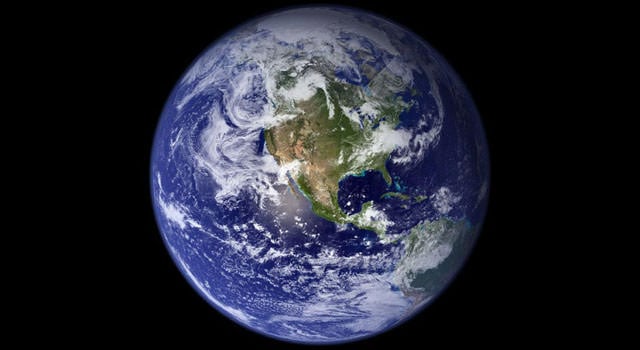
The European Space Agency's Rosetta spacecraft took this image of our home planet during its recent gravity assisting flyby. The spacecraft swept past the Earth on March 4/5 to get a speed boost on its way to Comet 67P/Churyumov-Gerasimenko. It studied the Earth and Moon using several instruments while it was in the neighbourhood and now the ESA has processed the images it sent back.
Continue reading
The next mission to make the journey to the Red Planet, the Mars Reconnaissance Orbiter, has arrived at Kennedy Space Center in Florida. Engineers will assemble various components, and test everything to ensure it's ready for launch. If all goes well, the MRO will lift off in August atop a Lockheed Martin Atlas V rocket, and then make the journey to Mars. MRO will study both the surface and underground of Mars in tremendous detail, and survey potential future landing sites.
Continue reading
NASA has decided to push back the launch of the space shuttle Discovery to July to give engineers more time to deal with some potential safety concerns with the return to flight. Managers are concerned about ice building up on the shuttle external tank, which could fall off and damage the orbiter during take off. The shuttle will be rolled back to the assembly building to make additional improvements. NASA is currently targeting a launch window of July 13 to 31.
Continue reading
Greetings, fellow SkyWatchers.This week's early dark skies will promote plenty of deep space action as we view the M51, M94, M53, and M64. Mid-week will provide some excitement as the reliable children of Comet Halley streak across our atmosphere during the peak of the Eta Aquarid meteor shower. In two months, Deep Impact will have reached Comet Tempel 1 - but why wait until then to view it? You can see it now! The call goes out to observers to help in scientific study and the week ends with a special treat. So grab your binoculars and telescopes and head out under dark skies...
Because here's what's up!
Continue reading
Alan Shepard flew first in the United States' space program and second overall in the space race. A brief 15 minute suborbital flight pitched him a few hundred kilometres east of his launch site. Later, as commander of Apollo 14, he walked on the moon's surface. But with 74 years of living, there was much more to his life which Neal Thompson openly and warmly presents in his marvellous book, Light This Candle, The Life and Times of Alan Shepard.
Continue reading
Astronomers working with the European Southern Observatory have confirmed the first direct photograph of a planet orbiting another star. The team originally announced their discovery in September 2004, but they confirmed their findings this year using the powerful new NACO instrument on ESO's Very Large Telescope in northern Chile. The planet is approximately five times the size of Jupiter, and orbits its brown dwarf star at about the distance that Neptune travels around the Sun.
Continue reading
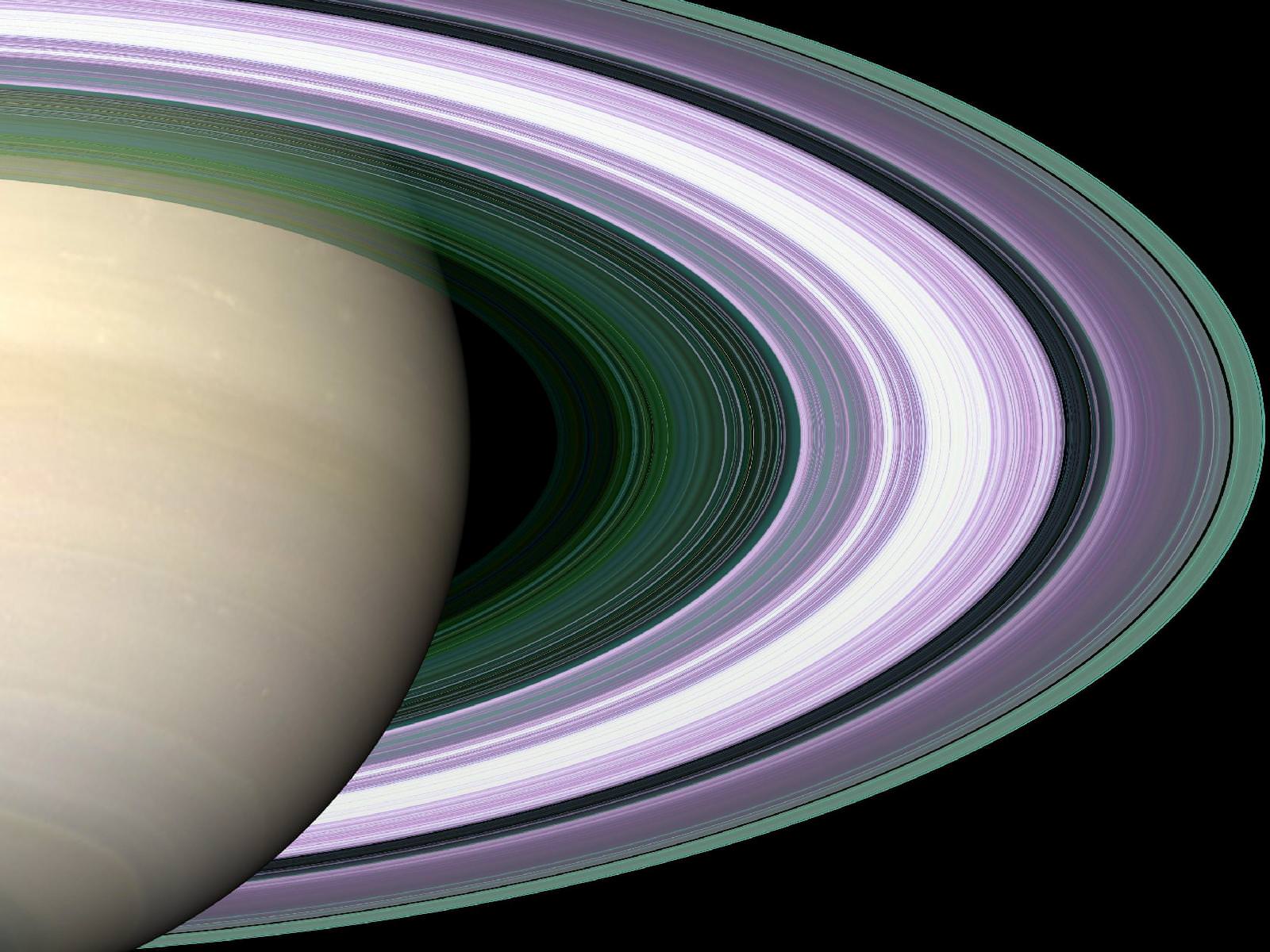
Now that it's completed flybys past several of Saturn's moons, Cassini will spend the next five months analyzing the planet's great system of rings. It'll view the rings from a position inclined 24-degrees, and orbit the planet 7 times, from now until September. This perspective will allow Cassini to analyze the rings in various wavelengths of light, from infrared to visible to ultraviolet. Cassini will also be in the perfect position to watch several occultations, where the rings pass in front of stars, and help scientists precisely measure their thickness and opacity.
Continue reading
Gravitational lensing happens when the gravity of a relatively close galaxy acts as a telescope lens to focus the light from a more distant galaxy. It allows astronomers to see distant objects they could never have a hope of observing with current instruments, essentially looking back to moments after the Big Bang (cosmically speaking). The galaxies are never perfectly lined up, though, and the "natural telescope" is a bit blurry. But now astronomer Remi Cabanac has found one of the most complete lenses ever discovered: a near perfect Einstein Ring, magnifying a distant galaxy with incredible clarity.
Continue reading
Before the first human steps foot on the Moon again, robots will have already done the ground work, searching out sources of water ice that could be used for fuel, air, and growing plants. The first will be the Lunar Reconnaissance Orbiter, scheduled for launch in 2008. It will carry 6 different instruments, and map out the surface of the Moon in high detail. Approximately one new mission will launch each year after that, until humans arrive on the Moon, no later than 2020.
Continue reading
Mission controllers at the European Space Agency are now planning to deploy the Mars Advanced Radar for Subsurface and Ionosphere Sounding instrument (MARSIS) on Mars Express in the first half of May. They delayed deploying the two 20-metre (65 foot) booms (and another, smaller boom) because simulations predicted that they could swing back and actually hit the spacecraft. They will put the spacecraft in a mode that will allow it to tumble freely while the deployment is performed to minimize risk to Mars Express.
Continue reading
This image, taken by the European Space Agency's Mars Express spacecraft, shows the Tithonium Chasma region of the Valles Marineris canyon on Mars. It ranges from 10 to 110 km (6 to 68 miles) in width, and has a maximum depth of 4 km (2.5 miles). The edges of the canyon have gone through significant erosion, and it's possible to see several landslides. Since Valles Marineris cuts so deep into Mars' surface, it gives geologists a unique view back in time through Mars' geologic history.
Continue reading
NASA's Deep Impact took its first photograph of its cometary target, Comet Temple 1, which it will smash into in just 10 weeks. Deep Impact took this image when it was 64 million kilometers (39.7 million miles) away. While it's just a few grainy pixels today, it will be the best view ever taken of a comet when the spacecraft streaks past on July 4. It will release the 1-m impactor shortly before reaching the comet, which will smash into it and carve out a crater the size of a football field.
Continue reading
European Space Agency astronaut Thomas Reiter from Germany will become the first from the agency to spend several months on board the International Space Station. Although ESA astronauts have visited the station several times before, they usually only stick around for about a week, perform a bunch of experiments, and then join the returning crew for the Soyuz flight home. Reiter will be launched with the Space Shuttle flight STS-121, currently planned for July 2006.
Continue reading
Astronomers have theorized that Mira AB is a binary star system consisting of an evolved red giant star and a white dwarf star, and now the Chandra X-Ray Observatory has been able to resolve their relationship. Chandra can actually resolve the stream of matter flowing off the red giant, which is then captured by the white dwarf. This matter heats up as it bunches up around the white dwarf, and blazes in the X-ray spectrum. Mira AB is only 450 light-years away, and the stars are separated by approximately twice the distance of the Sun and Pluto.
Continue reading
NASA's Cassini spacecraft has taken the best image so far of Saturn's small, irregular moon Epimetheus. Cassini took this photograph when it was only 74,600 kilometers (46,350 miles) away from the rocky moon. Clearly visible in the image is a large crater called Hilairea, which has a diameter of about 33 kilometers (21 miles). It takes up a large chunk of Epimetheus' surface, considering the moon is only 116 kilometers (72 miles) across.
Continue reading
Still rolling along across the surface of Mars, NASA's Spirit rover recently spotted a dust devil whirling across the Martian landscape. Spirit first turned up dust devils on Mars mainly by accident a few months ago, but controllers have refined their strategy to use the rover's navigation camera to regularly take a series of photos in the hopes of catching one in action. By watching them blow past, controllers can get an idea of local wind patterns.
Continue reading
The Liftport Group of space elevator companies has announced that it will be building a carbon nanotubes manufacturing plant in Millville, New Jersey, to supply various glass, plastic and metal companies with these strong materials. Although Liftport hopes to eventually use carbon nanotubes in the construction of a 100,000 km (62,000 mile) space elevator, this move will allow it to make money in the short term and conduct research and development into new production methods.
Continue reading
NASA's Cassini spacecraft has discovered an unusual cloud of particles around Enceladus, one of Saturn's many moons. They could be stray particles from Saturn's outermost E-ring or a previously unseen dust cloud. The discovery is so interesting to researchers that they'll have Cassini change its altitude on its next flyby - scheduled for July 14 - lowering the spacecraft so that it passes only 175 km (108 miles) above the surface of the moon.
Continue reading