It's for people. That's why we explore space, push ourselves to the next level, and continually strive forward. Machines may be the advance guard but they can never capture our hearts and souls. Perhaps people may forget this adage, but, under Ron Howard's direction, the cast and members of "Apollo 13" put on a memorable drama and remind us that people are number one.
Continue reading
After a long life, most sun-like stars grow into red giants once they've depleted most of their hydrogen fuel. The relatively small region around the star which is just at the right temperature to support liquid water will extend as the red giant expands. This means that previously frozen planets (like Mars) could thaw out and life might have a second chance to happen in a solar system. There are currently 150 red giant stars within 100 light-years of the Earth, and many of these could be a place to search for life in addition to main-sequence stars similar to our own Sun.
Continue reading
Galaxies are built up over time through a series of collisions with other galaxies. Each time this happens, clouds of gas and dust collapse and become regions of furious star formation. The European Space Agency's ISO infrared space telescope has shown the early stage of a collision between two galaxies (NGC 4038/4039) 60 million light-years away. The overlapping region between the galaxies is very rich in molecular hydrogen in an excited state. The shock waves are just starting to collapse the gas, and should lead to starbirth in the next few million years.
Continue reading
The European Space Agency's Mars Express spacecraft took this image of the Medusa Fossae Region on the Red Planet. This is an unusual region of Mars that was probably built up by a series of volcanic flows or rains of ash, and then partially eroded by water. Finally, a large asteroid, several kilometres across, struck the region and "splashed" ejecta onto the plateau.
Continue reading
Some current models of galaxy formation predict that large spirals such as the Milky Way and Andromeda Galaxy should have more satellite galaxies than are currently known to astronomers. Many of these galaxies should be much smaller than those already discovered. Astronomers reviewing data from the automated Sloan Digital Sky Survey (SDSS) have now added a tenth satellite to the Milky Way's dwarf spheroidal galaxy contingent and this one is a real lightweight.
Continue reading
Greetings, fellow SkyWatchers! This week will bring some excitement as asteroid Pallas flies through the galaxy fields of Virgo and the Moon occults Antares for Hawaii. We'll focus on exploring some strange and unusual nebulae, and learn why it's "aurora season". The week will end with the several meteor streams and the opposition of Jupiter. So grab those binoculars, set up the telescope and hope for clear skies, because...
Here's what's up!
Continue reading
The astronauts on board the International Space Station spent a few hours walking around in space today. They installed new antennas to help guide the new European "Jules Verne" cargo ship when it launches next year. They also released a tiny Russian satellite by hand - flight engineer Salizhan Sharipov "threw" it off the station at a velocity of about 1 metre/second. The whole spacewalk finished ahead of schedule, and the two men returned inside after spending about 4.5 hours in space.
Continue reading
A team of European astronomers has found some unusual objects in the central part of our galaxy which are emitting very high-energy gamma rays. What's strange, though, is these objects are invisible in the optical and X-ray spectra. So what they are is a complete mystery. Not only that, but these objects are also quite large; possibly on the order of several light years across. The observations were done using the High Energy Stereoscopic System (H.E.S.S.) telescopes in Namibia.
Continue reading
This is a satellite photograph of two huge sandy regions in the Fezzan region of Southwest Libya, near the border of Algeria. A persistent high-pressure system keeps this region of Libya completely dry for years at a time. The photograph was taken by the European Space Agency's Envisat satellite using its Medium Resolution Imaging Spectrometer (MERIS).
Continue reading
When a 10-km (6-mile), dinosaur-killing asteroid struck the Earth 65 million years ago, it released so much energy that it vaporized rock, which then fell like rain around the world. Scientists now think that these droplets of rock, called spherules, condensed out of a cloud of water vapour that surrounded the Earth shortly after the impact. They were able to trace the composition of the spherules back to the original Chicxulub impact crater, demonstrating that the material came from the Earth, and not the asteroid itself.
Continue reading
NASA announced on Wednesday their first Centennial Prizes, which will reward the development of new technologies for space exploration. The first is the Tether Challenge, where various teams will compete to see who can built the strongest cable material. In the Beam Challenge, teams will build power transmitters that send energy wirelessly to a robot climber - the winner's robot will lift the most weight to the top of a 50-metre cable. The winner of each prize will be awarded $50,000. Follow on challenges are planned for next year, and will award even higher prizes.
Continue reading
Officials announced on Tuesday that Greece has formally become the 16th country to join the European Space Agency. The country's Hellenic National Space Committee had been participating with the ESA since the 1990s, exchanging information, fellowship awards and access to databases and laboratories, but it only applied for official inclusion in 2003.
Continue reading
A new astronomical survey is in the works to help uncover the source of the mysterious dark energy which is accelerating the expansion of the Universe. Set to begin in 2009, the Dark Energy Survey will collect data on approximately 300 million galaxies, reaching back two-thirds of the history of the Universe. A 520-megapixel camera will be installed onto the 4-metre Blanco Telescope at the Cerro Tololo Inter-American Observatory in Chile, allowing astronomers to survey the sky 10 times faster than they could before.
Continue reading
NASA's Spitzer telescope has detected the light from distant planets for the first time. Until now, extrasolar planets have only been discovered indirectly, by the effect of their gravity on their parent star. Astronomers first detected two planets using indirect methods, and then used Spitzer to perform followup observation with its infrared instruments. They detected the difference in star brightness when the planet was in front and behind the star, and were able to calculate how much of this light was supplied by the planet.
Continue reading
The Milky Way has several star clusters; collections of stars pulling each other into a tight group. But now astronomers have located a super star cluster, containing hundreds of thousands of stars in a region only 6 light-years across. It's called Westerlund 1, and nobody discovered it before now because it's hidden behind thick clouds of dust. Astronomers used several of European Southern Observatory's infrared telescopes to peer through the dust and see the super cluster's true size.
Continue reading
Greetings, fellow SkyWatchers! With a full Moon this week, it will be hard to find things to do under the stars - or will it? We begin the week with morning observations of Comet LINEAR and move on towards meteor showers, variable and double stars and a Jupiter/Moon conjunction with an occultation for southern Australia. We'll explore lunar features and rudimentary astrophotography as well as just have some fun. So take out those telescopes and binoculars, because...
Here's what's up!
Continue reading
All Quasar's have black holes for hearts - but that doesn't mean they are unfriendly. In fact, 9 billion light year distant QSO2237+0305 may like us so much that it wants to make sure we see it even though it is actually hidden by a much nearer spiral galaxy. What can we learn from QSO2237+0305? For one, the cross that bears Einstein's name can tell us a lot about space-time curvature. For another, it can teach us invaluable lessons about how to see things otherwise hidden from view. If you have access to the scope and the skies, you too can see what the whole spectacle is all about.
Continue reading
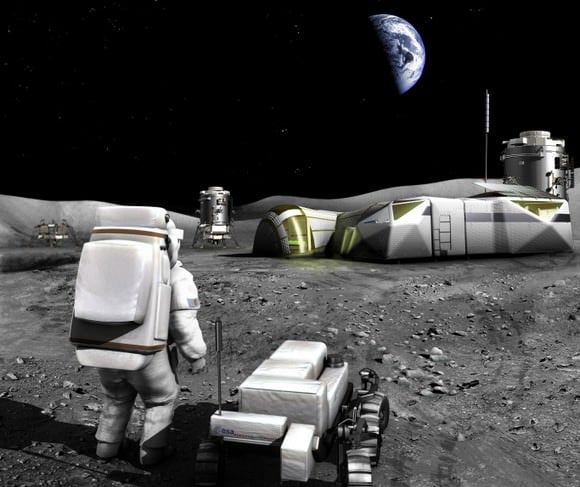
As part of its new Vision for Space Exploration, NASA will first be returning to the Moon before sending human explorers to Mars. Although Mars is a much more Earth like environment, with an atmosphere, similar length of day and large amounts of water, the Moon is going to be the agency's first target. Why? Mainly, it's much closer, so astronauts can practice working in an extreme environment close to home before making the much more difficult and riskier journey to Mars.
Continue reading
Officials from the European Space Agency and Indian Space Research Organisation have approved on a cooperative project to send a spacecraft to the Moon. ISRO will launch Chandrayaan-1 in 2007/2008 to analyze the Moon to help understand its origin and evolution. Europe will provide three scientific instruments identical to ones on SMART-1, which is currently orbiting the Moon.
Continue reading
NASA's Cassini spacecraft was recently in a lucky position in space earlier this month to watch its own private lunar eclipse, as one of Saturn's moons (Mimas) passed in front of another (Janus). Cassini's camera was rolling the whole time, and the spacecraft captured 37 images that have been stitched together into a movie of the event. Some large terrain is visible on Mimas, including its gigantic crater (the one that makes it look like the Death Star from Star Wars).
Continue reading
 Universe Today