 Universe Today
Some of the most scientifically important astronomical objects are the ones that push the boundaries of definitions. These objects can exist in the grey areas between competing definitions. They motivate astronomers to develop a deeper and more comprehensive understanding of Nature. One of these important dividing lines places planets on one side and stars on the other.
It's obvious that the rocky planets in our Solar System are planets. And it's obvious that the gas and ice giants in our Solar System are planets. But the dividing line between a massive gas giant and a star is trickier to find. Brown dwarfs reside in this grey area, and are sometimes called failed stars because they fuse deuterium but not hydrogen. It's not a question of composition: Jupiter is primarily composed of hydrogen and helium, much like a star, and so are brown dwarfs. Instead, the dividing line could be between how planets form versus how more massive objects like stars form.
Planets form in protoplanetary disks around young stars. In broad terms, they form via a bottom-up accretion process. Tiny dust grains become pebbles, pebbles become boulders, boulders become planetesimals, and planetesimals become planets. Some planetesimals gather a massive amount of gas and become gas or ice giants. There's a ton more detail involved, and many unanswered questions, but that's the raw outline.
Stars form differently. They form in massive gas clouds that fragment into smaller, denser pieces that accrete more gas. Eventually, the mass and density trigger fusion and a main sequence star is born. This collapse and fragmentation process could play out in protoplanetary disks. That can explain some massive exoplanets found at great distances from their stars.
So the dividing line between the two processes and the two outcomes is indistinct, and it involves brown dwarfs and the deuterium burning limit.
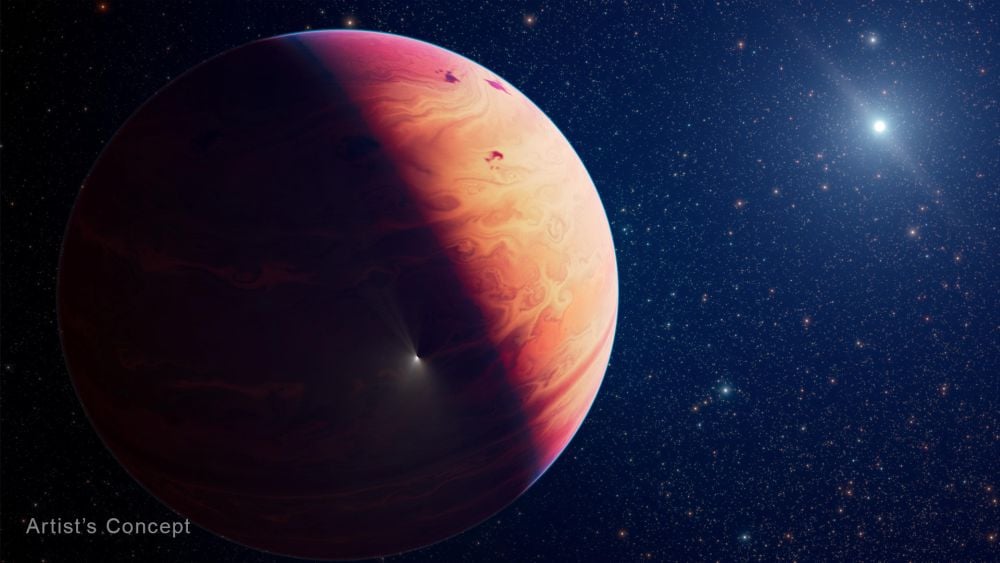
Now, new research using the JWST has directly imaged an object that straddles that line. It's called 29 Cygni b, and it's 15 times as massive as Jupiter and orbits its A-type main sequence star at a distance of 2.4 billion km. Its mass suggests a stellar object, but the JWST also detected heavier elements like carbon and oxygen, suggesting that it formed more like a planet in the star's protoplanetary disk.
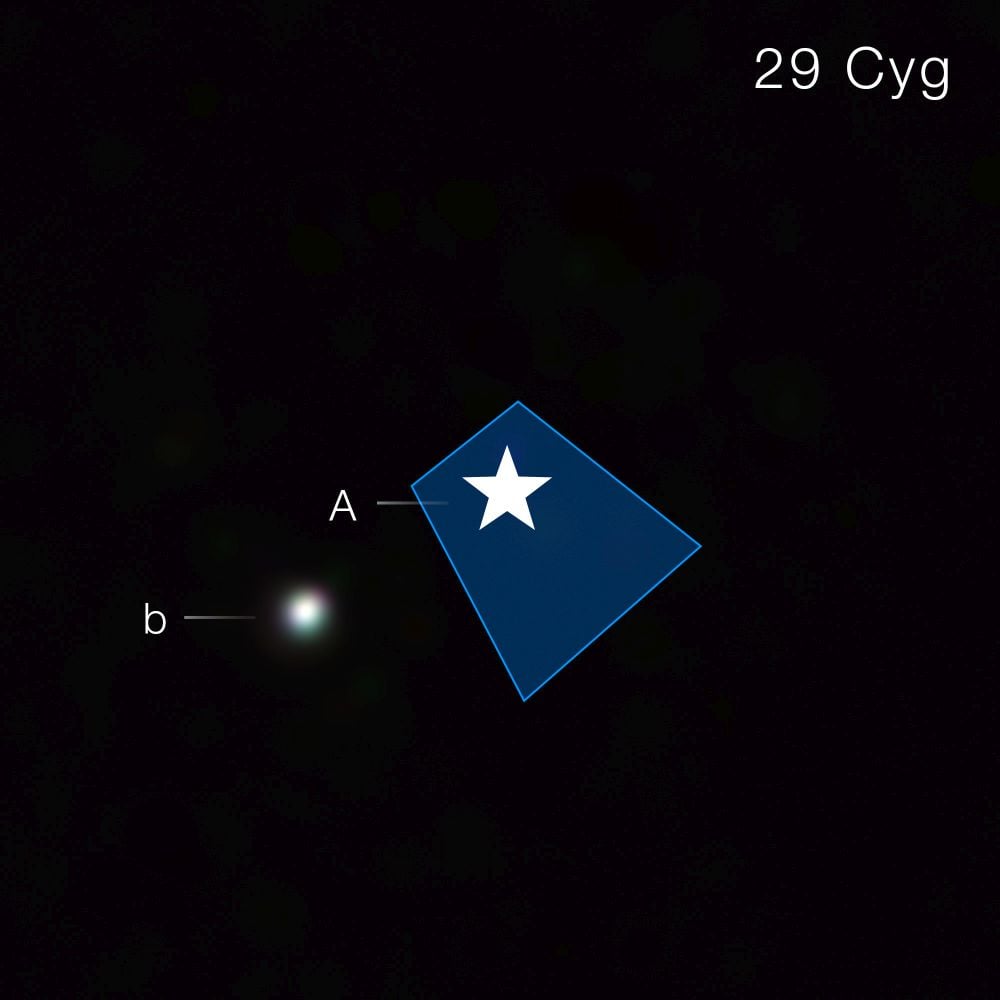 The JWST directly-imaged 29 Cygni b with its coronagraph and also detected carbon monoxide and carbon dioxide. Image Credit: NASA, ESA, CSA, William Balmer (JHU, STScI), Laurent Pueyo (STScI); Image Processing: Alyssa Pagan (STScI)
The research is titled "Direct Images of CO2 Absorption in the Atmosphere of a Super-Jupiter: Enhanced Metallicity Suggestive of Formation in a Disk." It's published in The Astrophysical Journal Letters and the lead author is William Balmer. Balmer is from Johns Hopkins University and the Space Telescope Science Institute.
A central concept in this work is the deuterium burning limit. Brown dwarfs are substellar objects that are sort of planets and sort of stars. While they're not massive enough to fuse hydrogen into helium like a main sequence star, they can fuse deuterium, an isotope of hydrogen. So the deuterium burning limit is a useful concept. However, it's somewhat arbitrary, because it doesn't explain how the object formed.
"This object has an uncertain mass that straddles the deuterium burning limit," the authors write. That limit is at about 15 ± 5 Jupiter masses, and 29 Cygni b has about 15 Jupiter masses. This makes the object very desirable in terms of defining what a star is and what a planet is.
"In computer models, it’s very easy for fragmentation in a disk to run away to much higher masses than 29 Cygni b. This is the lowest mass you could plausibly get. But at the same time, it’s about the highest mass you could get from accretion,” said lead author Balmer in a press release.
The JWST also found carbon and oxygen in its atmosphere as CO and CO2. 29 Cygni b is also richer in metals than its star. Since the object is so massive, the heavy elements it contains add up to about 150 Earths. Its high metallicity indicates that the object formed by accretion in the protoplanetary disk, where it could accrete metals, rather than by collapse like a star. If it followed the star-like fragmentation and collapse route, its metallicity should mirror that of the star it orbits.
There's additional evidence that it formed like a planet in the protoplanetary disk. Using CHARA, the Center for High Angular Resolution Astronomy, they measured 29 Cygni b's orbit. They found that it's aligned with the star's orbit, indicating that it formed in the disk.
“We were able to update the planet’s orbit, and also observed the host star to determine its orientation with respect to that orbit,” said co-author Ash Messier, a graduate student at Johns Hopkins University. “We showed that the inclination of the planet is well-aligned with the spin axis of the star, which is similar to what we see for the planets of our solar system.”
“Put together, this evidence strongly suggests that 29 Cygni b formed within a protoplanetary disk through rapid accretion of metal-rich material, rather than through gas fragmentation,” said Balmer. “In other words, it formed like a planet and not like a star.”
This research applies pressure on the idea that the dividing line between planet and star is mass or deuterium fusion. Instead, it looks at how objects formed to find the dividing line. So instead of seeing 29 Cygni b as a "failed star," as brown dwarfs are sometimes called, it's simply a very massive planet. It also suggets that massive gas giant planets can form in the protoplanetary disks around hot and luminous A-type stars.
Balmer and his colleagues are not confining their observations to 29 Cygni b. They're going to observe three other similar objects and search for differences in composition between the lower-mass and higher-mass objects within their sample. Their metallicities could explain more of the details in their formation.
"These can be used to revise our understanding of the formation mechanisms and timescales of giant planets," the authors write.

