Universe Today
I want you to imagine a scene. It's the red carpet. It's the night of the Oscars, or the Emmys, or the participation trophy ceremony for your kid's soccer team. That's not the essential part of the metaphor. What matters is who is there: Brad Bradington's adoring fans, curious onlookers, and of course the paparazzi, ready to take their shot.
In our analogy, Brad Bradington is a particle. An electron, a proton, even a neutrino if it felt like it. The crowd of onlookers and fans? That's a material — a substance, like air or water or diamond or the inside of your eyeball (which is mostly water and hopefully very little diamond).
And those paparazzi? They're the most important part.
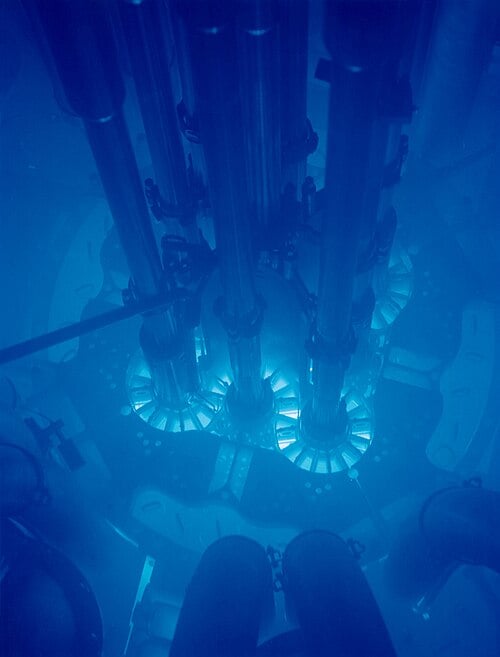
I'm talking today about something called Cherenkov radiation, which I prefer to call a "light boom" but as usual nobody listens much to me. We'll get to Brad Bradington and his red carpet moment. But first we need to talk about the man who stared at a faint blue glow for three years and refused to look away.
It's 1934. Pavel Alekseyevich Cherenkov is working in Moscow, doing the kind of science that sounds almost embarrassingly simple when you describe it at a party: he's shining gamma rays into a bottle of water.
That's it. That's the whole experiment.
Hey — in the 1930s, a lot of particle physics involved shining or shooting X into target Y, so it's not as lame as it sounds. But still. A bottle of water.
And when he shoots the gamma rays into the water, it glows. Blue. Faint, barely there. But unmistakably there.
Now here's the thing. This wasn't the first time anyone had seen this. Marie Curie's lab had noticed the same glow years earlier. Other physicists had seen it too. And every single one of them had looked at it, shrugged, and written it off as fluorescence — some impurity in the water absorbing the radiation and re-emitting it as light. Secondary effect. Not interesting. Move along.
Cherenkov looks at it and thinks the great hallmark of most scientific discoveries: huh, that's weird.
It's said that good scientists don't discover new things — they look at old things in a new way. Pavel did that.
He's not sure why he's suspicious. But he's suspicious. So he does what any good experimentalist does when something doesn't sit right — he starts poking it. He tries purifying the water. The glow stays. Hmm. He tries different liquids. The glow changes. Ooh! He varies the energy of the radiation. The glow responds. Neat! He changes the geometry of the experiment.
The glow has a direction.
Wait, what?
Fluorescence glows in all directions equally — it doesn't care which way you're looking at it. But this glow was asymmetric. It was stronger in some directions than others. It was doing something fluorescence absolutely does not do.
He doesn't know what this is. But this is definitely NOT fluorescence.
So Cherenkov does something that separates the great scientists from the merely good ones: he decides that not knowing what something is is not a reason to stop looking at it. He spends the next three years characterizing this phenomenon with almost obsessive precision. He's not a theorist — he can't tell you WHY it's happening. But he can tell you everything about WHAT it's doing. He measures its intensity, its direction, its dependence on the speed of the incoming particles, its behavior in different materials. He builds up a complete empirical portrait of something he fundamentally doesn't understand.
He publishes his results. The physics community is...mildly interested. This is the 1930s. There's a lot going on. Quantum mechanics is still being sorted out. Nuclear physics is exploding — literally. A faint blue glow in a bottle of water is not exactly front page news.
A few years later, a pair of theorists pick up his careful measurements and figure out what's actually going on.
It's Brad Bradington, showing up at the red carpet.
In Part 2, we need to talk about the crowd — and why the speed of light is not actually a universal speed limit.