Universe Today
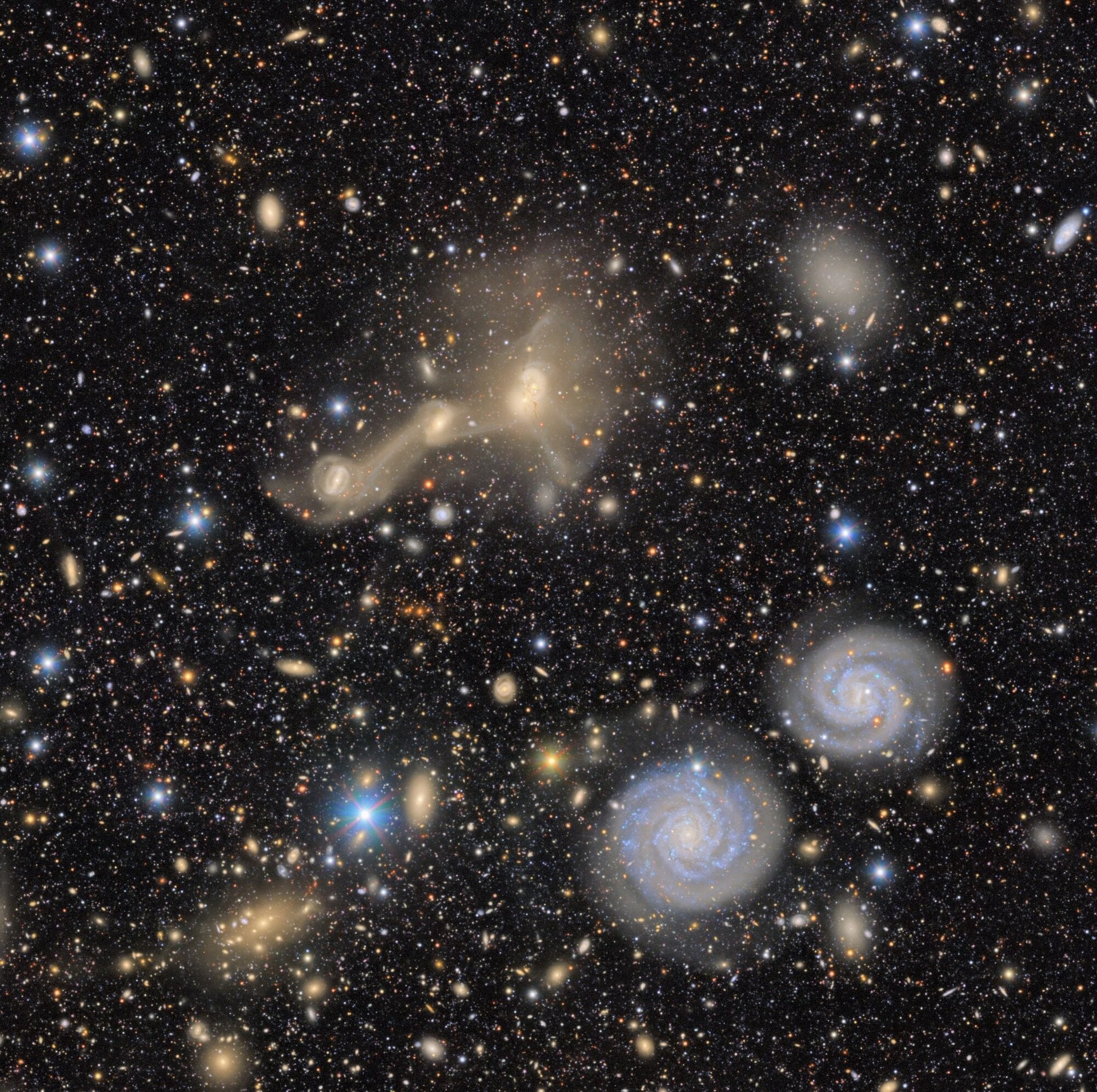
A pair of dwarf galaxies in the giant Virgo Cluster show what can happen when these stellar cities interact. Scientists at the University of Michigan focused the James Webb Space Telescope (JWST) onto the galaxies NGC 4486B and UCD736 and found each of them sporting "overmassive" black holes at or near their hearts. Those supermassive black holes comprise a large fraction of each galaxy's mass.
How could galaxies get such massive monsters at their hearts? It helps to look at their merger experiences. During the millions of years it took for them to interact, the power of the mergers stripped away a lot of their stars. That left behind the black holes, and many fewer stars. So, when scientists take into account the mass of the galaxies, the black holes comprise more of the galaxy mass than they used to. As astronomers observe more galaxy mergers and trace the effects of black hole mergers during those events, they get a clearer picture of the long-term evolution of galaxies throughout the Universe.
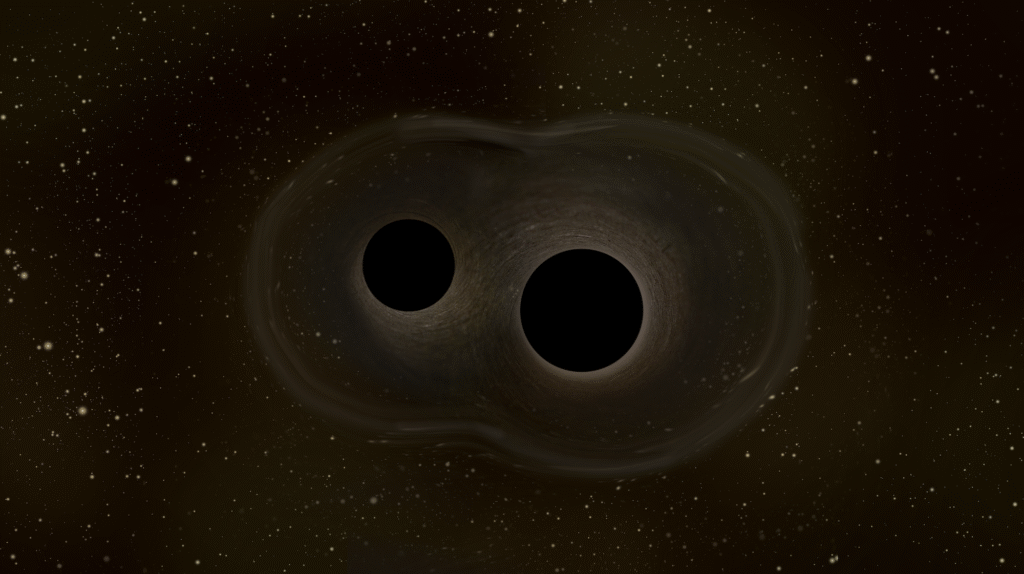 An artist's concept of two black holes in the merger process. Credit: ESA.
Understanding a Strange Dwarf Galaxy and its Black Hole
The JWST observations revealed that the dwarf galaxy NGC 4486B has a black hole that started out as two less-massive ones. During the interactions, the pair collided and merged. That black hole is about 360 million times the mass of the Sun. It's also off-center, as if it had wobbled out of place and is slowly moving back to the heart of the galaxy. "In most galaxies where we see a black hole, it’s bang-on in the center of the galaxy," said Monica Valluri, a professor of astronomy at UM and senior author of papers describing the observations. “You can see clearly that it’s off-center in NGC 4486B.”
Previous Hubble Space Telescope and ground-based views showed the off-kilter location of that black hole, but it took JWST data to reveal the effects of the merger that occurred in the recent past. That's when the two massive objects drew close to each other, danced for a bit, and then collided to become one colossally massive black hole. The process not only changed the pair, but affected the galaxy as well. “There have been a number of predictions about what galaxies that have experienced black hole mergers should look like in the aftermath. We believe this discovery is a smoking gun for that,” Valluri said.
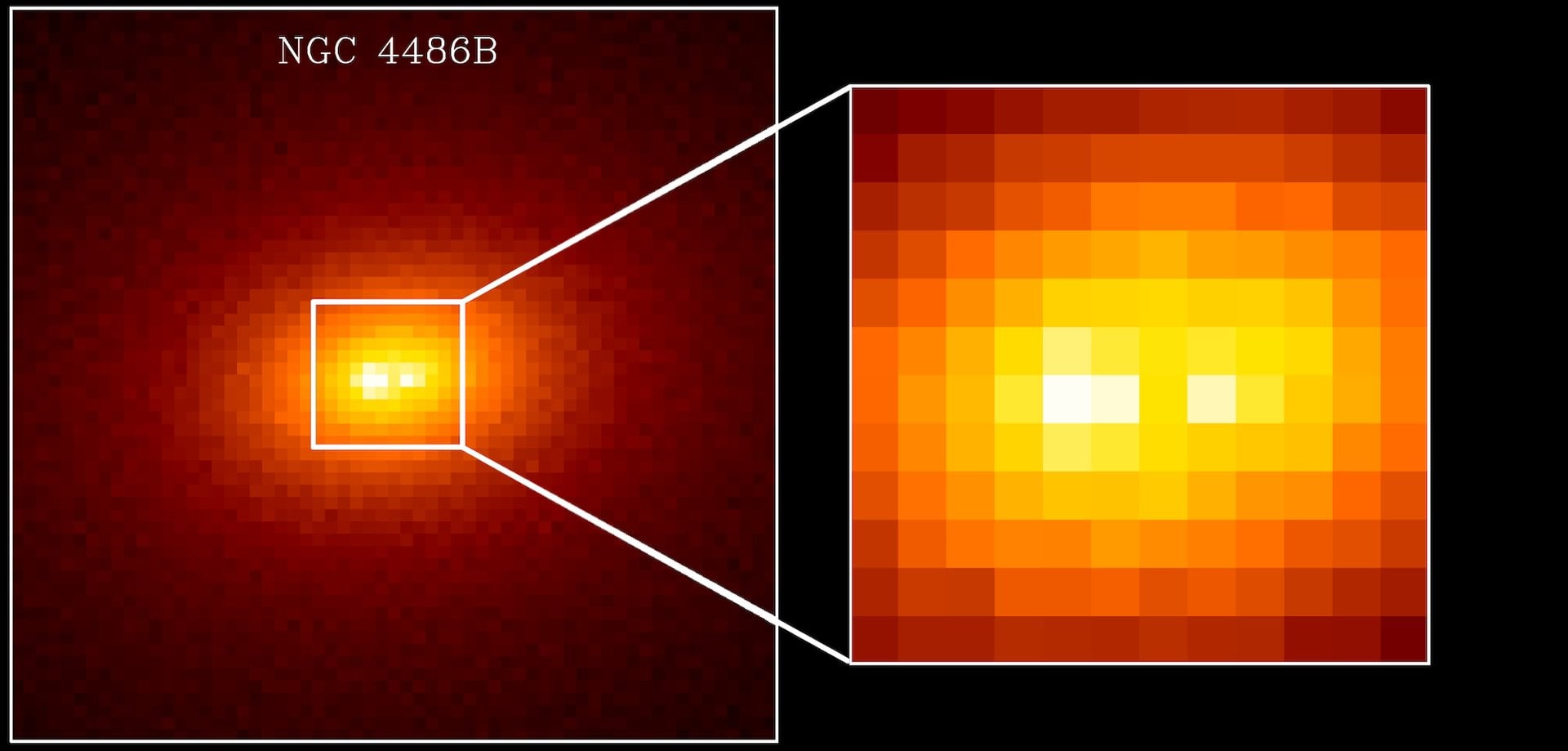 A Hubble Space Telescope view of the double nucleus of NGC 4468B. Image Credit: Karl Gebhardt (University of Michigan), Tod Lauer (NOAO), and NASA
The merger sent stars in the immediate neighborhood away from the scene. That left behind what scientists call a "stellar deficit", a sort of "hole" in the galaxy where few stars remain. The merger also created gravitational waves. As for the off-center location, Valluri and her team suggest that the black holes' pre-collision configuration could have created some kind of asymmetry. That likely caused the waves to emanate out preferentially in one direction, which created a recoil that nudged the black hole off-center. JWST observations made using NIRSpec tracked the paths of the stars that got kicked out and gave more information about the resettlement of the black hole, which could occur within the next 30 to 80 million years.
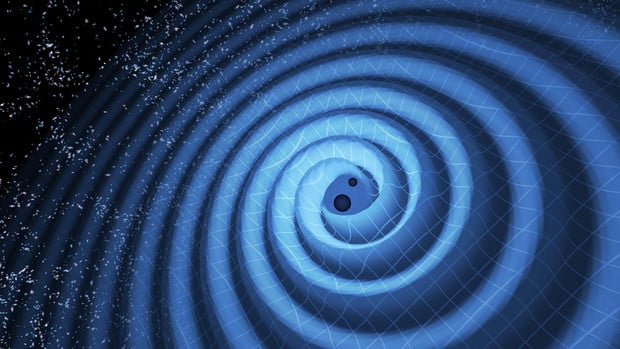 An illustration of two black holes as they spiral in toward each other, sending gravitational waves across space. Courtesy LIGO/T. Pyle.
“What makes this system particularly interesting is that the double nucleus appears to preserve the dynamical signature of a recoil kick following a black hole merger,” said Behzad Tahmasebzadeh, who was a postdoctoral fellow at the University of Michigan when he participated in the studies of the black holes. “By analyzing the motions of stars in the galaxy’s center, we can trace how the central structure was disturbed after this event,” Tahmasebzadeh said. “Observations like this provide rare insight into how black hole mergers can reshape the inner regions of galaxies.”
Another Overmassive Black Hole in the Cluster
There's another little galaxy in the Virgo Cluster with an overmassive black hole. It's called UCD736, and it didn't use to be so little. The science team thinks it was originally much larger in the distant past. Then, through interactions with other galaxies in the crowded cluster environment, it lost much of its outer structure to other galaxies. Today, there's just a nucleus of a galaxy left behind, sporting a black hole that's 8 percent of the mass of the galaxy. By comparison, most supermassive black holes in galaxies are less than a percent of the total galactic mass.
According to doctoral student and team member Solveig Thompson, using JWST to study these smaller and dimmer galaxies is uncovering a lot of new information about central black holes and their histories. “We also find parallels between UCD736 and NGC 4486B where they both host unusually large SMBHs for their size, suggesting they both started much larger than they are today and evolved along the same stripping pathway in the Virgo Cluster," Thompson said.
The Virgo Cluster is chock full of galaxies at many stages of the evolutionary process. This galactic commune lies some 55 million light-years from Earth and contains upwards of 2,000 galaxies. It's part of the larger Virgo Supercluster, which counts just under 50,000 members. That provides a lot of galaxies for scientists to study central supermassive black holes. Their activities at the hearts of their parent galaxies provide and preserve information about past mergers, as well as the often-violent events that strip galaxies of their stars and alter their shapes over time.
For More Information
My, what big black holes you have: Tales from the Virgo Cluster
A JWST View of the Overmassive Black Hole in NGC 4486B
?A Supermassive Black Hole in a Diminutive Ultracompact Dwarf Galaxy Discovered with JWST/NIRSpec+IFU