Universe Today
For most of human spaceflight history, the go to for communications has been radio waves, a technology that has served us remarkably well, but one that is beginning to show its age. When NASA's Artemis II mission carried four astronauts around the Moon in April the year, engineers quietly tested a laser communications terminal that could one day rewrite the rules of deep space exploration.
Bolted to the exterior of the Orion spacecraft, the Orion Artemis II Optical Communications System that was developed by MIT Lincoln Laboratory, became the first laser communications terminal ever to support a crewed mission at lunar distance. Rather than radio waves, the device used invisible infrared light to carry data between the spacecraft and receivers on Earth, exploiting the fact that the shorter the wavelength, the more information you can squeeze into a single beam.
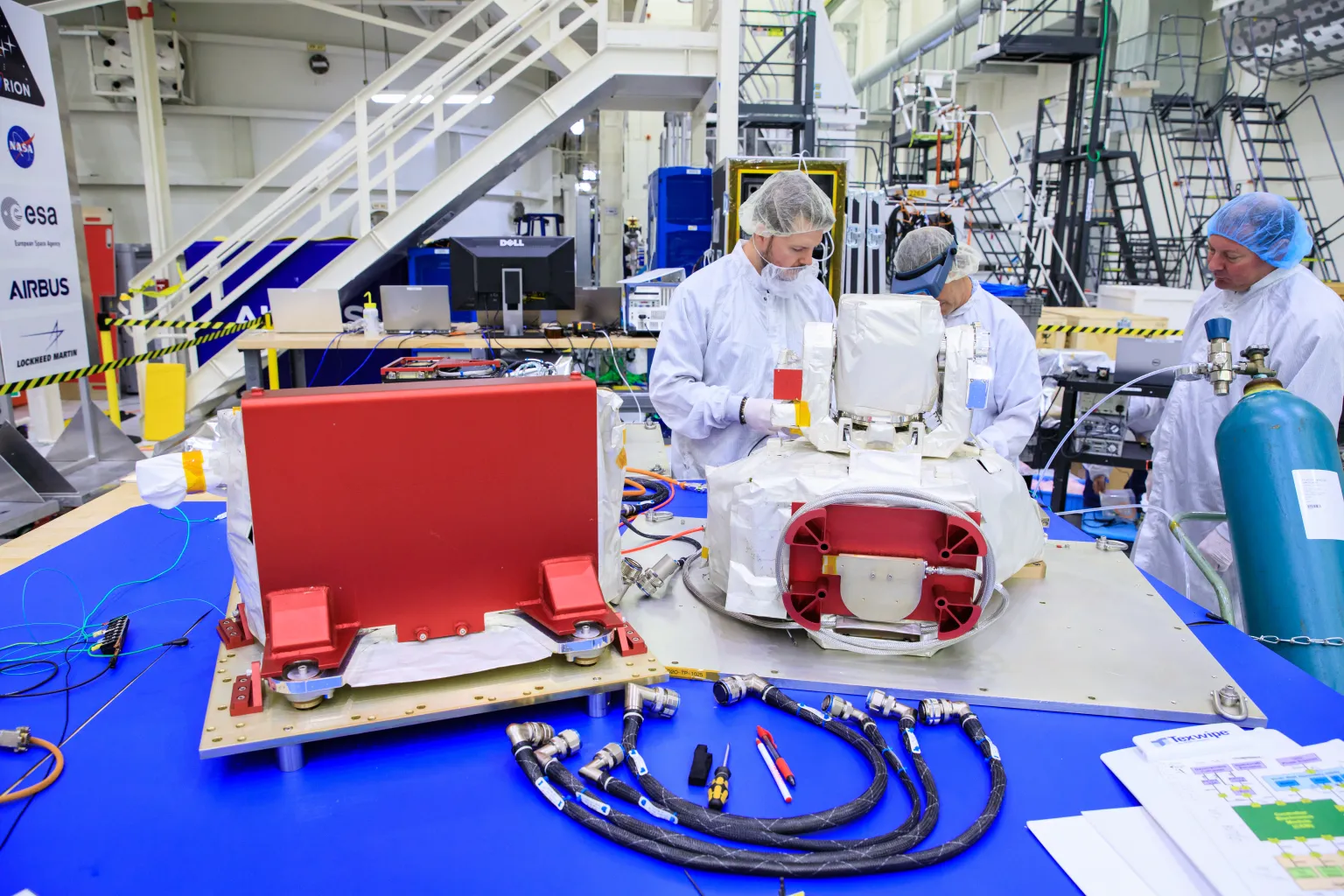 Inside the high bay of the Neil Armstrong Operations and Checkout Building at NASA’s Kennedy Space Center in Florida, technicians assemble on the Optical Communications System for the Artemis II mission on June 2, 2023 (Credit : NASA/Glenn Benson)
Traditional radio systems, operating at the distances involved in a lunar mission, were limited to single digit megabits per second. The optical terminal routinely achieved downlink speeds of 260 megabits per second, and ground stations at NASA's Jet Propulsion Laboratory and White Sands Complex set a record of their own. In just under an hour, they received, processed it and retransmitted it to mission control! Until I had fibre installed, this was far superior than my home broadband system.
Over the course of the roughly ten day journey, the system transferred 484 gigabytes of data between Orion and the ground in total. Those figures weren't just impressive on paper, they translated directly into the images that stopped the world. The striking photographs of Earthset, Earthrise, and the solar eclipse captured from the Moon's far side, images that circulated across front pages and social media feeds within hours of being taken. It all came home via that laser link.
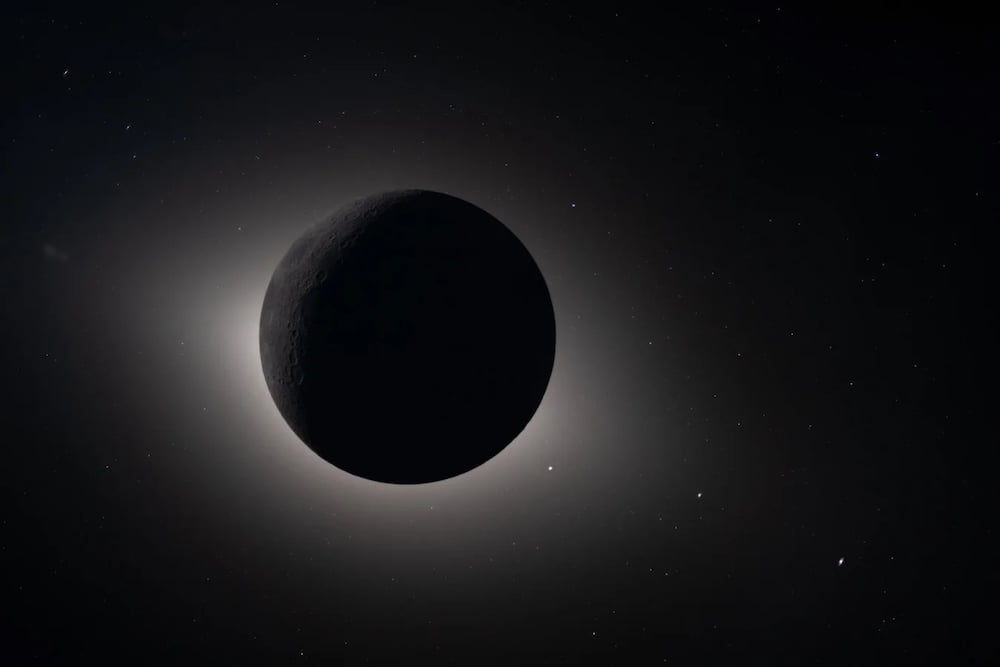 The solar eclipse captured by the Artemis II astronauts from the Orion capsule and beamed back using the optical communication system (Credit : NASA)
A ground station at the Quantum Optical Ground Station in Canberra, Australia, sustained a dual-stream live video connection with Orion for more than 15.5 hours, feeding the millions who watched the mission unfold in near real time. Perhaps most significantly, engineers demonstrated that commercial, off the shelf parts are entirely capable of building optical ground stations, a finding that dramatically lowers the barrier to rolling this technology out at scale.
For the astronauts heading to Mars in the decade(s) ahead, that matters enormously. Today's radio systems will struggle to sustain the kind of real time, high resolution communication that long duration deep space crews will need. Laser communications won't just give future explorers better pictures, it will give mission controllers the data they need to keep people alive, half a Solar System away.
Source : NASA Laser Terminal Enhances Views During Artemis II Mission