 Universe Today
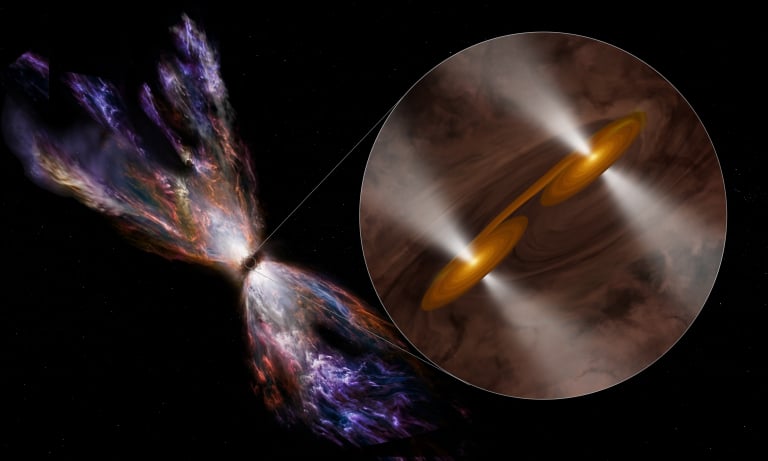
Our Sun is a bit of an outlier in the general stellar population. We typically think of stars as being solitary wanderers throughout the galaxy. But roughly half of Sun-like stars are locked in with more than one companion star. If there are two, it’s known as a “binary” system, but in many cases there are even more stars all collectively tied together by gravity. Astronomers have long debated why this happens, and a new paper, available in pre-print on arXiv from Ryan Sponzilli, a graduate student at the University of Illinois, makes an argument for a mechanism known as disk fragmentation.
Disk fragmentation is one of two competing theories for why close-companion formation happens. In this scenario, a single, massive disk of gas and dust surrounding a newborn star becomes unstable and breaks apart. Eventually, it coalesces into another star right next door. Critically for the study, since these stars were formed from the same spinning disk, their rotational axes should be aligned.
The second theory is known as turbulent fragmentation followed by inward migration. In this scenario, turbulence in the same cloud causes it to break into two widely separated clumps, which then go on to create their own stars. Over tens of thousands of years the two stars are dragged together through complex gravitational interactions, eventually ending up as a binary pair. Critically, since they formed from separate chaotic processes, their final spins and orbits should be randomly oriented.
Fraser talks about how stellar nurseries work.To determine which method was the dominant form of binary system formation, the researchers looked at 51 infant binary systems. Since these young stars are surrounded by blankets of gas and dust, we can’t see their rotation directly. But we can measure the orientation of the streams of gas that are blasting away from their poles.
Doing so required data from the Atacama Large Millimeter Array (ALMA), which traced the carbon monoxide present in these jets. This allowed the team to use the outflows as a proxy for the angular momentum of the system - if the jets are firing in parallel (and perpendicular to the line between the two stars), then they are spinning in sync, lending credence to the disk fragmentation theory. However, if they were pointed in seemingly random directions, that would be strong evidence for the turbulent fragmentation theory.
In their analysis, the data strongly favors the disk fragmentation theory. They found 42 outflows in the 51 binary pairs, across 38 systems. After some statistical simulation, they found a scenario that indicated that around 94% of the outflows were intrinsically “orthogonal” to the plane between the two stars. As the authors put it “based on this analysis, we suggest disk fragmentation is the dominant formation pathway for close-companion protostellar systems.”
Seems pretty definitive, but an argument could be made for the other side. What if, while the turbulent binaries take their sweet time migrating towards each other, their spins slowly start aligning as well. According to the authors, the likelihood of this happening is almost nil - the sheer prevalence of these aligned jets strongly point to in-situ formation rather than migration of the two stars.
Fraser talks about peering into the heart of the Milky Way, including a segment on how ALMA sees molecular clouds.This research doesn’t just solve a stellar birthing mystery. It also helps set the stage for our understanding of the orbital mechanics of early star systems. And perhaps more importantly, increases our understanding of how those orbital mechanics affect the planetary systems that will eventually form in these common star systems.
Learn More:
NRAO - Most Close Pairs of Stars Are Born as Cosmic Twins
R. Sponzilli et al. - Protostellar Outflows Shed Light on the Dominant Close Companion Star Formation Pathways
UT - Binary Stars Form Lots Of Exoplanets, But Many Of Them Are Ejected As Rogue Planets
UT - Binary Stars Form in the Same Nebula But Aren't Identical. Now We Know Why.

