 Universe Today
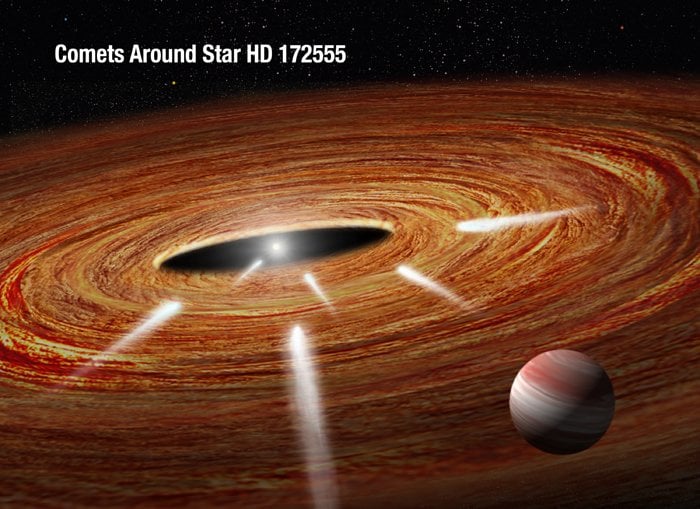
The James Webb Space Telescope (JWST) was involved in yet another first discovery recently available in pre-print form on arXiv from Cicero Lu at the Gemini Observatory and his co-authors. This time, humanity’s most advanced space telescope found UV-fluorescent carbon monoxide in a protoplanetary debris disc for the first time ever. It also discovered some features of that disc that have considerable implications for planetary formation theory.
HD 131488 is a relatively young (~15 million year old) star in the Upper Centaurus Lupus subgroup, in (no surprise) the Centaurus constellation about 500 light years away. It’s classified as a “Early A-type” star, which means that it's both hotter and more massive than our Sun. It’s also not the first time its been the subject of a paper about its disc.
Previous studies from ALMA, which operated in radio frequencies, found a massive amount of “cold” CO gas and dust roughly 30-100 AU away from the star. Additional preliminary infrared data from the Gemini Observatory and the NASA Infrared Telescope Facility (IRTF) showed there was likely hot dust and some solid-state features in the inner zone of the star. Additional optical studies even hinted that there was some “hot atomic gas”, such as calcium and potassium, in the inner disc, which is not the same as CO since it, by definition, is a molecule.
Video showing the formation of planets in a protoplanetary disc. Credit - NASA VideoBut the key to truly understanding what was going on in the inner part of the disc lay in the infrared spectrum, and that is where JWST shines. Or, more accurately, where it collects data on things that shine on it. When it turned its attention to HD 131488, which it did so for likely only around an hour in February of 2023, it found a small amount of “warm” CO gas, equivalent to about one hundred thousands of the mass of the cold gas in the outer disc.
This gas was spread between .5 AU and 10 AU, and had a couple of interesting features. First, there was a difference between “vibrational” temperature and “rotational” temperature. A gas’ vibrational temperature represents how fast the atoms within the molecule are vibrating back and forth, while the rotational temperature represents how fast the molecules are spinning - something equivalent to the kinetic energy. In a normal gas state, like what you would find in a typical room, these two temperatures would be the same as the collisions between the particle would equilize them to something called the Local Thermal Equilibrium.
However, surrounding HD 131488, the difference is massive. The CO molecule’s rotational temperature is only around 450K max (dropping to 150K farther from the star), whereas their rotational temperature is a blistering 8800K, matching the UV glare from their host star. This shows they aren’t in thermal equilibrium, and also explains why the molecules fluoresce appear (warm).
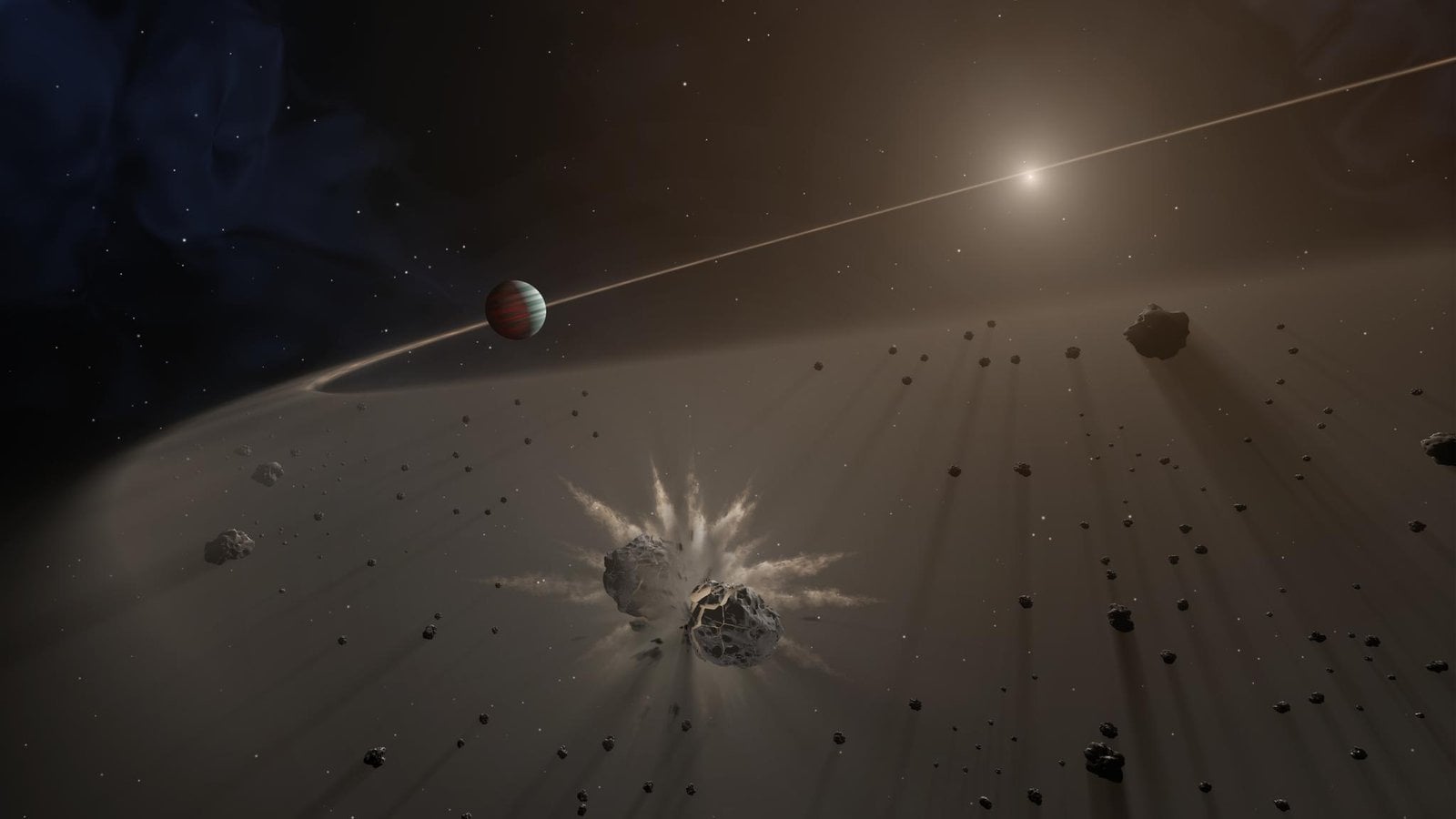 Cometary collisions happening in a protoplanetary disc. Credit - NASA / JPL-Caltech
The ratio of Carbon-12 to C-13 was also found to be high for this type of environment, which implied that there are probably some dust grains trapped in the sparse warm gas cloud blocking the light. Additionally, to emit the pattern of light JWST found, CO needs “collisional partners” - other molecules that bounce off of them and sapping some of their energy. Two potential partners were studied, with hydrogen seeming less likely, while water vapor from comets being destroyed by the star is seemingly more likely.
That “exocometary” hypothesis is a key finding of the paper. Scientists have long debated what creates this relatively rare class of CO-rich debris discs, such as HD 131488, and how they hold onto their gas. Two hypotheses have been put forward to explain that - first, that CO-rich disks are simply leftover from the star’s birth, and second, that the gas is constantly being replenished by comets being destroyed.
Results from this study land firmly in favor of the second explanation. But they also have implications for planetary formation. Since there was a significant amount of carbon and oxygen in this “terrestrial zone” of the disc, along with a dearth of hydrogen, any planet that would form there would have high “metallicity” (i.e. elements that aren’t hydrogen). That would distinguish them from hydrogen-rich primordial nebulae.
Ultimately these first-of-its-kind discoveries are exactly what JWST was designed to do, and it has been producing a steady stream of them since its launch. There are undoubtedly more star systems like HD 131488 that can add further evidence to the CO-rich disc debate, but for now this paper provides plenty of evidence about how these relatively rare systems form.
Learn More:
C. X. Lu et al - JWST/NIRSpec Detects Warm CO Emission in the Terrestrial-Planet Zone of HD 131488
UT - Why Rocky Planets Form Early: ALMA Survey Shows Planet-Forming Disks Lose Gas Faster Than Dust
UT - Astronomers See Carbon-Rich Nebulae Where Planets are Forming

