 Universe Today
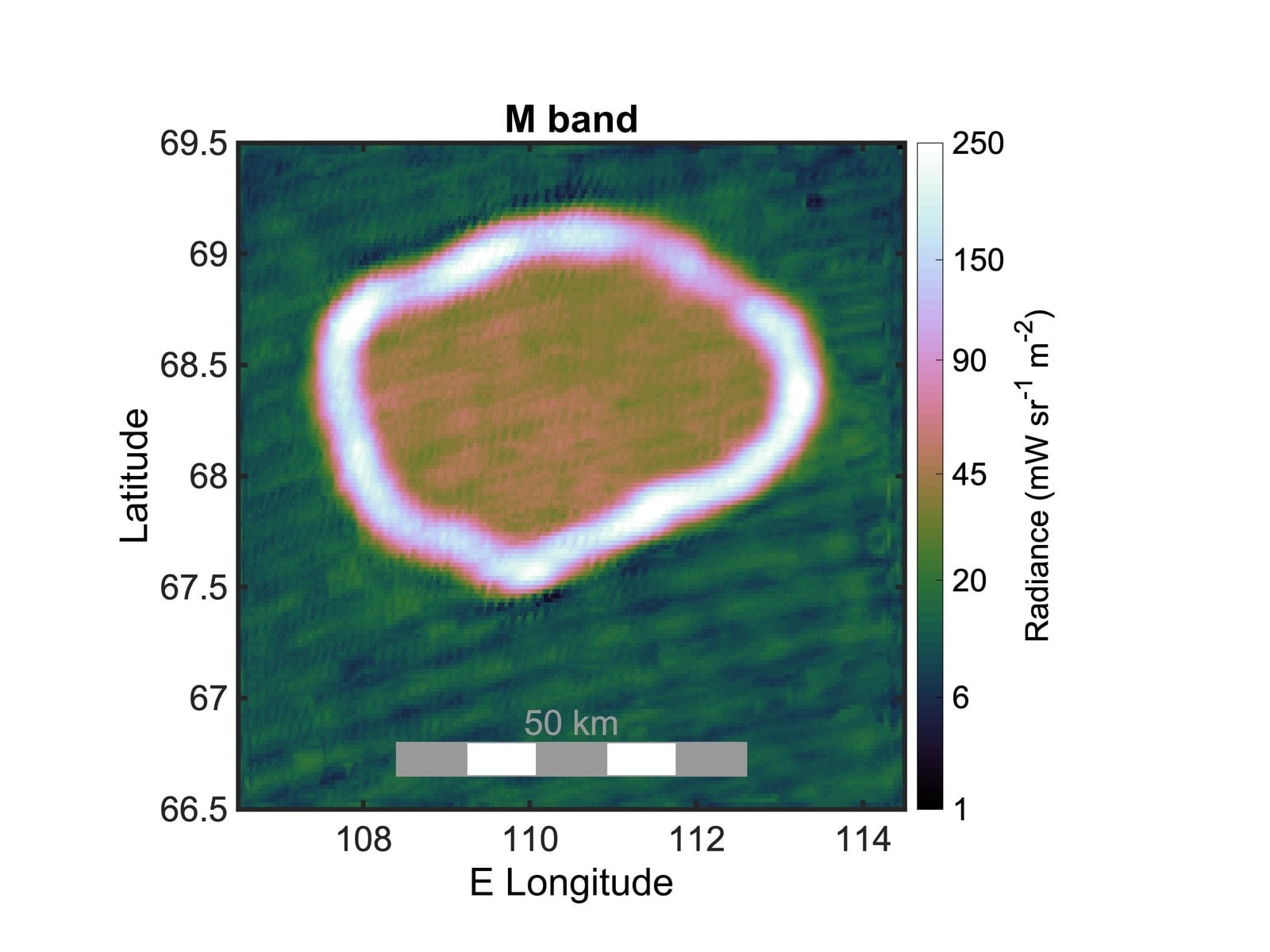
Io is a world of extremes. It is by far the most volcanically active world in our solar system. Being continually squeezed in the never-ending tug-of-war between Jupiter and its larger satellites will do that to a moon. As a result, Io has over 400 “paterae” - volcanic depressions that spew lava up onto its surface. And, according to a new paper available in pre-print on arXiv and utilizing data from Juno’s Jupiter InfraRed Auroral Mapper (JIRAM) tool, we have been massively underestimating the power output of those paterae for decades.
Io’s paterae can also be thought of as essentially lakes of lava. These lakes can be broken down into two main components, at least from a thermal perspective. First is a “central” part of the lava lake that acts similar to the “crust” that forms over lava that has been sitting for long enough. While still thermally active - with an average temperature generally in the 220–230 K range - they are much cooler than their blistering hot counterparts.
Forming a peripheral ring around the central crust is a blazing hot area that can reach temperatures of up to 900 K. At first glance, it might seem confusing why the external reaches of these volcanoes are hotter than their central core. But it is simply because the central crust acts as a cooling “lid” to the molten interior of the volcano itself. When lava is exposed to the vacuum of Io’s surface, it quickly begins to solidify. As it continually does so over eons, the crust thickens, creating an insulator between the vacuum of space and the churning molten lava underneath.
Fraser talks about a major volcanic outburst on Io.However, on the periphery, that crustal lid has not yet had time to form. The active magma that is reaching that section has not yet had time to cool, and in some cases might even be driven directly by a “piston” action that causes the volcanoes in the first place. Additional lava churning under the surface (similar to how it does on Earth) could push the hottest magma out towards the edges.
One of the most critical features of all this moving lava is its total thermal output. Previous estimates of this value used data from infrared cameras specifically in one wavelength - the “M-band”. The problem with that is the M-band is extremely good at picking up “hot spots” like the peripheral rings, but is essentially blind to the central crust of the paterae.
Despite being much cooler in temperature, the crustal areas themselves are much, much more massive than the peripheral rings. As a result, their overall thermal output is much higher as well, despite being “cooler” on the surface. The estimates in the paper suggest that current guesses at Io’s overall thermal output are off by an entire order of magnitude.
Fraser talks about the major lava lakes on Io.The study only looked at 32 of Io’s 400 paterae, and one in particular stood out as a good test subject. Known as P63, it was estimated to give off around 7 Gigawatts of thermal emission energy, though that would jump to 20 Gigawatts in some models. However, using the updated data from JIRAM, which also captures the thermal output of the lower temperature crustal areas, puts the power estimate at a whopping 80 GW.
In addition to updating estimates of Io’s power output, the data allowed the researchers to calculate the estimated “resurfacing age” of the crusts themselves. Plugging the temperature of the crusts into a thermal cooling model, they found that a 200 K crust would be about 13 years old, and statistical models derived a characteristic resurfacing timescale on the order of a decade (8–10 years).
However, that raises a question. We have visual images of Io from Voyager in 1979, Galileo in the 1990s, and Juno now. Over the course of those images, there doesn’t appear to be any notable changes in lake morphology during that time frame. Which raises a question - if we expect the surface to change roughly every ten years why haven’t we actually seen that change in the time frames we’ve been looking at this most active of moons.
NASA Video on the Juno Mission. Credit - NASAMarshall YouTube ChannelTo be fair, the paper does leave some other unanswered questions - JIRAM itself can’t map the actual area of the crusts used in the analysis, so the authors relied on older Voyager and Galileo data, which certainly isn’t as high of resolution as modern instruments would allow. In addition, extrapolating out the overall power output increase to all paterae on Io might be a stretch - many of them are not “lava lakes” so they wouldn't have the same bifurcated thermal structure as the ones in this study.
But there’s still time to clear up these remaining questions - Juno is planning on continuing its extended mission swinging around Jupiter and its associated moons, so maybe JIRAM or another of its instruments will have more to say about them. For now, it’s clear that this active little moon still holds a number of secrets for us to discover.
Learn More:
A. Mura et al. - Lava Lakes on Io: crust age and implications for thermal output
UT - The JWST Puts Io's Volcanic Nature In The Spotlight
UT - Volcanic Plumes Rise Above Lava Lakes on Io in this Juno Image
UT - Io has 266 Active Volcanic Hotspots Linked by a Global Magma Ocean

